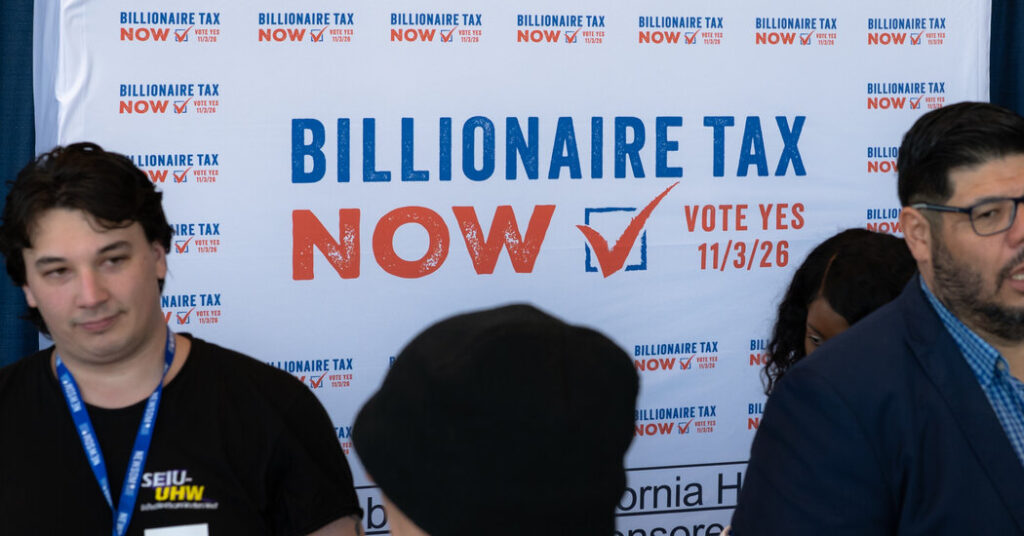
The labor union backing a proposal to place a new tax on California billionaires says it has collected enough signatures to place the measure on the state’s November ballot.
Supporters have collected more than 1.5 million signatures on petitions that call for a vote on the proposed tax, according to a statement from the campaign on Sunday. The group backing the measure intends to announce on Monday when it will submit the signatures to elections officials.
If approved to go on the ballot, the proposal will kick off an expensive election fight that will tap into voter anxieties about economic inequality as well as concerns from business leaders that California could lose its luster as a cradle of technological innovation. Powerful people, including Gov. Gavin Newsom and numerous Silicon Valley executives, have vowed to fight the proposal, while Senator Bernie Sanders, an independent of Vermont, has endorsed it.
The measure calls for placing a one-time 5 percent tax on the assets of California residents with at least $1.1 billion, and would dedicate most of the revenue to health care. The union leading the campaign, the Service Employees International Union-United Healthcare Workers West, argues that the tax is necessary to make up for cuts to Medicaid and other federal health insurance programs by the Trump administration last year.
“Healthcare workers and our allies won’t quit until we fully protect our patients from the looming healthcare disaster,” Suzanne Jimenez, a leader of the union, said in a statement.
Opponents of the proposed tax intend to release a new economic study on Monday showing that the tax would devastate California’s ecosystem of start-up companies just as the artificial intelligence industry is in its nascency. The new tax would lead to a raft of consequences, the report says, including the loss of an estimated 108,000 high-paying jobs and billions of dollars in income tax revenue over the next two decades. The study was written by consultants who worked in the finance departments of two former California governors, Jerry Brown and Arnold Schwarzenegger.
An earlier analysis by California’s Legislative Analyst’s Office found that the proposed wealth tax was likely to increase state tax revenue by tens of billions of dollars over several years. That analysis also found that the measure would decrease income tax revenue by hundreds of millions of dollars or more annually because some billionaires would leave the state.
“It’s gambling a potential one-time revenue bump in exchange for massive ongoing losses, which would force cuts to schools and health care,” said Dan Newman, a spokesman for an opposition group that is funded by the tech investor Ron Conway, among others.
Another opposition group, funded by the Google co-founder Sergey Brin and several other billionaires, is supporting rival ballot measures that could undermine the billionaire tax. One of them would prohibit new taxes on personal property and financial assets. The other two contain provisions that could invalidate the wealth tax in other ways.
Whether the billionaire tax or any of the rival measures will appear on the November ballot is still not certain. After backers of the wealth tax submit the signatures they’ve collected, election officials will go through a verification process. If at least 875,000 signatures are valid, proponents of the measure have until late June to decide if they want to proceed with placing it on the ballot.
Last month, Mr. Conway said that the rival ballot measures could serve as leverage for Mr. Newsom and other opponents of the billionaire tax to try to negotiate with its supporters to keep the measure off the ballot. Speaking on Jack Altman’s “Uncapped” podcast, Mr. Conway said that it was important that the rival measures collect enough signatures to also qualify for the ballot.
In California, if competing ballot measures on the same subject are approved by voters, the one with the highest number of yes votes takes effect. Competing ballot issues can also confuse voters, however, increasing the risk that any particular measure will fail.
“That will give Gavin some bargaining chips,” Mr. Conway said.
Laurel Rosenhall is a Sacramento-based reporter covering California politics and government for The Times.
The post California Billionaire Tax Has Enough Signatures to Land on Ballot, Backers Say appeared first on New York Times.