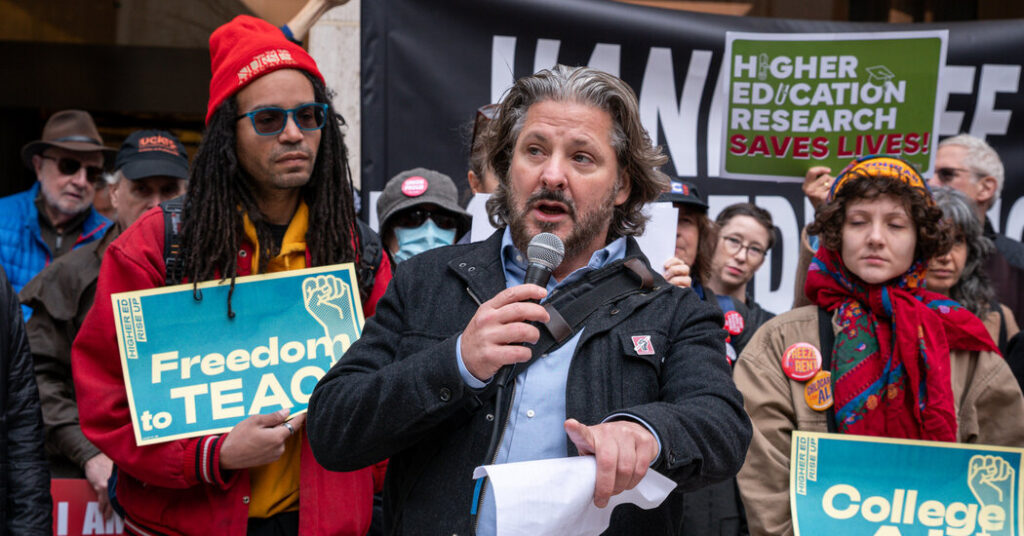
Two years ago, as universities were cracking down on campus activism, a handful of Harvard professors decided to push back.
Seven members joined a Zoom call. A few more trickled into meetings after that. Then Donald J. Trump became president again.
Membership in the group, Harvard’s chapter of the American Association of University Professors, surged to more than 300, reviving a branch that had been dormant since the McCarthy era, when professors had organized to advocate the rights of faculty members. Across the country, other professors built up their own chapters of the association, too, as Republicans in the federal government and in state houses tried to push a more conservative agenda on higher education.
The national organization grew to more than 57,000 members from about 43,000 in the summer of 2024.
Now, as dues pour in, the group has turned into one of the Trump administration’s main antagonists.
The association has filed nearly a dozen lawsuits, often becoming the first to jump into legal fights against the Trump administration’s attacks on university funding, speech rights and diversity initiatives.
Soon, the A.A.U.P., which was established in 1915, plans to step up its fight. It is hiring a political director for the first time and even plans to endorse candidates it deems supportive of its vision for higher education. The group just unveiled a platform including a call for free public college.
As the organization has grown, and become more aggressive, it has also faced sharp criticism. Some professors say the A.A.U.P.’s political stances — including its support of diversity efforts and its skepticism of the Republican push for “viewpoint diversity” — are proving the Trump administration’s point about the left-leaning tilt on campuses.
The organization’s leaders say it is filling a void.
The speed and the seeming arbitrariness of the new administration’s threats against universities left many schools shellshocked. Trump officials described professors as “the enemy,” tried to strip funding from research universities and pushed schools to sign a compact that would allow the government to exert more control over private institutions. Meanwhile, red state legislatures gutted faculty power and eroded tenure.
In response, school leaders often concluded that their best bet was to stay quiet and avoid drawing attention to themselves.
The chaos in higher education has turned the A.A.U.P. into a “fighting organization,” said Todd Wolfson, the president of the group.
“When people are feeling insecure they need a home and a place that they think can defend them,” said Dr. Wolfson, a Rutgers professor and former union leader there. “The A.A.U.P. has stepped into that breach.”
Kirsten Weld, the Harvard chapter’s president, said professors were especially upset when the Trump administration began arresting international students involved in pro-Palestinian activism.
“We were looking around, and our universities were not saying a word,” she said.
The group, whose first president was the philosopher John Dewey, has filed 11 lawsuits against the Trump administration, including A.A.U.P. vs. Rubio, in which a federal judge limited the government’s ability to arrest and deport noncitizens for their pro-Palestinian speech. The Trump administration is appealing the ruling.
The group also filed a lawsuit last April to block the government from threatening to take billions away from the university. Days later, Harvard also sued, and the cases were consolidated. A federal judge ruled against the Trump administration, saying its actions violated the First Amendment. The Trump administration said it would appeal.
The surge in membership to the A.A.U.P., which has both advocacy and collective-bargaining chapters affiliated with the American Federation of Teachers, reflects a larger wave of activism in higher education, said William A. Herbert, a collective-bargaining scholar at Hunter College.
“This is the greatest attack on higher education in American history,” Dr. Herbert said, adding, “You’re just seeing a massive growth in collective action on campuses by faculty and others.”
Critics, including those on the right and in the political center, have argued that the group has veered toward identity politics that helped animate the backlash against higher education, including by supporting diversity measures.
Since 2006, the organization had discouraged academic boycotts, which are the suspension of normal academic relations with a college or country in the service of a political goal. Then, in 2024, it adopted a new policy saying that individual faculty members and students should be free to debate and embrace such boycotts. The policy was released as Israel bombed Gaza and as pro-Palestinian activists urged cutting off ties with Israeli institutions.
The A.A.U.P. and its critics disagree on which policy is best for academic freedom.
Matthew W. Finkin, whose first job out of law school was as an A.A.U.P. attorney in 1967, said the group had grown more political and less deliberative in recent decades as it embraced union organizing at the expense of traditional concerns like academic freedom and tenure.
“You can no longer take its policy pronouncements as being above the fray, as being pure matters of principle,” Mr. Finkin said.
The political postures of the A.A.U.P. have led to many ruminations about the group’s “fall” and “unraveling.”
Dr. Wolfson has shrugged off, even reveled in, the criticisms, saying that now is the time to pick sides.
The proof his strategy is working, he said, is the recent membership boom. (The group’s peak was 90,000 in 1969, and its low point was 37,000 in 2012.) Tax records show the group had revenues, mostly from dues, of about $12 million in 2024. In an interview, Dr. Wolfson said 2025 revenues neared $17 million.
“Demand letters to universities, a compact which is nothing more than a loyalty oath, ideologically driven state houses that are ending tenure and collective-bargaining rights, ending academic freedom — and you’re going to tell me I should be neutral?” Dr. Wolfson said. “There’s no neutrality on a runaway train.”
Supporters like Dr. Weld say Dr. Wolfson’s fighting posture is right for this moment and one reason chapters are drawing new members.
In North Carolina, the group has gone to 800 members from about 200 in a year, said Belle Boggs, the state’s chapter president.
Last year, the group organized against a delay in awarding 33 professors tenure at the University of North Carolina’s flagship campus at Chapel Hill. It has opposed an effort to post the syllabuses of faculty members in a public-facing database. And it has created a legal hotline for professors, staffed by First Amendment lawyers.
Harvard’s chapter had been mostly dormant since the 1950s, when Joseph McCarthy was calling the university “a mess” and demanding the firing of professors suspected of being Communists. Professors and the A.A.U.P. praised Harvard’s president at the time, Nathan Pusey, for refusing to take action against the faculty members.
In 1954, at an A.A.U.P. event, Archibald MacLeish, a Harvard professor, said the fight was over whether “free institutions of learning” or government agencies should determine who got to teach.
These days, said Dr. Weld, a historian, a new generation of professors has become energized by a similar fight.
Vimal Patel writes about higher education for The Times with a focus on speech and campus culture.
The post A Professor Union Grows Fast as It Ramps Up Its Fight Against Trump appeared first on New York Times.