In India, the world’s largest democracy, a single misspelling from years ago can now threaten a person’s right to vote.
Mohammad Ali Halder, a 63-year-old garment manufacturer in West Bengal, found that out after receiving a worrying notice earlier this year, months before elections to select the state’s next government. The Election Commission of India informed him that his father’s name had been spelled differently in two sets of voter records, making it tough to verify Mr. Halder’s identity. He would not be able to cast his ballot until the matter was resolved.
Mr. Halder, who runs his own garment business in Kolkata, the capital, gathered documents to prove his citizenship — land records going back almost 100 years, his passport and other government-issued identity cards — and filed an appeal. But his name has not been restored, and voting has started.
“I feel like a living dead body,” said Mr. Halder, clutching a plastic bag stuffed with the documents.
Mr. Halder is one of roughly nine million voters, or more than 10 percent of the electorate in West Bengal, whose names have been deleted or cast as “doubtful” in a recent voter roll revision by India’s Election Commission. It is the most populous of the four Indian states and one union territory where voters go to the polls this month, with results expected May 4.
Many of those deleted were Muslims, and opposition parties have accused Prime Minister Narendra Modi’s government of abusing its power to disenfranchise Muslim voters. Mr. Modi heads a three-member committee that selects the chief of the commission.
The Hindu nationalist Bharatiya Janata Party of Mr. Modi has long described Muslims as invaders who compromise its idea of a Hindu nation. By deleting Muslim names from the voter list, the party may raise its chances in a state that has India’s second-largest Muslim population, and which it has never won.
The issue has become a flashpoint in the battle between the Trinamool Congress, a grass-roots party whose leader Mamata Banerjee, 71, is running for her fourth term in office, and the B.J.P., led in West Bengal by Suvendu Adhikari, a former Trinamool member.
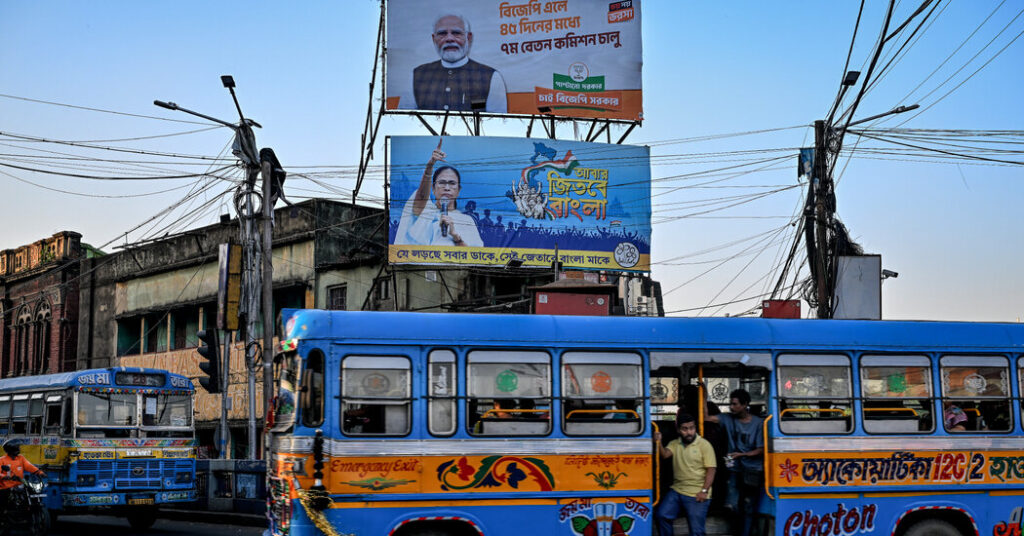
Ms. Banerjee, who has been the chief minister of West Bengal since 2011, is one of Mr. Modi’s fiercest critics and immovable foes. Her image as both accessible and protective has earned her the moniker “Didi,” or big sister.
Both the B.J.P. and the election commission have denied claims of manipulating the voter roll through its “special intensive revision,” which started last year in a dozen states and territories. The commission said it was necessary to remove the names of voters who have died, are duplicated or have left the state. The last such exercise happened in 2002.
The stakes are particularly high in West Bengal because the B.J.P. has been steadily making inroads. From winning only three of the 294 seats in the legislative assembly in 2016, it took 77 seats in the last election, in 2021. While many election analysts still expect Ms. Banerjee to win, they predict a smaller margin, and that Mr. Modi’s party could win more than 100 seats.
West Bengal is strategically important because the Siliguri Corridor, which shares borders with three countries and has China looming behind them, runs through the state. Sometimes called the “Chicken’s Neck” because it is around 13 miles wide at its narrowest, it is India’s only land route to its eight northeastern states, used for delivering civilian and army supplies to sensitive border regions.
The B.J.P.’s growing presence is a marker of the progress Mr. Modi and the Hindu right have made in their quest to dominate India. Their pitch that India can only be economically powerful if it places Hindus first at both the national and state level has resonated with many Bengalis. Hindus make up the majority of India’s population and Muslims around 15 percent.
Muslim voters tend to be loyal to Ms. Banerjee, an avowed secularist who is unflashy in her appearance but fiery in her missives against opponents. She also attracts many Hindu voters for whom the Bengali cultural identity trumps religion. Bengalis are proud of their rich intellectual heritage, having produced several Nobel laureates, including Rabindranath Tagore, who wrote the Indian national anthem.
“To us, she is a candidate for all 294 seats,” said Arindam Duttaroy, a businessman who joined a door-to-door campaign by Trinamool candidate Debasish Kumar on a recent Sunday morning. Ms. Banerjee had put Bengal on the path to progress, Mr. Duttaroy said. “She is a street fighter, she speaks for the common people.”
Many voters told us they fear that a B.J.P. state government would erase the Bengali identity and language. They expressed concern that the B.J.P. would try to impose speaking Hindi or enforce vegetarianism in a region known for its love of fish and meat. (To allay such fears, a B.J.P. candidate recently campaigned in Kolkata with a fish in his hand.)
Workers from Ms. Banerjee’s party distributed “Didi vs. Modi” snakes-and-ladders boards with a cutout that could be shaped into a die. The biggest threat on the board was a two-headed snake with the faces of Mr. Modi and Home Minister Amit Shah. Land on that square and the whole state would slide to the bottom, a party worker cheerfully explained.
But Ms. Banerjee’s governance has been uneven. While welfare programs that deliver cash to women have been popular, her government has been plagued by allegations of corruption. In one scandal, party officials were accused of selling teaching positions at government schools. Some voters said they were frustrated at the slow pace of job creation and worried about women’s safety after a female doctor was raped and murdered in 2024.
The B.J.P. has promised to double the cash handouts to women and made public safety a campaign issue: Ratna Debnath, the mother of the doctor, decided to run for office for the B.J.P., saying that not all the perpetrators had been brought to justice under Ms. Banerjee.
The B.J.P.’s emerging stronghold is in north Bengal, a hilly border region home to about a fifth of the state’s roughly 100 million people. The party holds 30 of the 54 assembly seats from the region’s eight districts. Voters here care less about religion and language. They want higher-paying jobs and better roads, and many accuse the Banerjee government of having overlooked their interests.
Reshma Mukhiya, who runs a small tea stall in Kurseong, a town on the way to Darjeeling, pointed to a potholed road that she said had not been repaired in months.
“In the last election, we supported Didi,” said Ms. Mukhiya, 40, who makes up to 20,000 rupees, or $214, a month from her shop, supplemented by the 1,500 rupees she receives from the welfare program for women. But the Trinamool does “little work,” she said. “There should be some change now.”
In these disaffected border areas, the B.J.P.’s promise to weed out “infiltrators” who compete for jobs has resonated. Mr. Shah, the home minister, has used the term to describe illegal immigrants from neighboring, Muslim-majority Bangladesh — long an issue in India, though formal estimates of their number are hard to come by.
Critics of the voter roll revision said it targets Muslim citizens of India by muddling the issues. The reasons officials have given for deleting names have been confusing to people with limited resources and time to prove their identities, said Farida Parvin, a councilor with the Kolkata Municipal Corporation and a Trinamool member. Muslims were deleted at higher rates than Hindus.
Tens of thousands of names were placed in “adjudication” for reasons ranging from a voter’s father being listed as female in 2002, or families with four children who now have six, Ms. Parvin said.
When SK Md. Amir, a 27-year-old homeopathic doctor, filled out his voter registration form earlier this year, he provided his father’s details, but he got a notice from the commission on April 6 that left him scratching his head. It said that the details linking him to the previous revision were that of his grandparents and there was an age discrepancy. “This means I have lost my voting right for now.”
Mr. Halder, the garment manufacturer in Kolkata, was told that his name and details were “incorrectly linked” because the spelling of his father’s name in the 2002 revision, “Rias,” did not match the name, “Riasuddin Halder,” which he put down in his application this year.
Sitting cross-legged on a bed in his family home in South 24 Parganas, a Muslim-majority district in Kolkata that has seen one of the highest deletions of voter names, Mr. Halder showed land records dating back to 1928. He said he was hoping to appeal the decision via special tribunals, except that one hadn’t been set up in his neighborhood yet.
He fretted that without his voter registration the bank might close his account, or the government shut his business.
“I fear my citizenship will be gone,” he said.
Chandrasekhar Bhattacharjee contributed reporting.
Anupreeta Das covers India and South Asia for The Times. She is based in New Delhi.
The post ‘Didi vs. Modi’: A Test for the Hindu Right in India’s Bengali Heartland appeared first on New York Times.