The U.S. is in the midst of a battery boom critical to keeping the lights on amid heat waves, winter storms and surging electricity demand from artificial intelligence. But developers are increasingly encountering communities afraid that large lithium-ion storage farms could spontaneously burst into flames.
As installations grow larger and are placed closer to neighborhoods, on farmland or in high-risk wildfire areas, local opposition is growing. That puts many states in a bind as they depend on renewable energy to meet rising electricity demand and to address climate change targets. The expansion of solar and wind energy is tied in part to batteries, which can store electricity for use after the sun sets and the wind stops blowing. They’re also key to the growth of data centers, which face rising resistance as well.
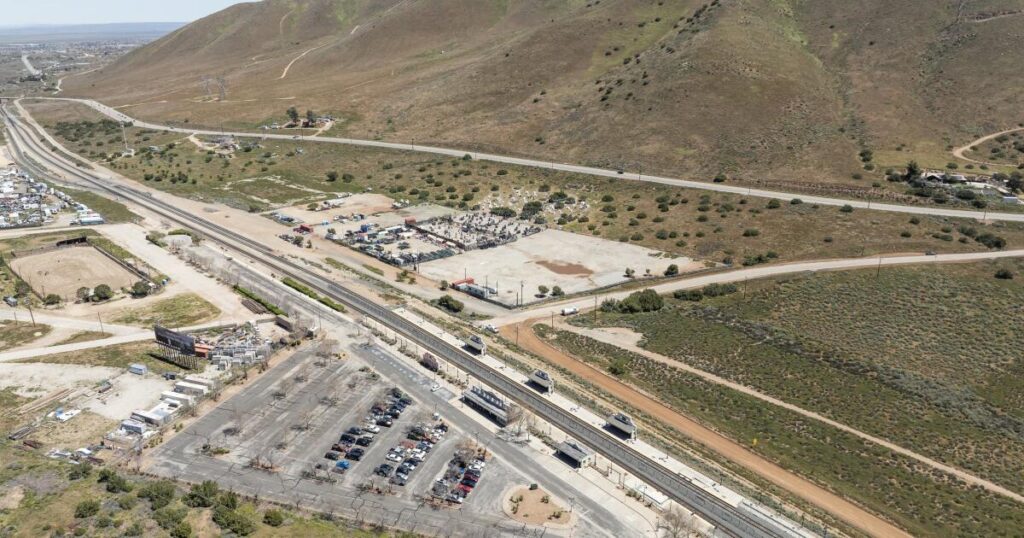
The rush to secure sites near key transmission lines for battery energy storage systems has led developers to places like Acton, a bucolic L.A. County town of horse ranches and animal sanctuaries. There, Blackstone-affiliated Coval Infrastructure wants to build the world’s second-largest storage array, a $1.9-billion facility called the Prairie Song Reliability Project.
Acton sits in a high desert mountain basin that the state has designated a “very high fire hazard severity zone.” The ferocious Santa Ana winds that fueled the 2025 Los Angeles firestorms barrel down canyons into town, prompting the local utility to occasionally shut off electricity to prevent downed power lines from igniting fire. The San Andreas earthquake fault lies just a few miles away.
Already primed for catastrophe, townspeople’s discovery that developers had quietly targeted Acton for multiple battery projects stoked fears of industrial blight, fire and contamination of residential water wells and the nearby headwaters of Southern California’s last free-flowing river.
“We live with the reality of wildfire risks every single year,” Don Laird, a resident since 1988 and a member of the Acton Town Council, told state officials at a public meeting on Prairie Song in February. “Acton is not the right location for a lithium-ion battery facility. The risks are too high.”
That risk hit home weeks later: In early April, a 385-acre blaze fueled by Santa Ana winds ignited several miles from the Prairie Song site, forcing residents to evacuate.
“This is so common in our community,” says Ruthie Brock, who notes a brush fire broke out last August behind her home about two miles from Prairie Song. “It’s pure insanity to put anything in this area that brings added fire risk.”
A Coval spokesperson wrote in an email that “there is a significant need for clean, reliable, and affordable energy infrastructure across the United States, and Coval is proud to help develop and deliver that through our projects.”
Yet sentiments like Brock’s are being repeated across California and the U.S., where hostility to battery projects has scuttled projects as residents and local officials sue to overturn government approvals or enact ordinances to ban the facilities or restrict where they can be built.
“The rising tide of community-based opposition,” utility-funded nonprofit Electric Power Research Institute warned in a 2025 paper, is contributing to “longer development time lines—doubling in some instances—and higher siting and permitting costs, along with high rates of project cancellation.”
That’s a problem, according to Dustin Mulvaney, a professor of environmental studies at San Jose State University. “It’s amazing how much we’ve transformed our electrical grid with batteries and we need more storage,” he says.
But while blanket opposition to battery facilities sounds like NIMBYism — shorthand for “not in my backyard” — Mulvaney says it represents something else.
“If there is local resistance to projects, in many ways that’s on the developer for making bad decisions about where they put projects,” he says.
The U.S. installed the equivalent of three nuclear reactors of grid-connected big batteries last year, and dozens more are in the pipeline to be built by the end of the decade. To ensure those come online, developers will need to find a way to assuage community concerns.
Six years ago, California boasted 500 megawatts of utility-scale battery storage; today it has nearly 15,000 megawatts, second only to Texas, and more than 110,000 megawatts of projects have applied to connect to the grid, according to the California Independent System Operator, which runs the grid. While many of those projects won’t end up breaking ground, says CAISO executive Neil Millar, the frenzy “is reflective of the level of competition.”
Battery storage facilities typically consist of a collection of shipping container-sized enclosures that, until recently, attracted relatively little notice. But as projects have proliferated and some have grown from a few dozen containers to thousands, they’ve become lightning rods, particularly in the wake of a series of fires at US lithium-ion battery storage plants.
A 2025 blaze in Moss Landing, Calif., made international headlines when it resulted in the evacuation of 1,200 residents, the closure of a busy coastal highway and contamination of nearby wetlands. The fires mostly involved a type of battery storage system built before the establishment of stringent safety standards that’s no longer deployed. Battery fires can be more challenging to extinguish and clean up, though fire departments are increasingly trained to handle lithium-ion blazes.
Scott Murtishaw, executive director of industry advocacy group California Energy Storage Alliance, notes such incidents are rare. Between 2018 and 2024, safety failures per installed gigawatt-hour fell 98% worldwide, according to EPRI, with about 12 events a year even as utility-scale battery capacity grew 50-fold.
“Battery storage is playing a critical role in keeping the lights on and will play a larger role in ensuring that as we decarbonize, we also maintain reliability of the grid,” says Murtishaw.
Noah Roberts, executive director of industry group the U.S. Energy Storage Coalition, attributes opposition in part to the massive rollout of batteries in just a few years. “There are hundreds of energy storage projects that are being built across the country and the conversation we’re having is more of a product of that scale than anything unique to the technology itself,” he says.
But overcoming perceptions that lithium-ion battery technology is inherently dangerous has proven challenging, and developers sometimes fuel mistrust by dismissing residents’ concerns about fire, toxic threats and the industrialization of natural landscapes. The hard sell of battery projects can also strengthen pushback.
Madeleine Krol is a clean energy land use specialist at the University of Michigan who advises local governments in her state when they receive developers’ battery proposals. “Oftentimes it feels like these projects are already ready to go and then being presented to a community with a great sense of urgency,” she says.
That was the case in Acton. “Projects like Prairie Song are not optional additions. They’re essential infrastructure,” Garrett Lehman, Coval’s director of development, told townspeople at the February meeting.
Residents’ first sign that they were living in a battery hot spot came in January 2023, when a developer showed up with county approval in hand to build a 400-megawatt facility called Humidor.
The town of 7,700 people already serves as a critical node to transmit renewable energy from distant solar and wind farms to urban areas. The transmission towers that dot the hills connect to a large electrical substation in Acton, making the surrounding scrub lands highly coveted by battery developers who could plug projects into the grid without building long, million-dollar-a-mile power lines.
Surprised by Humidor, Jacqueline Ayer, a resident of Acton for 25 years and a mechanical engineer, logged on to CAISO’s website and discovered that three additional prospective battery projects had applied to connect to the substation. She and local activist Brock started scouring property and corporate registration records to locate the proposed projects, and alerted neighbors that if built, the battery plants would industrialize hundreds of acres of chaparral and juniper surrounding the substation.
“There is no community anywhere in California that has as many high-voltage lines concentrated in one area that’s a very high fire hazard zone with high winds,” says Ayer, who serves as town council correspondence secretary. “I’m no NIMBY — I have solar panels and a battery at my own house — but no lithium-ion battery storage facilities should be built here given the extremely high fire risk.”
At least one may not. The community group Ayer runs sued to stop Humidor, and in October, a state court judge overturned the county’s approval of the project, ruling it violated zoning codes. Developer Fullmark Energy had not appealed the judgment by a Monday court deadline, according to Alene Taber, the attorney for Ayer’s group. A Fullmark spokesperson declined to comment. The company has withdrawn an application to connect a second Acton battery project — one of the three Ayer uncovered in the CAISO queue — to the substation.
Other developers are forging ahead. Coval Infrastructure sidestepped local regulations last June by applying to the California Energy Commission for state approval to build the 1,150-megawatt Prairie Song plant, which would consist of 2,035 shipping containers housing lithium iron phosphate batteries spread over 100 acres, including on land designated as ecologically sensitive.
“Prairie Song would start here, right by those homes and extend for a mile,” says Ayer as she pilots her Subaru past modest dwellings that would abut a perimeter wall topped with razor wire towering as high as 14 feet. Even on this winter day — when California gets the vast majority of its rain — the landscape looks parched, and a large Los Angeles County Fire Department sign nearby warns, “Danger Extreme Fire Hazard Area.”
In its application to the energy commission, Coval notes that 80 wildfires have burned within five miles of the project site since 1911, and that fires may start on or spread to the property. But the company says the facility “will not exacerbate wildfire risk” due to safety precautions like clearing the site of vegetation.
The story in Acton is playing out across the state and nation.
In Morro Bay, Calif., Vistra Corp. abandoned plans to build a 600-megawatt battery storage plant last October after residents passed a ballot measure requiring voter approval of such projects and the powerful California Coastal Commission determined that impacts from sea level rise and the facility’s location on sensitive habitat made state approval unlikely.
The same month, Engie North America suspended its state application for a battery project in San Juan Capistrano to search for a new site while this month, energy giant AES Corp. cancelled a 320-megawatt battery project in San Diego County. Both proposed facilities were near neighborhoods and high-risk wildfire zones and faced fierce resistance from residents. In a statement, Engie said it paused the project for economic reasons, not because of local opposition.
Hecate Energy, the developer of what would have been New York’s largest battery energy storage system, pulled the plug on the 650-megawatt Staten Island project last August after residents and local politicians lobbied state officials to kill it over fire concerns.
Even in Texas, where developers face fewer regulatory hurdles, the state Republican Party last year vowed to protect “counties from the many dangers associated with battery energy storage systems.”
Developers declined to make executives available for interviews.
With such widespread antagonism — and climate change making more areas dangerously fire-prone — it raises the question of where the additional 29 gigawatts of batteries set to be installed in California by 2035 will go.
This fall will yield some answers. In September, the California Energy Commission will decide whether to let NextEra Energy Resources build a 400-megawatt battery plant on prime farmland north of San Francisco over the objection of residents and county officials who’ve restricted such projects to industrial areas. The commission is also set to rule on Prairie Song in October. An energy commission spokesperson said in an email that the agency considers public comments and whether a project conflicts with local regulations.
Mulvaney, the environmental studies professor, says battery developers and government officials should take a lesson from battles fought in the 2000s over the siting of wind and solar farms on ecologically vulnerable land. Those fights faded once governments began delineating specific zones where such projects were allowed and impacts could be minimized.
“A lot of these tensions around where to build battery storage can be resolved by reinvigorating the planning process because otherwise it’s going to be a long slog to get projects built,” he says.
Woody writes for Bloomberg.
The post California is ground zero for growing battery opposition appeared first on Los Angeles Times.