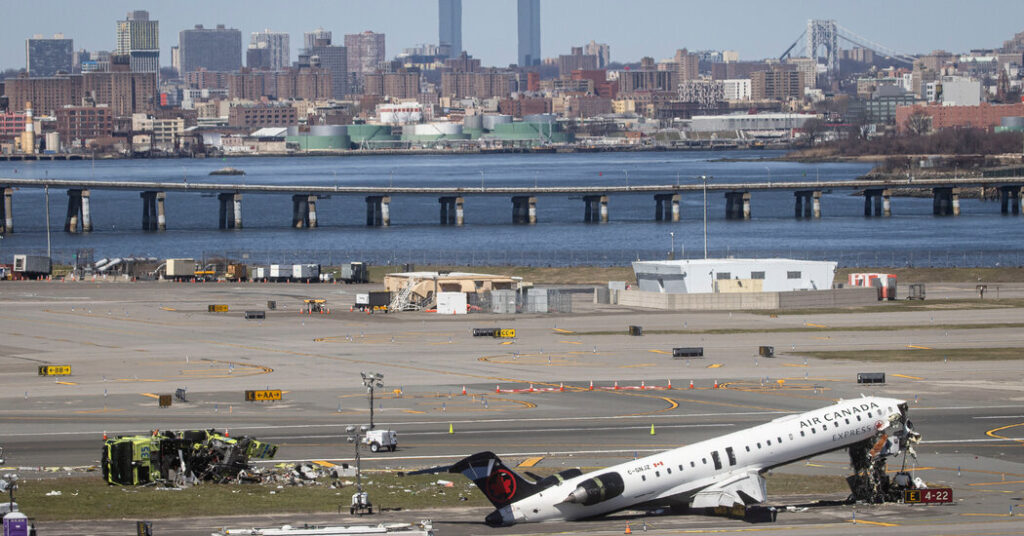
LaGuardia Airport’s failure to put communication transponders on emergency vehicles played a role in a fatal runway collision between an Air Canada passenger jet and an airport fire truck, according to a preliminary report the National Transportation Safety Board issued on Thursday.
The air traffic controller who allowed the fire truck to cross the runway even as the jet was approaching for a landing on March 22 had been juggling air and ground traffic leading up to the collision, the report says. And it details how the firefighters driving that truck, the lead vehicle in a convoy responding to an issue with another plane, failed to immediately understand that instructions they heard over the control tower frequency radio to “stop, stop, stop” were meant for them.
But the report focuses in particular on the lack of transponders in the emergency vehicles, which investigators suggested could have allowed an automatic warning system to alert the controller that the plane and the vehicles were on a potential crash course.
Without the transponders, the “system could not uniquely identify each of the seven responding vehicles or reliably determine their positions, or tracks,” investigators wrote in the report. “As a result, the system was unable to correlate the track of the airplane with the track of Truck 1” — the truck that was struck by the plane. Thus, the report added, the system “did not predict a potential conflict with the landing airplane.”
The Federal Aviation Administration recommended last year that airports outfit their emergency vehicles with such technology to avoid close calls. On Thursday, before the report was released, Kathryn Garcia, executive director of the Port Authority of New York and New Jersey, told reporters that the agency would wait to see the report before making any changes. The Port Authority operates the three major airports in the New York area, including LaGuardia.
The 15-page report offers the most comprehensive presentation the N.T.S.B. has issued detailing the factors that led to the March 22 collision, but it is still preliminary, and the board has yet to reach a conclusion about what caused the accident. Similar investigations usually take about a year.
Still, the report did answer some key questions about the first deadly accident at LaGuardia in more than three decades. That included what role air traffic controllers played that night and what the people in the fire truck heard before the collision. The accident killed both pilots of Air Canada Flight 8646 and sent 39 passengers, as well as the two firefighters in the truck, to hospitals.
The report details how the convoy of emergency vehicles, which was responding to a separate incident involving a United Airlines plane, made multiple attempts to contact the air traffic control tower to seek permission to cross the runway. The attempts began more than 90 seconds before the collision.
Truck 1 had not been the intended lead vehicle in the convoy. Originally, a tool truck that went by the call sign Truck 7 was in front. But Truck 7’s first attempt to reach the tower was blocked by other radio communications. After a second attempt, its drivers switched places with Truck 1, which took over the lead position and, with it, responsibility for making contact with air traffic control.
In the tower, two controllers were on duty, as is standard for the overnight shift at LaGuardia. But according to the report, in the minutes leading up to the collision, only one controller was managing both the airplanes and the ground vehicles. The second controller had been helping the United Airlines plane find its way back to a gate.
About 20 seconds before the collision, according to the report, Truck 1 got permission from air traffic control to cross Runway 4, along with the rest of the convoy. At that moment, the Air Canada jet was in the final seconds of its descent toward the runway and only 130 feet above the ground, according to the N.T.S.B.’s report.
Seconds after that, the controller began urgently calling on the fire truck to “Stop, Truck 1, stop!” But the truck did not stop. According to the report, it accelerated.
Farther back in the convoy, the driver of Truck 7 — the tool truck that was originally intended to be the lead vehicle — heard the controller’s command. Seconds later, she saw the oncoming plane and called “stop, stop, stop” to the drivers of Truck 1, according to the report. There are no recordings of the communications between the emergency vehicles, investigators said.
The fire truck’s turret operator recalled hearing an order to “stop, stop, stop” on the tower frequency, but did not initially realize that it was intended for his vehicle, according to interviews conducted by investigators. It clicked when he heard “Truck 1, stop stop stop,” but at that point, the vehicle had already entered the runway.
The report said that in the moments before the crash, the fire truck turned left — away from the oncoming plane. But it was not enough to avoid impact.
Karoun Demirjian is a breaking news reporter for The Times.
The post Communication Failures Preceded Deadly Crash at LaGuardia, N.T.S.B. Says appeared first on New York Times.