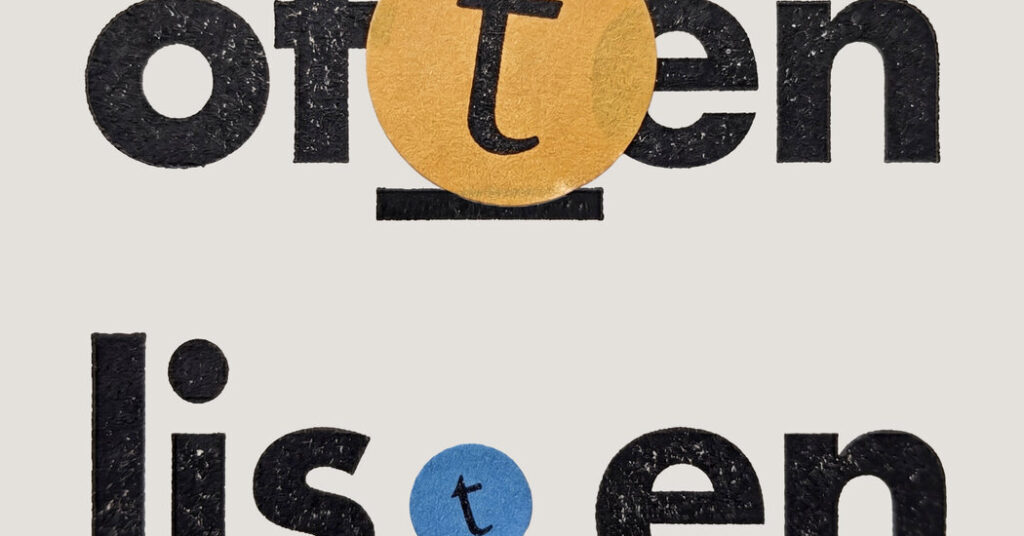
People without enough to do like to find unnecessary rules for English speakers. I discussed dangling modifiers last week. In that vein, let’s do “often.”
Many think it should be pronounced “off-ten” rather than “offen,” or at least feel better saying “off-ten.” But why, when we don’t pronounce “listen” as “lis-ten”?
You might say that it’s because there is an actual word “oft” and so we should hold on to the “t” sound, whereas with “listen,” there is no verb “list” that refers to hearing.
Except there is. In earlier English, one could say “list” instead of “listen.” It’s in old poems, and it’s in the old song “After the Ball” in the lyric “List’ to my story I’ll tell it all.” The -en in “listen” is a remnant from Old English when verbs often ended in -n: “love” was “lufian,” “have” was “habban.” Today that suffix has worn away, except when we use it to change nouns and adjectives into verbs: “strengthen,” “soften.” Life is always messy, and “listen” is one of the few verbs that happened to hold on to that -en, like the last peanut in the bag.
So, if saying “offen” is leaving something out, like saying “liberry” for “library,” why not “lis-ten”? And if the idea is that the old “list” word is no longer current and so we technically aren’t leaving a “t” out, then certainly we must say “sof-ten” because there is the word “soft.” And while we’re at it, maybe it’s time to say “whis-tle.”
Saying “off-ten” doesn’t hurt anybody, but it is, frankly, inconsistent. Keeping the “t” in “often” but not “soften” is a symptom of something larger — our reluctance to let our language do what all languages always do: change. We are taught to think that when a language changes, it’s falling apart. But really, it’s just morphing. All languages always have — a language that stays put is as impossible as a sky where clouds never move.
English is full of words with sounds that dropped out because of natural processes. “Falcon” was originally “faucon,” but pedants stuck the “l” in because the original Latin word was “falconem.” It leaves us pronouncing the word like ancient Romans, for no reason.
This kind of thing leaves things messier than they ought to be. “Off-ten” but not “sof-ten.” Or “clothes” spelled with a “th,” which people are as ambivalent about as the “t” in “often.” By the Middle Ages, “clothes” had lost the “th” sound and was pronounced the way I suspect most of us sense as natural today, “close.” You see it in, for example, the poet Robert Herrick’s “Upon Julia’s Clothes”: “Whenas in silks my Julia goes / Then, then (methinks) how sweetly flows / That liquefaction of her clothes.” But a sense lingers that the “real” way to say it is with the old “th,” because that is the way it’s spelled.
This reluctance to let go of the past is much of why English spelling is such a nightmare. “Doubt” was originally spelled “doute.” The “b” was inserted because the Latin word was “dubitare.” The “s” in “island” was added because the Latin word was “insula” and the French one was “isle” (and despite the fact that “island” was unrelated to the French and Latin words).
Our spelling is so ridiculous that naturally there have long been people urging us to get past it. But it’s a tough sell. It’s one thing to want our spelling to make sense, but another to actually encounter what it would actually look like. Starting in the 1930s, The Chicago Tribune started using an ever-increasing list of sensible spellings such as “staf,” “hocky” and “iland.” Logical this was. But even I have to admit that it also looked … bizarre.
But this nevertheless leaves us with a language in which what we pronounce as “vittles” is spelled “victuals.” With about 1 in 5 people worldwide using this language and more to come, we should at least try to make our spelling the least crazy as possible. Like buying war bonds in the 1940s — it didn’t change the world, but at least you were pitching in. If we’re not going to start saying “sof-ten” and “lis-ten” — and we’re not! — why not learn to stop worrying and say “offen.”
The post What’s Better Left Unsaid appeared first on New York Times.