Canada and the United States have yet to start negotiations over their free trade deal, but they are already publicly squabbling over various issues, reflecting the depth of their ruptured relations.
As their talks to renew the North American trade pact that also includes Mexico have failed to get underway, Ottawa and Washington over the past week exchanged threats and insults, with the United States particularly perturbed over the decision by eight Canadian provinces last year to remove American wine and spirits from the shelves of government-owned liquor stores.
In a hearing before the Senate on Wednesday, Howard Lutnick, the U.S. secretary of commerce, called the move “insulting” and “disrespectful,” and also complained that Canada discriminates against American dairy products.
The same day, Jamieson Greer, the U.S. trade representative, said the United States was “kind of at the end our rope” when it came to the American alcohol ban and suggested he may take “an enforcement action” over it.
On Thursday, Prime Minister Mark Carney of Canada snapped back when asked about Mr. Greer’s threats, saying that Canada has grievances of its own when it comes to the United States.
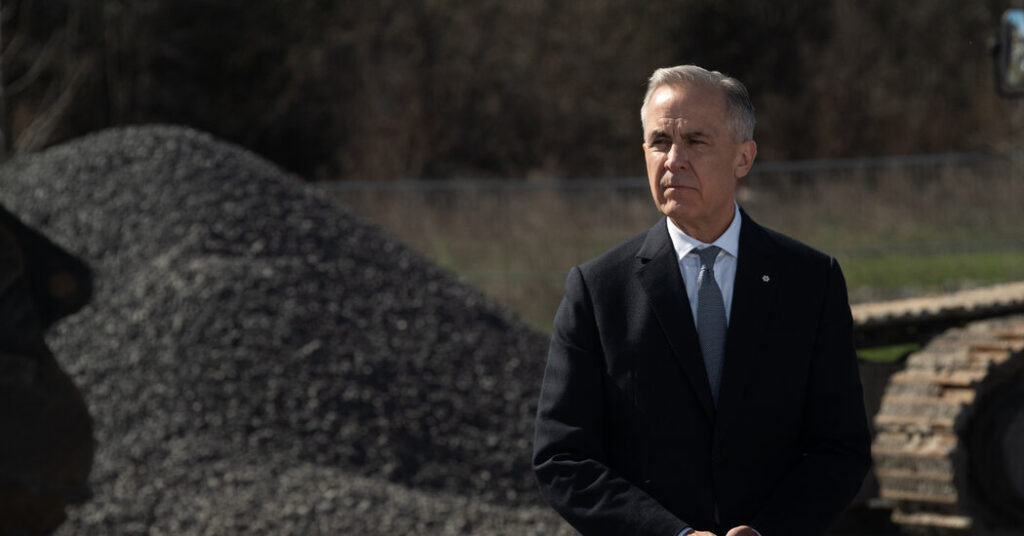
“You know what’s an irritant? A 50 percent tariff on steel and aluminum, 25 percent on automobiles, all of the tariffs on forest products,” Mr. Carney told reporters at a construction site in the capital where he had made a housing announcement. “Those are more than irritants. Those are violations of our trade deal, OK?”
While pointing out that Canada’s federal government has no powers over provincial liquor stores, Mr. Carney suggested that American alcohol will only return to Canadian shelves once the United States lifts punishing tariffs which have had a significant effect on Canadian industries.
“We can make progress very quickly on that with progress in other areas,” Mr. Carney said.
Canada’s largely closed dairy market, Mr. Lutnick suggested, breaks the terms of the United States-Mexico-Canada trade pact which has a July 1 deadline for its review.
“We are trying desperately to get them to live to the deal that they have on U.S.M.C.A. and stop treating our dairy farmers so poorly,” he testified.
Last week, while speaking at a conference, Mr. Lutnick blasted Canada for its trade negotiating strategy, adding, “They suck.”
Mr. Greer noted that only Canada and China have retaliated against President Trump’s tariffs over the past year, adding: “So that’s the kind of company they’re running in.”
He said he had told Canadian counterparts consistently over the past year that if they could make some changes in Canadian trade practices, “it’s going to help me get over the political hump that we face here in the United States. So I think there are things that can be done.”
In sharp contrast to his dealings with Canada, Mr. Greer’s office announced after he visited Mexico City this week that talks between Mexico and the United States on the trade agreement will start on May 25.
Mr. Carney dismissed the significance of a lack of a similar date for Canada.
“We’re ready to go into detailed negotiations,” he said. “We’re also ready to wait if that’s what has to happen.”
Earlier this week several Canadian news outlets, citing unnamed sources, said that the United States is demanding that Canada make concessions before any review of the trade agreement can begin. The sources described it as an admission fee to the negotiations.
Mr. Carney, however, said on Thursday that those reports are incorrect.
“I don’t know where the talk of an ‘entry fee’ is from, certainly it’s not coming from me,” he said. “And it’s not language I’ve ever heard from the president of the United States.”
He added: “These things have their own rhythm. They also have what’s happening above the surface and what’s happening below the surface.”
But Mr. Carney, who has made reducing Canada’s economic dependency on the United States the central focus of his government since becoming prime minister just over a year ago, said that Canada will not simply accede to demands from the United States once negotiations begin.
“We’re not sitting here taking notes, OK, and taking instruction from the United States,” he said.
Mr. Greer was not alone among his office in complaining about Canada on Wednesday.
Rick Switzer, a deputy U.S. trade representative, said at an event hosted by the Council on Foreign Relations on Wednesday that Mr. Carney had made the fight with the United States personal. He characterized Mr. Carney’s actions as “political malpractice,” saying that “Canada is dependent upon the U.S. economy. That’s just a fact, right, that’s not hubris.”
He said that Canada could have an economy that is underperforming and Mr. Carney “can feel superior,” or “Carney can do what a grown up should do, which is figure it out.”
Ian Austen reports on Canada for The Times. A Windsor, Ontario, native now based in Ottawa, he has reported on the country for two decades. He can be reached at [email protected].
The post Without Formal Trade Talks, Canada and the U.S. Go Public With Their Grievances appeared first on New York Times.