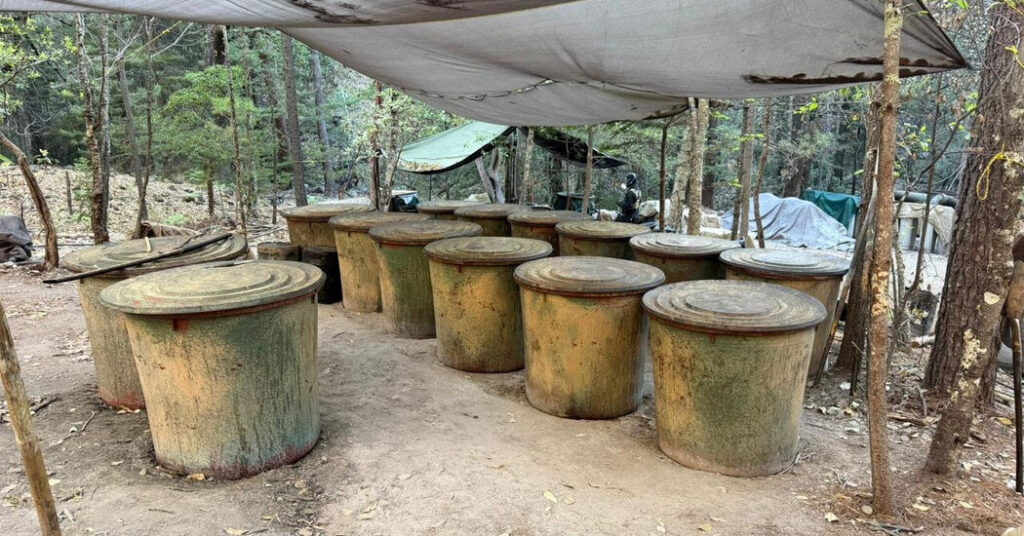
The deaths of two Americans in an automobile crash on a remote mountain road in northern Mexico has raised urgent questions about the extent of U.S. involvement in the region’s drug war. The vehicle, carrying the Americans and two Mexican security officials, was returning from a raid on a large clandestine drug lab when it plunged off the steep terrain of the Sierra Tarahumara.
Who were the Americans, and what were they doing there? Did they have authorization to operate in Mexico, and in what capacity? The questions intensified after The New York Times and other outlets reported that the U.S. officials were C.I.A. officers, sharpening scrutiny of the agency’s expanding role in Mexico’s fight against organized crime.
President Claudia Sheinbaum said she was not aware of the officers’ activities and would investigate whether their presence violated national security laws. If the inquiry confirms that officers were engaged in a field security operation, she said her government would send a formal reprimand to the U.S. government.
Ms. Sheinbaum has drawn a firm line: Cooperation with the United States is essential, but without U.S. troops operating on Mexican soil. Her position reflects a broader national sentiment, with most Mexicans opposed to the idea of an American military intervention to confront the cartels.
Yet the presence of C.I.A. officers in Mexico is not without precedent. For decades, U.S. intelligence and law enforcement agencies have played a quiet but consequential role in Mexico’s security operations, in an often uneasy partnership that has evolved as threats and political currents shift on both sides of the border.
In the last year, the relationship has grown more strained, under pressure from President Trump for Mexico to do more against cartels and curb the flow of drugs north. Mr. Trump has repeatedly vowed to pursue unilateral military action on Mexican soil, a line Ms. Sheinbaum has firmly rejected.
Still, security cooperation remains close and sustained. “We have very strong coordination,” said Omar García Harfuch, Mexico’s top security official, in a recent interview with The Times. “There is a great deal of information sharing.”
Mr. García Harfuch described regular contact with the U.S. ambassador, a former C.I.A. paramilitary officer, as well as direct communication with U.S. security agencies. “I speak with all of them,” he said, adding that such ties reduce the likelihood of U.S. unilateral action.
That level of coordination has drawn praise in Washington. Secretary of State Marco Rubio has described security ties under Ms. Sheinbaum as reaching a “historic” level.
But such close, constant communication and intelligence sharing have not always been smooth or assured.
The Evolution
Over the past four decades, U.S.-Mexico security cooperation has moved from informal collaboration to more institutional partnerships, even as it remains shrouded in secrecy and periodic friction, according to experts, analysts and former security officials.
U.S. agencies have also operated through quieter channels, carrying out intelligence work off the books by cultivating local assets and penetrating criminal networks, said Raúl Benítez, a security analyst in Mexico. Driven by the rising power of drug cartels and a surge in U.S. demand for drugs, cooperation has intensified as these criminal organizations became a shared priority for both nations.
Under President Felipe Calderón, who took office in 2006, Mexico launched its war on drugs, deploying the military to dismantle powerful cartels with the backing of President George W. Bush.
Through the Mérida Initiative, a 2008 security partnership backed by roughly $1.4 billion in U.S. funding, the United States began providing equipment, advanced surveillance and training to Mexican security forces. It also brought a deeper U.S. presence on the ground.
Mexican officials would later describe it bluntly: “entraron hasta la cocina,” Spanish for “they went all the way into the kitchen.”
Those efforts also came with a sharp increase in homicides in Mexico, and generated a sixfold increase in human rights complaints against the Mexican military from 2006 to 2008.
More recently, some of the most high-profile operations against cartel leaders have relied, at least in part, on U.S. intelligence. That includes the 2016 recapture of Joaquín Guzmán Loera, known as El Chapo, the infamous leader of the Sinaloa Cartel, by Mexican marines.
Most recently, the C.I.A. provided important intelligence on the location of another cartel boss: Nemesio Oseguera Cervantes, the longtime leader of the Jalisco New Generation Cartel, known as El Mencho, who was killed during an operation carried out by Mexican special forces in February.
The operation was part of a broader government offensive against cartels, marked by a wave of arrests, large drug seizures, the dismantling of clandestine labs and the sending of nearly 100 people accused of being criminal operatives to the United States.
Cooperation Under Strain
Strain between the two countries has tended to deepen after crises, especially those involving American victims. The 1985 killing of the Drug Enforcement Administration agent Enrique “Kiki” Camarena was a turning point. His torture and murder heightened tensions, but it also galvanized the Reagan-era war on drugs and pushed the D.E.A. into a more central role in Mexico, expanding coordination for years.
But the bilateral collaboration has at times been marked by tragic missteps.
In one of the starkest failures of cooperation, the D.E.A. obtained traceable cellphones for top leaders of the Zetas cartel and shared them with a vetted Mexican federal police unit in 2011. The information was quickly leaked back to the cartel, which unleashed a scorched-earth retaliation, killing dozens, possibly hundreds, of men, women and children.
In some cases, those risks extended to the very top of Mexico’s security leadership.
During his tenure as Mexico’s top security official from 2006 to 2012, Genaro García Luna was praised by U.S. officials as a crucial ally in the war on drugs. But his 2023 conviction in a U.S. court for taking millions of dollars in bribes from the Sinaloa Cartel marked one of the most embarrassing episodes for U.S. intelligence. It revealed that the official was protecting powerful drug traffickers, including El Chapo.
More recently, the relationship cooled under President Andrés Manuel López Obrador, elected in 2018. In 2020, after U.S. prosecutors arrested Mexico’s former defense secretary, Salvador Cienfuegos, during the first Trump administration, Mexico reduced cooperation with the D.E.A. Mr. López Obrador also dismantled a vetted unit that had worked closely with the U.S. agency for more than two decades, arguing it had been compromised by criminal groups. But the action, which damaged the long-term security ties, was seen as a defensive response to Mr. Cienfuegos arrest, which Mexico had seen as a violation of its sovereignty. (He was later exonerated.)
Craig Deare, a former U.S. military attaché at the U.S. Embassy in Mexico in the 1990s, noted that military cooperation has expanded significantly in recent years, helping to ease a legacy of mistrust. These tensions are rooted in the Mexican-American War, which ended in 1848 with Mexico’s defeat and the loss of nearly half its territory.
“There are frictions — personal, institutional, ideological. There is mistrust, but those responsible for defending our countries understand the need to keep moving forward,” said Mr. Deare. “The stakes are simply too high.”
On the Border, Coordination Expands
Nowhere is U.S.-Mexico cooperation more evident than along the border, where joint operations and intelligence sharing have long been routine.
In Chihuahua, the northern state where the C.I.A. officers died, officials described a partnership with U.S. law enforcement focused on drug and human smuggling, as well as migration flows into the United States.
Jorge Armendáriz, a spokesman for the state’s public security secretariat, said that later this summer up to 18 analysts from U.S. agencies including Homeland Security Investigations, the D.E.A., the F.B.I., Customs and Border Protection and the Bureau of Alcohol, Tobacco, Firearms and Explosives would be stationed at a new intelligence center in Ciudad Juárez, roughly 10 miles south of El Paso, Texas. Their role, he said, will be monitoring, border-related analysis and intelligence sharing, not field operations, as dictated by Mexico’s national security laws.
Mr. Armendáriz said Chihuahua’s geography, its 164-mile border with New Mexico and Texas, and its security challenges make such coordination essential, adding that local security forces carry out weekly joint operations with C.B.P. officers, working simultaneously on their own sides of the border.
“Coordination with these agencies and institutions will be based on reciprocity, technical exchange and strategic collaboration, always under clear rules, mutual respect and full adherence to the Mexican legal framework,” Mr. Armendáriz said, adding that the C.I.A. would not participate in the new intelligence center.
Paulina Villegas is a reporter for The Times based in Mexico City, where she covers criminal organizations, the drug trade and other issues affecting the region.
The post A Deadly Crash Is a Reminder of the Depth of U.S. Security Ties in Mexico appeared first on New York Times.