The artificial intelligence company Anthropic said this month that it would share its latest A.I. technology with only a small number of partners because of cybersecurity concerns.
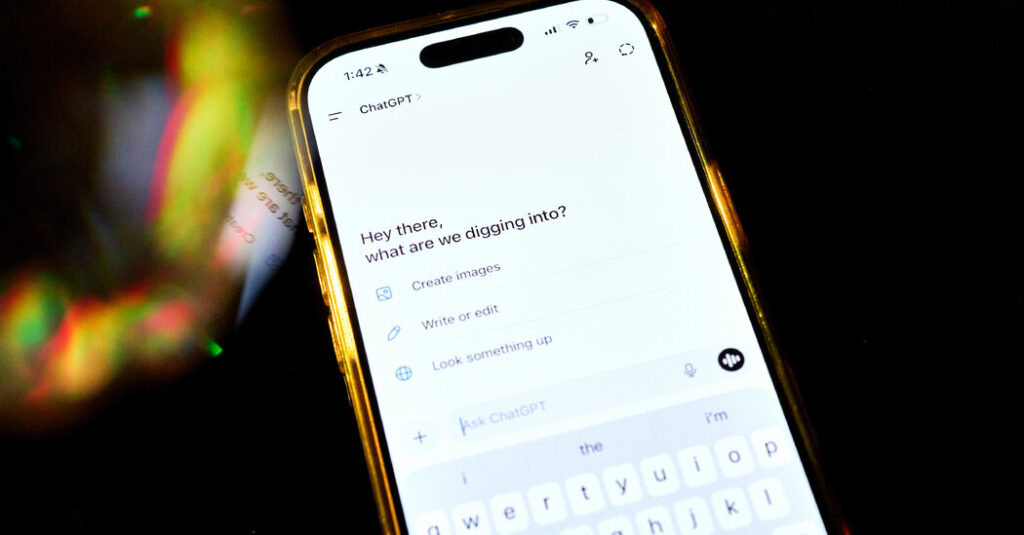
On Thursday, Anthropic’s chief rival, OpenAI, took a different approach. The company unveiled a new flagship A.I. model, GPT-5.5, and began sharing the technology with the hundreds of millions of people who use ChatGPT, its online chatbot.
The companies’ contrasting strategies are a clear indication that Anthropic and OpenAI disagree on how they should handle technology that is increasingly useful for the people trying to defend computer networks as well as those trying to break into those networks.
But OpenAI is not throwing caution to the wind. The company said it was not yet releasing the technology as an application programming interface, or A.P.I., which would allow companies and individuals to fold the technology into their own software applications and other tools. That will give OpenAI more time to study security issues in the new system.
In a blog post, OpenAI described the new model as a significant upgrade over the systems that previously powered ChatGPT, adding that the new technology was better at writing computer code and performing tasks related to other office work.
Code generation has become an increasingly important skill for A.I. systems, including technology from giants like Google and smaller companies like OpenAI and Anthropic.
A.I. code generation can accelerate software development. It also allows systems like GPT-5.5 to operate as A.I. agents — personal digital assistants that can use other software applications on behalf of office workers, including spreadsheets, online calendars and email services.
As A.I. systems have improved at writing computer code, they have gotten better at identifying security vulnerabilities in software — a skill that is fundamentally changing cybersecurity.
This month, Anthropic limited the release of its latest technology, Claude Mythos, to about 40 companies and organizations that maintain critical infrastructure, including Apple, Amazon, Microsoft and Google. Anthropic said the approach would allow these organizations to patch security holes before malicious hackers could exploit them.
Some cybersecurity experts questioned the approach, saying Anthropic is not allowing all companies, government agencies and other organizations to understand what the technology can do and use it to defend their computer networks right away.
If the technology is not widely distributed from the beginning, the experts argue, it will ultimately pose a greater security risk because fewer organizations will be able to defend themselves using the most powerful systems.
About a week after Anthropic unveiled Claude Mythos, OpenAI said it, too, would share a new A.I. system only with a group of trusted partners. But OpenAI shared that technology, GPT-5.4-Cyber, with a much larger group than Anthropic that included independent cybersecurity professionals and other experts.
OpenAI said it would distribute the technology to hundreds of organizations before expanding the release to thousands of additional partners in the coming weeks. It also said it would work to verify the identity of users to prevent misuse.
Now, OpenAI has publicly released the more powerful GPT-5.5. But it has added guardrails to GPT-5.5 aimed to prevent people from using the technology for cybersecurity tasks. With GPT-5.4-Cyber, it dropped those guardrails so that trusted cybersecurity professionals could work with the entire system.
OpenAI’s latest’s technology, however, is not as powerful as Anthropic’s Claude Mythos, according to benchmark tests run by Vals AI, a company that tracks the performance of the latest A.I. technologies.
(The New York Times has sued OpenAI and its partner, Microsoft, accusing them of copyright infringement of news content related to A.I. systems. OpenAI and Microsoft have denied those claims.)
Cade Metz is a Times reporter who writes about artificial intelligence, driverless cars, robotics, virtual reality and other emerging areas of technology.
The post OpenAI Unveils Its New, More Powerful Model appeared first on New York Times.