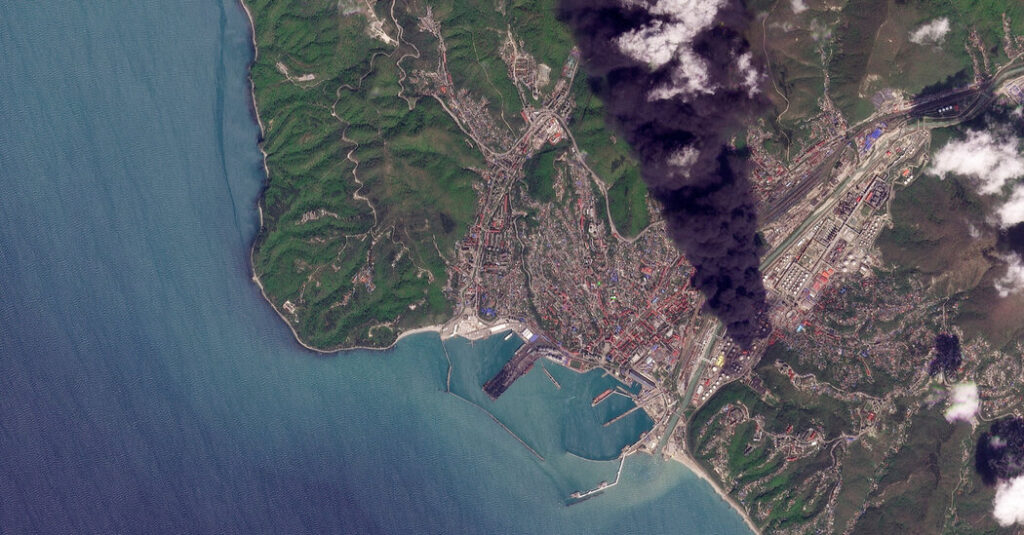
Officials in southern Russia have warned of dangerous levels of toxins in a Black Sea resort town’s air, ending days of official silence about the aftermath of Ukrainian strikes on an oil refinery there.
The refinery, in the coastal town of Tuapse, has been out of commission since April 16, when a Ukrainian drone attack caused extensive damage to it, resulting in an oil leak. Ukraine’s general staff said the strike had targeted facilities “actively involved in supplying the Russian Army.”
On Monday, another Ukrainian drone hit the refinery, starting a fire that began releasing huge amounts of smoke into the air. Residents of Tuapse soon began documenting a phenomenon called black rain, recently seen after strikes on Iranian fuel depots, in which drops of dark, oily toxins fall from the sky.
But not until late Wednesday night did Russian officials acknowledge the danger. A local emergency task force said in a statement that on Tuesday night, air quality monitoring across Tuapse had shown levels of benzol, xylene and soot that were two to three times the maximum amount to which people can safely be exposed. As of Thursday, the fire at the refinery was still burning.
The task force, which recommended that people in some parts of Tuapse stay home, did not explain why the warning had not been issued sooner. “The situation will get back to normal as soon as the fire is extinguished,” it said, adding that nearly 300 firefighters were trying to put out the blaze.
A trail of black smoke from the fire stretched for hundreds of miles, according to NASA Worldview satellite data from this week.
Officials have not closed schools or public offices in Tuapse. The task force said local hospitals had received no patients with symptoms consistent with exposure to toxins. As of Thursday, senior Russian officials had said nothing about the fire, which appears to be the worst environmental disaster for Russia from the war in Ukraine since the 2022 invasion.
Ukraine began ramping up its attacks on Russian oil facilities after the war in Iran began in late February, hoping to chip away at the economic benefits Russia was receiving from higher oil prices.
For days, Tuapse residents have posted images of animals, cars and rooftops covered with thick, oily droplets. One social media user posted a photo of a child’s hands covered in tiny black dots, writing, “This is what my child looked like when got back from school today — any chance our children can switch to distance learning?”
A local animal shelter called for volunteers to help wash oil off stray animals, posting images of dogs and a cat soaked in gooey, black liquid. “Almost all the street animals are covered in oil,” the shelter wrote on the social media platform Vkontakte, adding, “This is a catastrophe.”
Some people accused the government of downplaying the risks to the public. One person in a popular group on Vkontakte said there had been black rain as early as last week, after the first Ukrainian attack on the refinery. Other people asked why schools had not been closed.
After the strikes on oil facilities in Iran last month, the World Health Organization warned that black rain and other toxins in the air could cause respiratory problems, urging people to stay indoors. Experts warned of long-term risks from exposure to the toxins.
On Tuesday, in what seemed to be an attempt to project normalcy, the Tuapse prosecutor’s office released images of uniformed employees planting saplings as plumes of pitch-black smoke rose in the background. The images instantly became a meme in Russia, where state media had said little if anything about the fire, and the prosecutor’s office deleted the photos.
Pro-war Russian bloggers accused the authorities of trying to conceal the scale of the disaster. “This is essentially like Hiroshima, but without radiation: After a massive fire at the oil facilities, the town and nearby areas have seen ‘black rains’ that kill plants and animals,” one blogger, RIA Katyusha, said in a post this week.
Some pro-Kremlin politicians seem to be mindful that the reports could hurt the public image of Tuapse, which is famous for its beaches.
“Right now, there is nothing threatening the tourist season,” Fyodor Gerashchenko, who leads the local chapter of the pro-Kremlin People’s Front movement, told a local television channel on Wednesday.
Nataliia Novosolova contributed reporting.
The post Russian Officials Say Town’s Air Is Toxic, Days After Strike on Oil Refinery appeared first on New York Times.