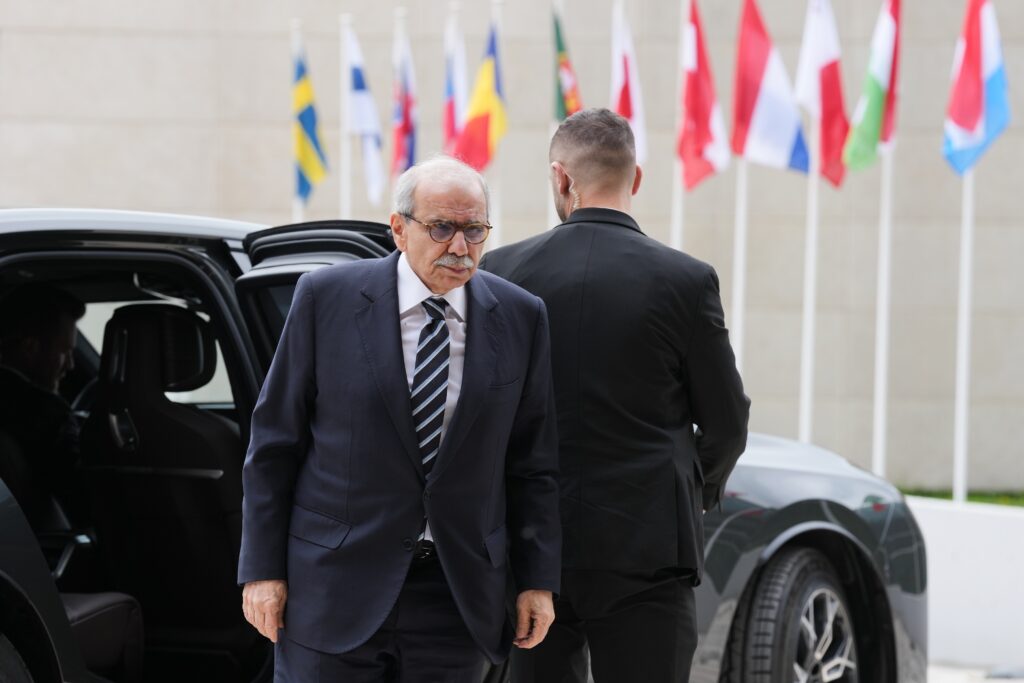
PARIS — Heading into a second round of rare direct talks with Israel, Lebanon is urging the Trump administration to pressure Israel to scale back its demands and end its military invasion of the country, Lebanese Prime Minister Nawaf Salam said in an interview with The Washington Post.
In Paris — days after the Israeli army published a map showing off the strip of southern Lebanon it says it seized as a buffer zone against Hezbollah attacks — Salam said Lebanon could not sign any agreement that does not include a “full withdrawal” of Israeli forces.
“We cannot live with a so-called buffer zone,” he said, “an Israeli presence where Lebanese displaced people are not allowed to return, where destroyed villages and towns cannot be rebuilt.”
The prime minister called for extending a shaky ceasefire brokered by the United States that expires at the end of this week, following the example of President Donald Trump, who has extended the ceasefire between the United States and Iran.
So far, efforts to hold a second round of U.S.-Iran peace talks have failed. Lebanese and Israeli diplomats, however, are due to hold their second bargaining session on Thursday at the State Department. It is the first time in decades that Lebanese and Israeli officials are bargaining directly in a U.S. bid toward potentially normalizing relations, which Hezbollah has long rejected.
Israel has said the ceasefire, which includes provisions in its favor, will not stop its military operations to devastate Hezbollah, the Iranian-backed militant group in Lebanon.
Beirut hopes to prolong the initial 10-day ceasefire, eventually secure an Israeli military withdrawal and allow more than a million displaced people to return home. Some have already ventured back to the south, but Israel has warned residents not to cross into the Lebanese villages it now controls.
The 72-year-old prime minister, who is a former president of the International Court of Justice in The Hague, said the U.S. role as a mediator is crucial.
“We are entering these negotiations convened by the U.S. convinced that the U.S. is the party that can have leverage over Israel,” Salam said Wednesday after meeting with French President Emmanuel Macron. “Their role was critical in reaching the ceasefire, and we hope they will continue exercising their leverage over Israel.”
In recent days, however, Israeli Prime Minister Benjamin Netanyahu said his forces created a “buffer zone” about 10 kilometers deep into Lebanon, giving no indication that Israel would be willing to step back from hard-line demands to occupy swaths of the country’s south.
The declarations illustrate that the efforts to end the war — let alone achieve an elusive, controversial peace deal — face long odds, even as Trump seems eager to proclaim he has resolved the deep-rooted conflict.
Lebanon emerged as a sticking point in negotiations between the U.S. and Iran, after a deadly Israeli barrage pounded Beirut, the capital, this month, killing more than 300 people in a day. The Trump administration intervened to broker the ceasefire in Lebanon, seeking to advance the negotiations with Iran.
Since then, Trump posted on Truth Social that Israel was “prohibited” from bombing Lebanon and that the U.S. would work with Beirut to “deal with” Hezbollah “in an appropriate manner.”
Yet Washington has not articulated a firm position against this Israeli invasion of Lebanon, and the country’s fate probably will also depend on the result of talks over the U.S.-Israeli war against Iran. Trump has extended the truce with Iran indefinitely, though its future is uncertain as a standoff persists over the Strait of Hormuz.
Asked whether the U.S. appears understanding of his government’s stance, Salam said Wednesday that talks were “really at the very beginning.”
“I don’t know what we can achieve through negotiation, but I know what we want,” Salam added. “And whether it’s an avenue we should pursue? My answer is indeed yes. Because we don’t want to leave any stone unturned to reach our objectives.”
Ahead of the talks, Israeli strikes killed several people in southern Lebanon, including a journalist, rescuers said Wednesday, in an attack the government condemned as a “blatant violation of international law.”
While Beirut hopes Washington will exert pressure on Netanyahu, it’s unclear how long Trump is willing to stay the course. The Lebanese government, meanwhile, is engaging in talks mediated by Israel’s biggest ally with little backup or leverage.
Israel has ignored European warnings against another occupation and has sidelined France, historically a key mediator in Lebanon.
Israel insists that its forces pushed into southern Lebanon, where Hezbollah is dug in, to eliminate the militant group, which continues to fire rockets and drones across Israel’s northern border. The Lebanese government’s position is that the invasion violates the country’s sovereignty and that it is up to the Lebanese army, not Israel, to disarm Hezbollah.
Lebanese officials insist they cannot accomplish that mission while under attack by Israel. Israel insists that the Lebanese military does not have the capability to disarm Hezbollah.
“We are remaining in Lebanon in a reinforced security buffer zone,” Netanyahu said last week. “That’s where we are, and we are not leaving.” The Israeli military’s map highlights a belt of territory it has seized along the border, showing dozens of villages under its control.
Some analysts say repeated Israeli incursions into southern Lebanon, including an occupation from 1982 to 2000, have provided fertile ground for Hezbollah, which was founded after the 1982 invasion and grew into Tehran’s most important and powerful regional proxy.
The rise of Hezbollah, including attacks against Western nations such as the 1983 bombing of the U.S. Embassy in Beirut, was also central to the collapse of previous efforts to achieve a peace deal between Lebanon and Israel.
Hezbollah, down but not out, is still pledging to fight back and has denounced the direct negotiations.
In the interview, the Lebanese prime minister said only a Lebanese mission can disarm Hezbollah — a main demand of Israel and Western nations. Salam has maintained that Lebanon did not seek out this war, which began after Hezbollah attacked Israel last month to avenge the U.S.-Israeli killing of Iran’s supreme leader.
Faced with Israeli criticism that his government hasn’t done enough to disarm Hezbollah, Salam said authorities made “bold decisions” and showed progress by confiscating weapons and outlawing Hezbollah military operations. He said a state monopoly over arms is a “Lebanese interest,” regardless of Israeli demands, because “it’s high time to recognize that a state cannot have two armies.”
“Disarmament is a process; it’s not something that’s going to happen overnight. But what’s more important is that we have shown seriousness,” he continued, adding that “the only way to do it is to strengthen the army.”
Salam said Lebanon is appealing to partners including Washington and Paris to help expand and reinforce its cash-strapped military with equipment and training, as well as to provide funds for an “unprecedented humanitarian tragedy” and for huge reconstruction needs.
Salam, who has also served as ambassador to the United Nations, took office last year in what was seen as a blow to Hezbollah’s influence over Lebanese politics.
After Israel weakened Hezbollah with pager attacks and a 2024 war in Lebanon, the new Lebanese government, which was backed by the U.S., pledged to disarm the militants and reform the financially distressed state. But despite U.S. pressure to force Hezbollah’s hand, Lebanese officials have also been wary of sectarian strife, a threat that Hezbollah has wielded as it refuses to lay down arms.
Lebanon maintains delicate power-sharing between factions that fought a bloody 15-year civil war until 1990.
Countries including the U.S. and France have long backed the Lebanese army as a potential counterweight to Iranian sway, but the Western support is dwarfed by U.S. military aid to Israel and Tehran’s backing of Hezbollah.
Now, Salam’s government is treading a fine line, contending with Israeli and U.S. proclamations of a possible peace deal, at a time when Israeli forces are leveling homes in the south and the Lebanese are still burying their dead, with over 2,290 people killed in Lebanon since early March. The attacks have forced an estimated 20 percent of the population to flee, according to U.N. officials.
With his Western interlocutors, Salam is receptive to negotiations and at times parses his words. With the Lebanese at home, he is navigating tense divisions in a country where many are increasingly critical of Hezbollah for undermining the state, while others accuse the state of failing to protect them.
Israel’s military advance and its warnings that Lebanese will not be allowed to return to the south have raised fears of a long occupation seeking to reshape not only the border region, but also its demographics. The Shiite community, from which Hezbollah draws its core base, is bearing the brunt of Israel’s attacks.
Israeli officials previously indicated intentions to clear up to 10 percent of Lebanon of its residents, as some in Netanyahu’s government advocated for annexing the land.
Responding to domestic criticism about engaging directly with Israel while Lebanon is under fire, Salam said the diplomacy is not “a concession to anyone.”
Salam held a flurry of meetings with European officials this week to shore up support, including talks in Paris with Macron. Israel, however, has sought to keep France out as tensions rise over Macron’s rebuke of Israel’s war in Gaza and “territorial ambitions” in Lebanon.
Salam said France would have a big role in bolstering the army and rallying aid for devastated villages. Lebanon, he said, needs to “mobilize all our friends.”
Suzan Haidamous in Beirut contributed to this report.
The post Lebanon looks to Trump for ‘leverage over Israel’ with ceasefire set to expire appeared first on Washington Post.