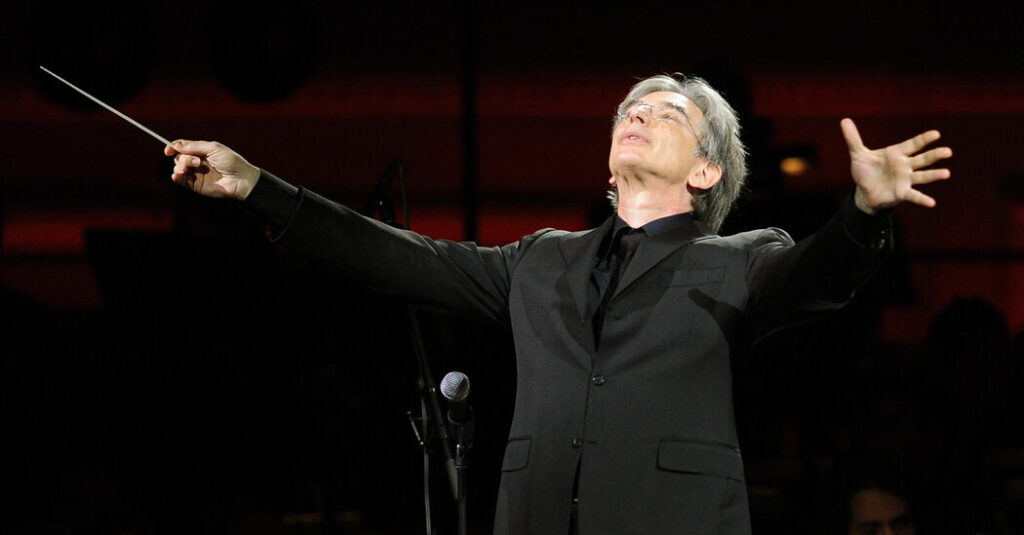
Michael Tilson Thomas, the American conductor, composer and pianist whose 25-year tenure as music director of the San Francisco Symphony became a model of collegial music-making, artistic adventurousness and community engagement, died on Wednesday at his home in San Francisco. He was 81.
The cause was glioblastoma, an aggressive form of brain cancer, Constance Shuman, his publicist, said in a statement.
Mr. Thomas announced in the summer of 2021 that he had had surgery for a brain tumor. In March 2022, he specified that he had been diagnosed with glioblastoma.
Although Mr. Thomas’s prognosis seemed ominous and he was forced to cancel some scheduled performances, for more than three years he rallied and led a number of inspiring concerts in San Francisco, Los Angeles, London and elsewhere. In September 2024, he opened the New York Philharmonic’s season with an account of Mahler’s mighty Fifth Symphony that, the New York Times critic Zachary Woolfe wrote, “had searching, saturnine weight” and “left an appropriately disorienting impact.” He also began teaching at the San Francisco Conservatory of Music.
In February 2025, he announced that his tumor had returned, and he conducted his final performance that April, in a return to San Francisco for a belated celebration of his 80th birthday.
Mr. Thomas displayed comprehensive musical skills. He was a technically crisp and sensitive pianist, especially during his early years as an adept exponent of contemporary scores, and a composer with a small but striking and stylistically diverse catalog of chamber pieces and songs for voice and orchestra. A recording of his song cycles “From the Diary of Anne Frank” and “Meditations on Rilke” with the San Francisco Symphony won the 2021 Grammy Award for best classical compendium.
Mr. Thomas was also the best teacher and demystifier of classical music for the general public since Leonard Bernstein — a popular pedagogy that Mr. Thomas carried out through award-winning television programs, videos and online educational sites.
Still, from the day his high school orchestra director unexpectedly tapped an oboe-playing Mr. Thomas to take over a rehearsal, he seemed destined for the podium. As his career developed and he increasingly committed himself to conducting, he found himself suited to a role that demanded both musical and leadership skills. He was also openly gay at a time when nearly no one else of his prominence in classical music was, and over the years in San Francisco he became a local gay icon.
He explained the role of a conductor in an American Masters profile that aired on public television in 2020. Its title, “Michael Tilson Thomas: Where Now Is,” was taken from his statement that a conductor’s job involved “getting 100 people or so to agree where now really is.” (The phrase was inspired by a line from the James Brown song “Cold Sweat.”)
He expounded on conducting in an interview with The Times in 2002. “I am like a director who has the luxury of being able to see the big scene,” he said, “and be very helpful at focusing the ensemble and encouraging a section or an individual soloist to deliver a line expressively.”
A performance, he explained, should sound like “the musicians were making it up at that moment, as if they were not reading music but playing with a kind of larger sense of commitment and abandon.”
Before he took the helm of the San Francisco Symphony, Mr. Thomas had conducted most of the world’s major ensembles; held the post of music director of the Buffalo Philharmonic for eight years in the 1970s; served as principal guest conductor of the Los Angeles Philharmonic from 1981 to ’85; and was principal conductor of the musician-run London Symphony Orchestra from 1988 until 1995, when he began his San Francisco tenure.
From the start, he set about turning the San Francisco Symphony into a hotbed of innovation, balanced with fresh, vibrant accounts of the standard repertory. He made a statement on his first program by leading the premiere of a major commissioned work by Lou Harrison, a maverick American composer then in his late 70s. A beloved musical guru to generations of musicians in the Bay Area, Mr. Harrison had been ignored by the symphony, his hometown band. During his first season, Mr. Thomas included a work by an American composer on every program he led.
Audiences heard plenty of exciting, cogent performances of repertory pieces at Davies Symphony Hall, the orchestra’s home. Guided by Mr. Thomas, the ensemble developed into a major Mahler orchestra, documented on recordings of the nine symphonies and orchestral songs that scooped up multiple Grammy Awards.
An Experimenter
Mr. Thomas said his approach to formidable symphonic scores was akin to visiting a national park. “I know the map well,” he told The Times in 2014, “yet being on the trail is always a new experience, and who you are with changes it entirely.”
Still, ambitious projects and experimentation defined his time in San Francisco. He fostered contemporary music by forming relationships with living composers, among them John Adams, Meredith Monk, Steve Reich and Charles Wuorinen. He inaugurated American Mavericks festivals that brought attention — and drew large youthful audiences — to pioneering, flinty composers like Charles Ives, Ruth Crawford Seeger, Henry Cowell, Carl Ruggles, John Cage, Henry Brant and the guitarist John McLaughlin. He reimagined the concert-going experience by incorporating video technology to present semi-staged productions of works, including Britten’s “Peter Grimes” and Bernstein’s “West Side Story.”
Under Mr. Thomas, the San Francisco Symphony in 2001 became the first American orchestra to introduce its own label, SFS Media, which produced edited recordings of live performances.
That he was ideally suited to music education was already clear during the 1970s, when for six years he was music director of the New York Philharmonic’s Young People’s Concerts, the televised venture that helped make Bernstein a household name. Mr. Thomas took this work further in San Francisco, creating a series of “Keeping Score” videos in which he explored the backgrounds of seminal works like Stravinsky’s “The Rite of Spring,” Beethoven’s “Eroica” Symphony and Mahler’s First Symphony.
Michael Tilson Thomas was born on Dec. 21, 1944, in Los Angeles, the only child of Ted and Roberta (Meritzer) Thomas. His father, born Theodore Hertzl Thomashefsky, was a stage manager and producer for New York theaters and later in Hollywood, both in film and television. Mr. Thomas’s mother established the research department of Columbia Pictures and later taught English and social studies at public schools in the Los Angeles area.
His father, Mr. Thomas recalled in the American Masters program, was a “bohemian kind of guy” who taught him to experience the “wondrousness” of music. His mother, he said, was the breadwinner, homemaker and teacher. As a child he studied piano and spent hours improvising at the keyboard.
His father’s parents were Boris and Bessie Thomashefsky, superstars of New York’s Yiddish theater, which thrived at the turn of the 20th century on the Lower East Side of Manhattan and on tours to American cities.
Mr. Thomas later created a 90-minute semi-staged program called “The Thomashefskys: Music and Memories of a Life in the Yiddish Theater,” which took the form of a personal memoir, narrated with wry, loving warmth by Mr. Thomas. It was first presented at Carnegie Hall in 2005 and performed with various orchestras and musical theater singers for over a decade. It led to his creation of the Thomashefsky Project, which preserves Yiddish theater records and materials.
Mr. Thomas’s breadth of musical and intellectual interests were shaped by his upbringing in a Los Angeles culture hospitable to classical music, modernism (Stravinsky and Schonberg lived there at the time), jazz, rhythm & blues, pop and Hollywood films.
When he was 12, he met a fellow student, Joshua Robison, then 11, while both were members of their middle school orchestra: Josh played cello, Michael the oboe. They “weren’t chums” at first, Mr. Thomas recalled in an interview for SF Gate magazine. But they bonded over music. (Mr. Robison’s sister is the noted flutist Paula Robison.)
Mr. Robison attended the University of California, Berkeley, and became a national collegiate gymnastic champion. Years later, he and Mr. Thomas reconnected and, in 1976, became a couple. They married in 2014. Mr. Robison, who was Mr. Thomas’s manager and producer in numerous creative projects, sustained a fall last year and died in February. Mr. Thomas leaves no immediate survivors.
A Break at Tanglewood
Mr. Thomas enrolled in the University of Southern California in 1962 to study piano with John Crown and composition and conducting with the German American composer Ingolf Dahl, who, in his protean career, was also a critic, scholar, editor and translator — an ideal mentor to the multifaceted Mr. Thomas.
Mr. Thomas played piano at U.S.C. for students in the classes of two giants: the violinist Jascha Heifetz and the cellist Gregor Piatigorsky. He became a regular pianist and conductor for the Monday Evening Concerts of the Los Angeles Philharmonic, a groundbreaking series of contemporary music, where he performed in premieres by Pierre Boulez, Karlheinz Stockhausen, Stravinsky and others. When he was chosen to conduct the Young Musicians Foundation Debut Orchestra, a prestigious pre-professional ensemble established in 1955, his path seemed fixed.
A big break came in 1968 when Mr. Thomas, as a fellowship student at Tanglewood in Massachusetts, worked with Bernstein, who became a lifelong mentor and colleague, and won the prestigious Koussevitzky Prize for student conductors. Talk within the classical music world spread that the next Bernstein — a charismatic, telegenic, multitasking musician — had arrived, and the comparison often resurfaced in Mr. Thomas’s career. The following year he was appointed assistant conductor of the Boston Symphony Orchestra.
His official debut with the orchestra in the fall of 1969, leading a challenging program of works by Haydn, Ives, Stravinsky and Debussy, proved auspicious. “Resisting the temptation to prophesy,” the Boston Globe critic Michael Steinberg wrote in his review, “let me say simply that right now he is one of the ablest and most interesting conductors in the profession.”
Later that year, when William Steinberg, the Boston Symphony’s music director, became ill during a program at Carnegie Hall, Mr. Thomas, then 24, had to take over for the second half, conducting works by Robert Starer and Richard Strauss.
The event was a triumph. “A tall, thin young man, he came onstage with an air of immerse confidence and authority and showed that his confidence was not misplaced,” Harold C. Schonberg of The Times wrote in his review.
As Steinberg recuperated, from what was later determined to be a heart ailment, Mr. Thomas wound up leading the orchestra in 37 more concerts, many including works he had not previously conducted. In 1970, he was appointed associate conductor of the Boston Symphony, an upgrade, and made his London debut with the London Symphony Orchestra that same year.
Steinberg was slated to step aside in 1972, the year after Mr. Thomas became music director of the Buffalo Philharmonic. But there was talk in Boston musical circles of whether Mr. Thomas might have a future in Boston as well. Michael Steinberg explored the question in a January 1972 article for The Boston Globe Magazine. Mr. Thomas was already engaged in adventurous projects with players in Buffalo who seemed open to anything.
“I don’t know, I wonder,” Mr. Thomas remarked to Mr. Steinberg. “Perhaps some of the smaller orchestras, the less prestigious ones — St. Louis, Atlanta, Buffalo, which are not so committed to a received idea of a particular sort of greatness — are by their nature more flexible.”
Restless in Boston
Yet, as the Globe article reported, some players in the Boston Symphony were reacting negatively to what they perceived in Mr. Thomas as aggressive precociousness, bratty outbursts and a penchant for having them repeat passages in rehearsals without saying why.
Looking back, in a revealing 1976 interview with The Times, Mr. Thomas said that in Boston, he “was not joyous about the spirit of music-making that was going on” and that “he got tired of looking at people whose eyes were totally dead,” whose “defensive grimace” kept conveying that “‘this is not the nobility of Beethoven!’”
The Boston Symphony appointed another youthful maestro, Seiji Ozawa, who in 1973 began what would become a 29-year tenure.
Mr. Thomas focused his energies on Buffalo and other ensembles, including the Berlin Radio Symphony Orchestra, Cleveland Orchestra, Israeli Philharmonic and New York Philharmonic. His reputation as a restless renegade with an arrogant streak lingered. Some players in Buffalo found him brash, impatient and inconsistent. Then, in 1978, at 33, he was arrested at Kennedy International Airport as he returned from London and charged with carrying a small amount of cocaine, some marijuana cigarettes and a few amphetamine tablets. He pleaded guilty to disorderly conduct in a plea bargain.
The incident tarnished his public image, as he later acknowledged in a 1995 article in The New York Times Magazine.
“People found out I was not the model of a nice Jewish boy,” he said. “The event pushed me from wunderkind to desperado. It hurt, and I probably did not get some jobs I might have gotten, but hurt is important and instructive for a musician.”
He forged on, appearing with major orchestras, growing increasingly in demand and making recordings, more than 120 over his career, earning 12 Grammy Awards overall.
Some who followed his career wondered why Mr. Thomas never landed at one of the so-called “Big Five” American orchestras of New York, Boston, Cleveland, Chicago and Philadelphia. But others saw him in the vanguard of a shift that turned the two major West Coast ensembles — the San Francisco Symphony, under Mr. Thomas, and the Los Angeles Philharmonic, under Esa-Pekka Salonen and then Gustavo Dudamel — into the dynamic leaders of a re-energized American orchestral scene, in which the “Big Five” designation had been rendered irrelevant.
Ever since his association with Tanglewood, Mr. Thomas worried for the futures of talented musicians in the insecure world of classical music. In 1987, he realized a dream. With the support of Ted Arison, the owner of a cruise ship line who had once hoped to become a concert pianist, he founded the New World Symphony, a professional training academy based in Miami. The academy’s fellows have a three-year residency, in which they work on orchestra programs with Mr. Thomas and other conductors, present some 70 concerts a year, receive chamber music coaching and hone their auditioning skills. Mr. Thomas was its artistic director until March 2022.
Mr. Thomas spoke of the New World Symphony in 2007 as a place for young players to take a sort of musical Hippocratic oath: “‘I will do this because of my love of learning and caring about people,’” as he phrased it, “as opposed to, ‘I can become such a star plastic surgeon that I can have a 19-car garage.’”
The academy could be a “launching pad for people’s lives,” he said.
“My personal mission,” he said, “is to have them hold onto ‘What does this mean?’ I’m trying to give the larger message of what music is all about.”
In 2011, the ensemble moved into the multipurpose, high-tech New World Center in Miami Beach, a 756-seat concert hall designed by the architect Frank Gehry in consultation with Mr. Thomas. The complex immediately proved a game-changer.
The hall has seats bunched in groups around the stage, and screens to incorporate video elements. The rehearsal and practice rooms are connected to an internet network that enables members of the orchestra to take lessons from mentors in distant cities. Audiences in a park outside can watch Wallcasts, as they are called, of live performances from the hall, with remarkably clear and rich amplification.
The young musicians who came through the New World Symphony helped Mr. Thomas maintain the excitement that drew him to music as a youth.
“I am a person who has never unlearned the enchantments of childhood,” he said in the 1976 Times interview. “I have never totally accepted the scheme of values, the paths of behavior, you’re supposed to eagerly assume as you enter adult society.”
The post Michael Tilson Thomas, Celebrated American Conductor, Dies at 81 appeared first on New York Times.