Tesla’s profit rose slightly during the first quarter, the company said Wednesday, but was well below levels seen a few years ago as car sales remained tepid.
The carmaker earned $477 million in the first three months of 2026, compared with $409 million a year earlier. Sales rose 16 percent to $22.4 billion, the company said.
Four years ago, in the first quarter of 2022, Tesla reported profit of more than $3 billion. The trend since then has been downward. The company’s earnings reflect the decision by Elon Musk, its chief executive, to devote resources to self-driving taxis and humanoid robots that have yet to bring in much revenue.
Tesla car sales appear to have stalled at fewer than two million per year. And the company is earning less money from selling clean air credits to other carmakers because Congress and President Trump have largely dismantled the regulations that required such trading.
Wall Street values Tesla at $1.2 trillion, far more than any other automaker, based on promises by Mr. Musk that the company will soon begin mass producing products using artificial intelligence. Those include a humanoid robot called Optimus and a “Cybercab” that can drive itself without human intervention.
Tesla’s factory in Austin, Texas, produced the first Cybercab in February, Mr. Musk said on social media. But it is not clear when or if regulators will approve use or sale of the car, which does not have a steering wheel, brake pedal or side mirrors.
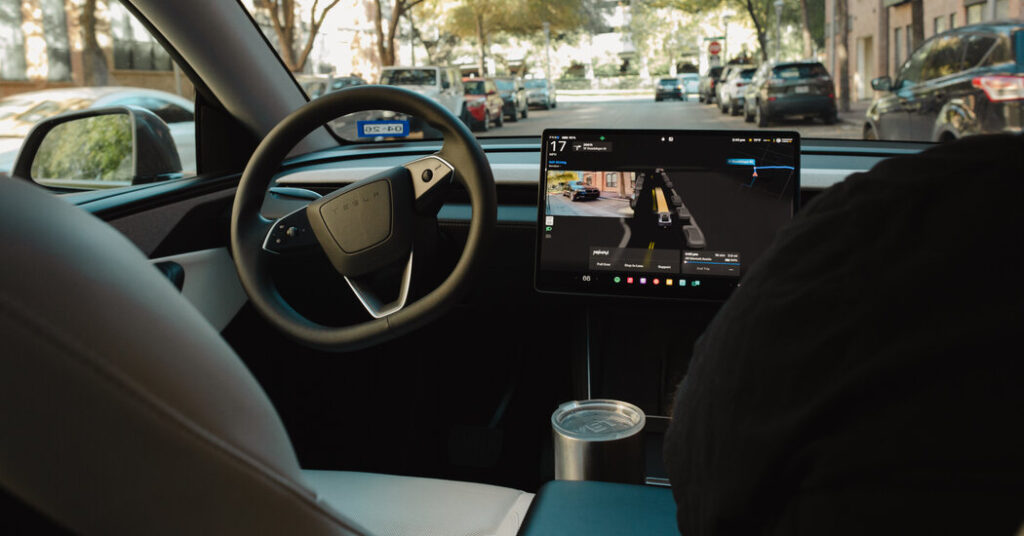
Tesla has begun offering paid rides to customers in Texas in Model Y sport utility vehicles equipped with autonomous driving software. Tesla, which introduced the service in Austin last year, added vehicles in Houston and Dallas this month.
But the number of autonomous taxis is small compared with that of Waymo, a unit of Google’s parent company. Waymo is offering paid, autonomous rides in 11 cities and has identified plans for 20 more.
Investors are showing signs of uneasiness. Tesla shares have fallen more than 10 percent since the end of last year.
Tesla earlier reported a slight increase in first-quarter car sales, a sign that rising gasoline prices may be pushing more people to consider electric vehicles.
But Tesla continues to contend with intensifying competition, especially in Asia and Europe where Chinese carmakers are selling vehicles that cost a lot less but offer comparable or superior technology.
Tesla has stopped producing the Model S and Model X, its luxury vehicles, and the Cybertruck pickup has sold poorly.
Almost all of Tesla’s revenue from car comes from the Model 3 sedan and Model Y sport utility vehicle, which appear increasingly dated especially as Chinese carmakers roll out new models at a dizzying pace.
Tesla’s exit from the luxury market creates an opportunity for other manufacturers offering electric vehicles for people who can afford to spend $80,000 or more.
“Tesla S and Model X customers are more than welcome to visit our stores. We have a car for them,” Sebastian Mackensen, the chief executive of BMW of North America, said in an interview Wednesday.
On Thursday BMW unveiled a redesign of its top-of-the line 7 Series sedan. An electric version costing $125,000 has a new kind of battery allowing it to travel 350 miles on a charge.
Some investors have expressed concern that Tesla is manufacturing far more vehicles than it is selling. In the first quarter the company produced 408,000 cars but delivered only 358,000.
Tesla also faces more competition in the market for large batteries used by electric utilities, businesses and homeowners. Sales of those batteries, an important source of profit, fell 15 percent in the first quarter as measured by their storage capacity, the company said on April 2.
The market for storage batteries, which can be as big as shipping containers and as little as a television, is becoming more competitive. Companies like LG Energy Solution and Ford Motor are taking factories originally designed to produce electric vehicle batteries and outfitting them to make storage products, driving down prices.
At the same time, rising oil prices could stimulate demand for Tesla’s electric vehicles, including the long-awaited Semi, an electric heavy truck the company is expected to begin delivering in large numbers soon.
The price of diesel, used to power most big trucks, has risen even more than gasoline, to $5.40 per gallon from $3.53 per gallon a year ago, according to U.S. government figures.
“In the current backdrop around rising gas prices,” said Melissa Otto, head of research at S&P Global Visible Alpha, “my guess is we are going to see more investors taking a look at Tesla once again.”
Jack Ewing covers the auto industry for The Times, with an emphasis on electric vehicles.
The post Tesla Profit Rises but Remains Below Earlier Highs appeared first on New York Times.