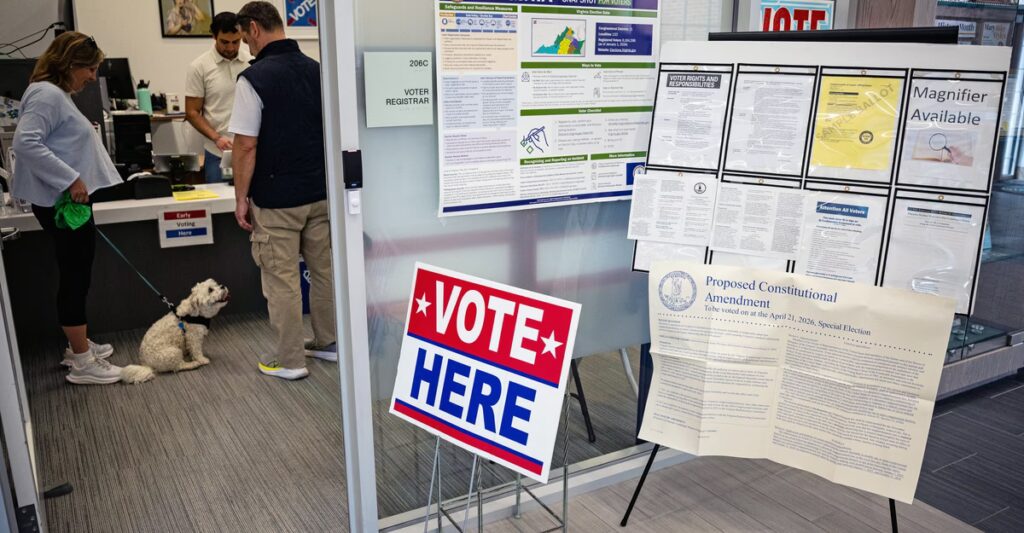
Voters in Virginia approved a lopsided congressional map on Tuesday, reducing the expected number of Republican-leaning districts in the Democratic-controlled state from five to one. Republicans have reacted by complaining that conservative-leaning voters in the state have been disenfranchised by gerrymandered maps that reduce the influence of their vote.
And they’re right. That is exactly what the new Virginia map does.
Gerrymandering is an attempt to thwart the will of the voters. It circumvents the vital process of democratic feedback by insulating politicians from political backlash. It should not happen, and yet this latest chapter of the redistricting wars did not begin in Virginia. It did not even begin last year, when Donald Trump openly urged red states to gerrymander their congressional maps so Republicans might retain possession of the House during the midterms. He did so despite the fact that the maps had been drawn after the 2020 census and would normally be expected to last until 2030.
Gerrymandering as a practice goes back to the beginnings of the republic—the term comes from maps drawn under Governor Elbridge Gerry in 1812. But the current redistricting arms race was prompted by the conservative-controlled Supreme Court’s 2019 ruling in Rucho v. Common Cause, which said partisan gerrymandering was a political issue the Court couldn’t interfere with. That ruling granted conservatives a victory they had long sought, and they may be on the verge of another. The Roberts Court will soon release its decision in Louisiana v. Callais, in which it may further neuter the Voting Rights Act to allow racial gerrymanders in the name of so-called color- blindness. If this happens, politicians would have a free hand to draw districts along partisan lines, and, as the Brennan Center, a left-leaning legal organization notes, many politicians would see the Court’s decision “as an invitation to return to the racially discriminatory systems that previously entrenched the power of white voters at the expense of minority communities.”
[Read: Trump’s enormous gerrymandering blunder]
Republicans have justified gerrymandering in the past much as they have defended other forms of malapportionment in the American political system: by arguing that the votes of constituencies that lean Republican are more legitimate than those that lean liberal. “If you took Madison and Milwaukee out of the state election formula, we would have a clear majority—we would have all five constitutional officers and we would probably have many more seats in the Legislature,” Robin Vos, the Republican speaker of the state assembly in Wisconsin, said in 2018. The logic here is clear: Rural votes, more likely to be Republican, should count more than urban votes, which tend to come from Democrats. At the time, Republicans in Wisconsin had managed to draw maps so effectively that even when Democrats won 53 percent of the vote, they won only about a third of the seats in the legislature.
Be careful what you wish for. Before 2019, some Democratic-controlled states had tried to lead by example, installing nonpartisan redistricting commissions to draw fair maps. Republicans liked that because it meant they could gerrymander conservative-leaning states and get fair treatment in liberal-leaning ones, thereby maximizing their representation in Congress. While the nonpartisan commissions respected the will of the voters, Democrats understandably began to see them as a form of unilateral disarmament.
Republicans seem to have expected that Democrats would continue to follow rules they had long since enthusiastically abandoned. The Washington Post editorial page, exemplifying its rightward turn under owner Jeff Bezos, dismissed Democratic concerns about Texas gerrymandering last year, arguing that “what’s happening in the Lone Star State is not a threat to democracy.” The editorial-board members were considerably less enthusiastic about Virginia’s redistricting, which they called a “power grab”; Democrats, they warned, had plunged America “deeper into the gerrymandering abyss.” Whoops!
What Virginia Democrats did by redrawing the congressional maps was antidemocratic, and it should be illegal. But, for those who care about ensuring the future of democracy, it was the least bad option of those available. As the political scientist Seth Masket wrote last year, Democrats couldn’t force the Republican Party to “feel more reverent toward institutions and norms”; they could only “raise the costs of irreverence. In the long run, that’s the most effective tool available.”
[Read: The state that handed Trump his biggest defeat yet]
Republicans should use their newfound realization that gerrymandering is an antidemocratic practice whose purpose is to insulate politicians from the electorate to work together with Democrats to ban gerrymandering, or at least to limit its rewards. If the long-term outcome of the redistricting wars is a fairer system for drawing legislative maps, then it will have been worth it. The only way out of this is for both parties to agree to make the rules fairer. As Greg Sargent points out, Democrats attempted to ban partisan gerrymandering last time they had a House majority—only for Republicans to oppose it in the Senate.
I suspect, however, that Republicans have not had this realization, and that they simply believe that disenfranchising Democrats is good but disenfranchising Republicans is bad. If that’s the case, then this race to the bottom will continue indefinitely. On Monday, Trump called the new maps a “shameful effort” to “silence the voices of Virginia conservatives.” He either didn’t remember or didn’t care that he had set off this whole process by demanding that liberals in Texas and other Republican-controlled states be similarly silenced. In fact, the president complained in a post on Wednesday that the election had been “rigged” by virtue of the fact that all the votes—including mail-in ballots—had been counted.
“The partisan gerrymanders here debased and dishonored our democracy, turning upside-down the core American idea that all governmental power derives from the people,” Justice Elena Kagan wrote in her 2019 dissent inRucho. “If left unchecked, gerrymanders like the ones here may irreparably damage our system of government.”
Kagan was right then, and she’s right now. If Republicans had listened at the time, they would not be tasting their own bitter medicine today.
The post Redistricting and Revenge appeared first on The Atlantic.