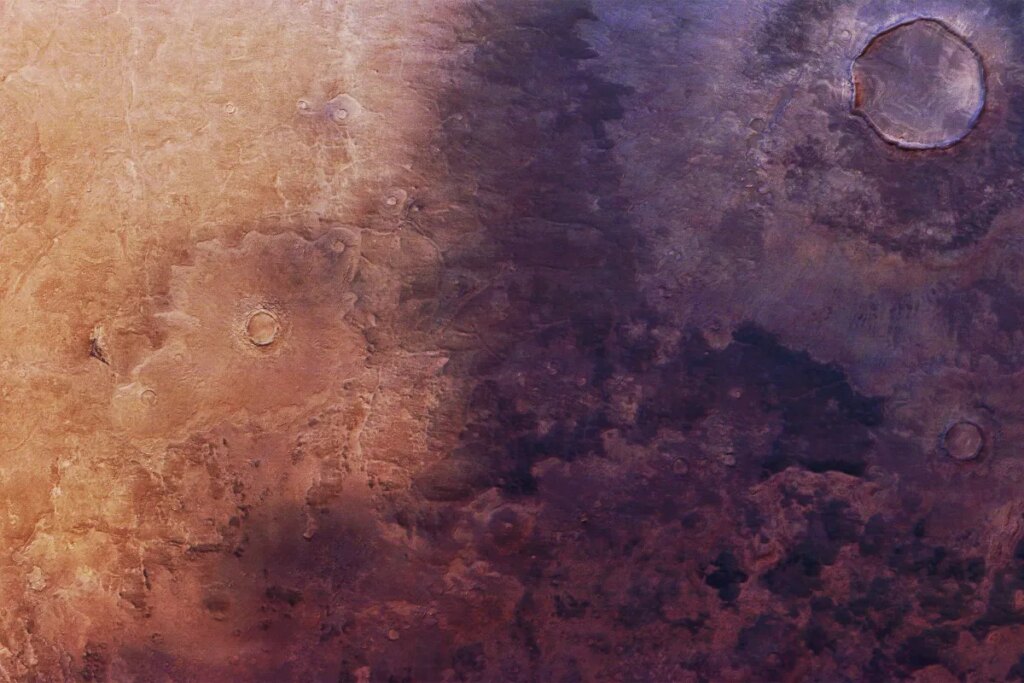
A shadowy presence is spreading across the surface of Mars.
New images released by the European Space Agency that were taken by its Mars Express orbiter show a rapid transformation taking place in the planet’s Utopia Planitia basin, which scientists believe was once the site of an ancient ocean.
Today, it’s a veritable battleground between the forces of light and dark.
That’s only being slightly hyperbolic. In one half of a composite image taken with the mission’s High Resolution Stereo Camera is the Red Planet’s traditionally light colored, sandy beige surface. In the other half, the landscape is a dark reddish-brown, as if corrupted by a horrific blight.
Mars Express has captured a blanket of dark ash creeping across the Red Planet. It has spread hundreds of kilometres in less than 50 years. 1/4 pic.twitter.com/vxz8cIvsGM
— ESA Science (@esascience) April 15, 2026
Planetary scientists are still piecing together what’s behind the unusual phenomenon. They suggest the dark presence could be volcanic ash deposited by martian winds. Alternatively, said winds could be blowing away ochre-colored dust that covered the blanket of ash.
According to the ESA, the material is made of what’s known as mafic minerals that formed at high temperatures, such as olivine and pyroxene.
Like Earth, Mars is a volcanic world and is host to the largest volcano in the entire solar system, Olympus Mons, which towers nearly 14 miles above the surrounding landscape, with a base around the size of the state of Arizona. Whether volcanic activity still takes place on Mars, which has long, and now contentiously, been considered a geologically “dead” world, is a matter of ongoing debate. But its rich volcanic history is plain to see — and possibly still coloring the planet’s surface.
If the darkening blanket is caused by spreading ash, it would be moving at a breakneck pace. A side-by-side of images taken by NASA’s Viking orbiters in 1976 and the new ones from Mars Express show the dark patch growing significantly in the fifty intervening years. That’s orders of magnitude quicker than other noticeable visual changes on the Martian surface, which can take place across millions of years, according to the ESA.
More on Mars: NASA’s Mars Rover Comes Across Formation That Looks Like the Scales of a Massive Cosmic Reptile
The post Scientists Puzzled by Huge Shadowy Blight Spreading Across Surface of Mars appeared first on Futurism.