When the U.S. and Israel went to war with Iran, Iran retaliated with airstrikes on Washington’s Gulf Arab allies, including the United Arab Emirates. Iranian expatriates in the country abruptly found themselves in a very uncomfortable position.
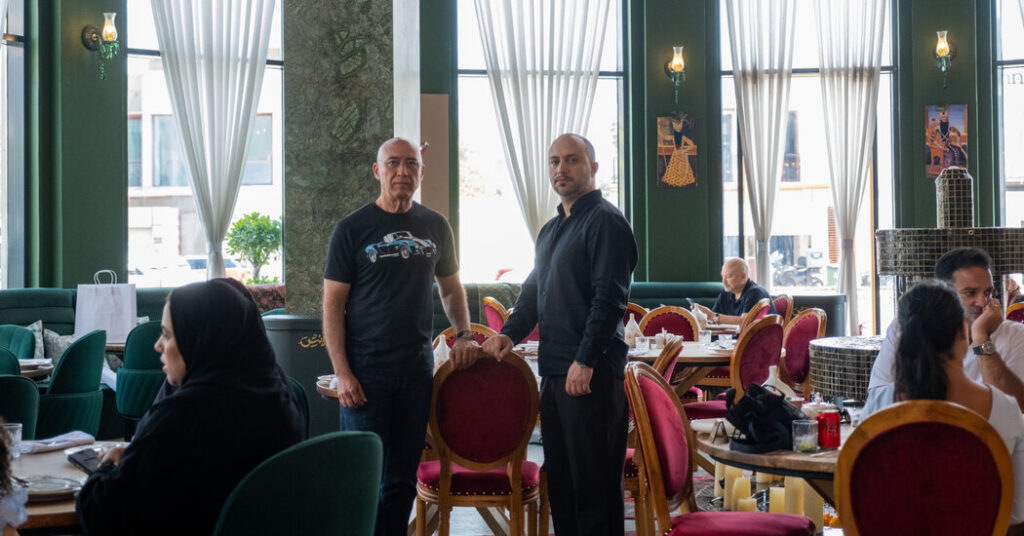
“Suddenly to have our home here under attack from our homeland, it’s a surreal experience,” said Reza Namazi, an Iranian who moved to Dubai with his family 20 years ago. “Where do your loyalties lie at a time like this? One hundred percent your home,” he added.
Over generations, hundreds of thousands of Iranian immigrants have made the Emirates their home, forming a community that has grown, prospered and woven its influence into Dubai’s souks, trade and arts scene.
Mr. Namazi said he has various businesses in Dubai including a restaurant he opened three years ago called Iranish, meant to evoke the meals that one might eat at their Persian grandmother’s home.
The sense of home that Iranians have felt in their adopted country was further shattered when the Emirati government began revoking the visas and residency permits of some Iranian expatriates.
Mr. Namazi said one of his relatives was in Spain vacationing with his family for Eid al-Fitr, the holiday that marks the end of the holy month of Ramadan, when he found out his wife’s Emirati visa had been canceled. That left the family stranded abroad.
“It does shake you,” he said over lunch at his restaurant in Dubai recently.
Sitting across the table was Amin Ebra, a chef at the restaurant. He said his friend was vacationing in Bali last month and landed back at the Dubai airport to discover that her residency permit had been canceled. She was told she wouldn’t be admitted to the country and had to book a flight to Turkey.
The Emirati foreign ministry said earlier this month that there had been “inaccurate media claims regarding the residency status of the Iranian community,” without clarifying what was inaccurate or whether some residencies had been revoked. The ministry added that the Emirates “is home to a respected and valued Iranian community that forms an integral part of its social fabric.”
A number of Iranian residents of Dubai said that in all the cases they had heard of, the Iranians who had their visas or residency permits revoked were outside the country at the time. Some, they said, had their status reinstated after an appeal.
Some Iranians in Dubai — from shop owners selling Iranian saffron and Persian rugs, to bank managers at Iranian banks — did not want to be interviewed or spoke on the condition they not be identified. They seemed worried that their loyalties might be questioned and that the Iranian community could face harsher crackdowns by the government.
Mr. Namazi said his daughter was only 4 years old when the family came to Dubai and it is the only home she knows. But her sense of belonging has been shattered.
“My daughter was like, ‘What will happen if they cancel our visa? Where will we go?’” he said. “We can’t go back to Iran.” She worried about living somewhere where she might not be welcome.
Since the beginning of the war and before a two-week cease-fire went into effect earlier this month, Iran has launched more than 2,800 drone and missile attacks against the Emirates, which at its closest point is less than 50 miles from Iranian territory, just across from the Strait of Hormuz. The attacks killed 10 civilians, according to the ministry of defense.
Adding to the tense atmosphere, the Emirates said on Monday that it had arrested 27 men who belonged to a “terrorist cell” linked to Iran. The statement did not mention their nationalities, but many appeared to be Emirati citizens.
In response to Iranian attacks, the Emirati government in mid-March ordered the closure of the Iranian Hospital, a cultural club and schools — all of which it says are connected to Iran’s regime.
Outside the emergency room entrance at the shuttered Iranian Hospital last month — its facade decorated with turquoise tile typical of Persian design — a sole ambulance was parked and two security guards sat nearby.
A day earlier, the last of the hospital’s patients had been transferred to other medical facilities, the security guards said. Online, Dubai residents bemoaned the closure of one of the few affordable health care facilities in the city.
Administrators at the Iranian Hospital could not be reached for comment and the C.E.O. of the Iranian cultural club did not respond to written questions.
The Emirati foreign ministry told The New York Times that “certain institutions directly linked to the Iranian regime” and Iran’s powerful Revolutionary Guards will be closed “after being found to have been misused to advance agendas that do not serve the Iranian people, and in violation of Emirati laws.”
The statement added that the country is home to a longstanding and vibrant Iranian community that continues to play an integral role in society and remains a valued contributor to the country’s continued progress.
In addition to the hospital and club, a handful of Iranian schools, including the Islamic Azad University in Dubai, were closed, said Mobin Salehi, a Dubai-based journalist with Iranian UAE, a news site devoted to covering the Iranian community in the country.
Iranians began immigrating to the Emirates long before Dubai became the global destination it is today and generations of Iranians helped make it the vibrant metropolis that it is.
Several waves arrived, driven by various factors like the imposition of customs on merchants in the early 20th century and the Islamic Revolution in 1979, said Amin Moghadam, a professor of international migration at the University of Poitiers in France. Now the Iranian population is estimated at about half a million, according to some analysts.
When the Emirates was founded in 1971, it offered citizenship to many of the Iranians who were living there. Some accepted and others didn’t, according to Mr. Moghadam, who has researched the Iranian community in the Emirates.
Those Iranians who have been in the country for more than a generation became known as Ajami Emiratis. Ajami means non-Arab and often refers to those from Iran. They have become indistinguishable from Arab Emiratis in their speech, their way of dressing and their sense of belonging.
For some immigrants who did not take U.A.E. citizenship when it was offered to them, virtually the only Iranian thing about them is their passport.
“The U.A.E. is using immigration and visa policies as a leverage,” said Mr. Moghadam. “It’s a form of retaliation, but it’s a political retaliation. I think it’s wiser than getting openly involved in a military intervention.”
Ali, an Iranian expat who lives in Dubai, was in Paris last month with his wife celebrating Nowruz, the Persian New Year, when his wife learned that her Emirati residence permit had been canceled.
Ali, a former competitive kickboxer who now works as a coach and personal trainer, said the couple are in limbo, stuck in France having overstayed their visa but unable to return to their home and unsure of what to do about it all.
“When the war happened, everything changed,” said Ali, 43, who asked to be identified by his first name only for fear of retribution. He spoke by phone from a cafe in Paris.
He said he and his wife, a cosmetician, were building their lives in Dubai, having sold everything they had in Iran to buy property there. His own visa doesn’t appear to have been revoked, but he said he fears that if he tries to return, he too will be barred.
“I don’t have any future,” he said. “I can’t go back to Iran. I can’t go back to Europe. I couldn’t go back to United Arab Emirates.”
Omnia Al Desoukie and Sanam Mahoozi contributed reporting.
Raja Abdulrahim reports on the Middle East and is based in Jerusalem.
The post Iranian Expats in U.A.E. Caught Between Home and Homeland appeared first on New York Times.