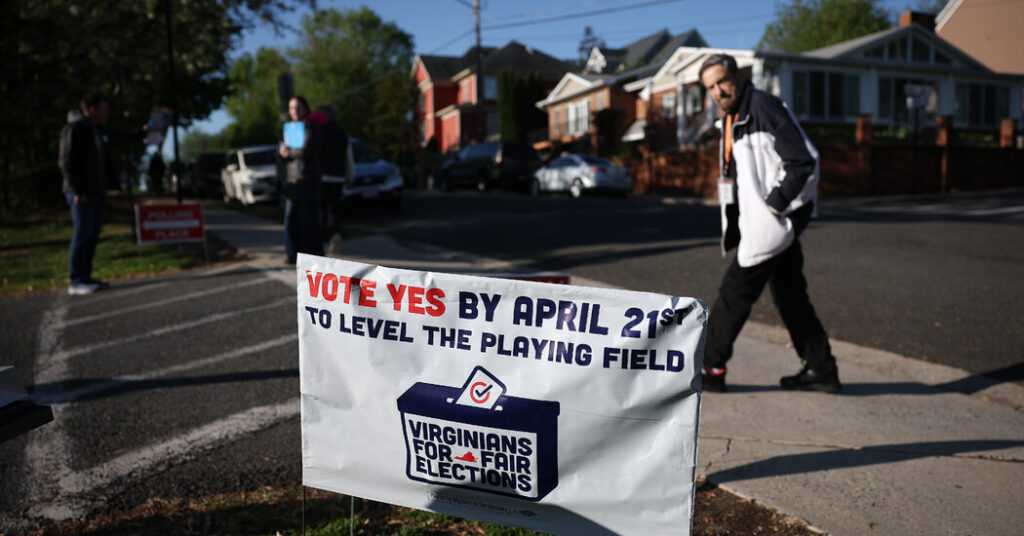
Democrats’ success in pushing through one of the country’s most aggressively gerrymandered congressional maps on Tuesday in Virginia represented the latest example of the party’s willingness to take the gloves off as it seeks to win back control of Congress and thwart President Trump’s agenda.
It was a stark reversal for a party that has decried partisan gerrymandering for years. But Democrats said that the new map, which could flip as many as four Republican-held seats blue, was necessary to counter similar G.O.P. efforts in Texas and other states.
Their new mantra: It’s time to play hardball.
“While many expected Democrats to roll over and play dead, we did the opposite,” Hakeem Jeffries, the House Democratic leader from New York, said in a statement after The Associated Press called the race. “Democrats did not step back. We fought back. When they go low, we hit back hard.”
The party’s newly combative approach extends beyond redistricting as it has felt a new urgency to regain power in Washington. Despite their qualms over dark money, Democrats are nowadays more reliant on it than Republicans. And on Capitol Hill, they have adopted an uncompromising approach to spending negotiations, forcing a partial government shutdown earlier this year after they refused to fund immigration enforcement operations without new restrictions on federal agents’ tactics.
All of it amounts to a new openness among Democrats — spurred on by angry constituents demanding more forceful opposition to Mr. Trump — to reverse their opposition to political tactics they once considered bad governance. And none has been more head-spinning than the Virginia gerrymander, which transforms a nearly evenly divided 11-member congressional delegation into one with only one surefire Republican seat.
Proponents framed the initiative as a less than ideal but very necessary rebuttal to a gerrymandering war kicked off by Republicans. The measure allows for the “temporary” adoption of a new map, returning control of the process to an independent commission in 2031.
“We cannot bring a stick to a knife fight,” said Kelly Hall, the executive director of the Fairness Project, which spent more than $12 million backing the redistricting referendum.
With Republicans “assaulting the integrity of representation in the U.S. Congress, we need to be able to respond with every tool that we have,” she said.
Even getting the measure on the Virginia ballot required some parliamentary trickery. Without the two-thirds vote needed in each house to call a special legislative session last year, Democrats instead seized on a budget session called by Glenn Youngkin, then the governor and a Republican, to schedule the referendum.
Such tactics represent a dramatic reversal from the recent past. Throughout the Trump era, Democrats have portrayed themselves as the high-minded party focused on preserving democratic institutions. In an ideal world, they say, Citizens United — the 2010 Supreme Court ruling removing limits on independent political spending by corporations — would be overturned, and there would be a nationwide prohibition on partisan gerrymandering.
“We would like to get rid of this stuff,” said Tim Persico, a veteran Democratic strategist. “But in a world where one side is still actively, openly, cravenly engaging in it, we cannot afford to not engage by the same rules.”
That contrast has opened the party to attacks from Republicans, who have had no trouble finding national Democrats’ past words opposing partisan gerrymandering. Dueling video advertisements from former President Barack Obama in the closing weeks of the Virginia campaign, which attracted more than $80 million in spending, underscored how Democrats have evolved: Republicans ran ads featuring Mr. Obama’s past opposition to partisan gerrymandering, while Democrats highlighted his current support for the measure.
“This is all about having a level playing field,” said Representative Eugene Vindman, a Virginia Democrat. Mr. Trump, he said, shouldn’t feel like he could take “vengeance out on Democratic-leaning states and expect Democrats to always take the high ground.”
Democrats are hardly alone in showing flexibility when it comes to hewing to past positions. When Mr. Trump campaigned against the Virginia measure on the eve of the vote, he told a local radio host: “I don’t know if you know what gerrymandering is, but it’s not good.” But it was the president who helped kick off the mid-decade gerrymandering battles with his call last year for Texas to draw new maps to benefit Republicans.
Some Democrats remain divided over just how far they should go in trying to place a check on Mr. Trump’s administration. The debate has played out in statehouses, federal primaries and national party meetings this spring.
A similar effort to flip a Republican-held seat in Maryland by gerrymandering its map failed to advance this month, after the Democratic president of the State Senate refused to bring it to a final vote.
The argument against redistricting there was more tactical than ethical — the senate president suggested that a new map could backfire or face legal challenges — but he also noted in a letter that he had “personal concerns with mid-cycle redistricting and its potential long-term effects on the resilience and trust in democracy.”
Maryland’s eight-member congressional delegation includes just a single Republican, meaning the new map would have eliminated any Republican representation in the House. Roughly one-third of Marylanders voted for Mr. Trump in 2024.
The fault lines are more muddled when it comes to how willingly Democratic candidates should welcome money from groups that accept unlimited corporate contributions, sometimes with no disclosure requirements.
Many in the party view so-called “dark money” — money from undisclosed donors — as morally reprehensible. And they decry the influence of corporate interests, in particular groups representing cryptocurrency and artificial intelligence companies, and powerful interest groups funded by major donors such as the American Israel Public Affairs Committee, the hard-line pro-Israel group.
That debate was on display this month at a Democratic National Committee meeting in New Orleans, where some Democrats pushed for resolutions condemning dark money.
One such resolution moved forward but was stripped of language specifically calling out A.I. and crypto money. Another, targeting AIPAC, failed to pass, partly because the D.N.C. had already resolved to ban dark money from presidential primaries, but also because Democrats are wrestling with how firmly to call out AIPAC and whether they want to discourage candidates from accepting large financial contributions.
Melissa Bean, who won a Democratic primary in Illinois last month with the help of millions of dollars from an AIPAC-linked group, echoed the sentiments of other Democrats when she told a local radio station that she did not think “we as Democrats should tie our hands behind our backs” by turning down campaign contributions.
“The stakes are incredibly high, and we have to ensure that we have the resources that are required to at least get one branch of government,” said Rusty Hicks, the chair of the California Democratic Party, who was in attendance in New Orleans.
Others at the D.N.C. meeting took a harder line.
“There is so much public outcry and opposition that I worry if we don’t reject it, or if we don’t show an intent to reject it or a plan to move away from it, we will have more people sit out, because they’re like, ‘They’re all evil,’” said Francesca Hong, a Democratic candidate for governor in Wisconsin. “We should read what the majority of people are saying. There’s bipartisan opposition to AIPAC.”
For all such hand-wringing, Democrats continue to benefit from hundreds of millions of dollars from increasingly opaque interest groups and wealthy donors.
A big test of Democrats’ newfound appetite to play hardball came last year in California, where Gov. Gavin Newsom persuaded voters to pass Proposition 50, bypassing an independent redistricting panel and gerrymandering California’s map to flip five Republican seats.
The effort’s stewards took a cautious approach, knowing how some on the left would feel about unwinding policies seen as good for democracy, said Paul Mitchell, the Democratic strategist tapped to redraw California’s map. They pitched the initiative as a limited action in response to Republican redistricting in Texas, and framed it as a temporary Band-Aid that would sideline the independent panel for only three election cycles.
“It wasn’t 10 toes in on this idea of, ‘If they go low, we’re going to go lower,’” Mr. Mitchell said. “It was, ‘If they’re going to go low, we’ll go low for a short period of time and then go right back to going high.’”
Kellen Browning is a Times political reporter based in San Francisco.
The post In Virginia Redistricting Win, Democrats Play Hardball to Thwart Trump appeared first on New York Times.