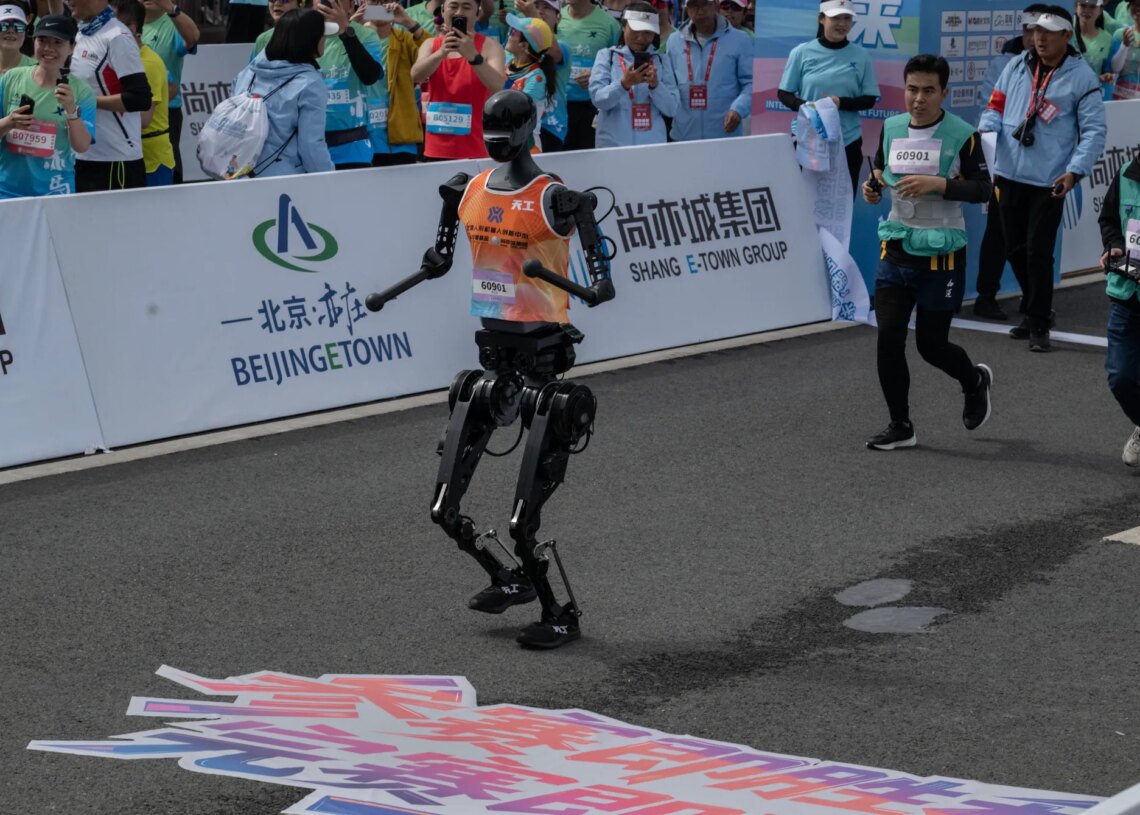
A humanoid robot winning a half-marathon sounds like a milestone until you remember what robots are for. In Beijing’s recent humanoid robot half-marathon, a machine named “Lightning,” built by smartphone maker Honor, clocked 50 minutes and 26 seconds over 13.1 miles. It comfortably beat the human world record of 57:20. Another version, remotely controlled, posted an even faster time before immediately crashing into a barrier at the finish line, much like humans after actual marathons.
The headline writers for traditional news outlets tasked with summing up this story in a neat, compact sentence were handed an impossible task. They needed to relay the story’s basic information, but the natural title would seem overly sensational for something that isn’t that impressive. That’s the double-edged sword of a story like this.
A robot that beat the human record for a half-marathon sounds like it should be impressive, and yet it’s the opposite. It’s actually deeply unimpressive; it’s not surprising. It is a little funny to watch them run, though.
This Chinese humanoid robot just broke the world record for a half marathon, finishing in 50 min 26 sec.
This video shows its crash just meters before the finish line. It’s by Honor, the smartphone maker and was teleoperated while others were autonomous. pic.twitter.com/4NMZw6rKnh— Massimo (@Rainmaker1973) April 19, 2026
A Humanoid Robot Set a Half-Marathon Record. Here’s Why That’s Not Impressive.
It’s closer to buying a better blender than witnessing a miracle. Machines outperform humans at tasks they’re explicitly designed to do. That’s their entire deal. You don’t hand out medals to a blender for making smoother smoothies than your forearms ever could. At most, that blender gets the Wirecutter seal of approval.
You certainly don’t marvel at a robot for running fast when a team of engineers has spent months fine-tuning motors, balance systems, and route familiarity to do exactly that. It’s especially unimpressive when I consider that stunts like these are just bench tests to see how well it can perform a specific task that will later on just be used on a battlefield, or will be used as an excuse to replace someone’s job.
All of this just accentuates why human records still matter. When a person breaks a barrier, it carries weight because we understand the human limits they had to break through. The fatigue, the pain, the self-doubt. A machine has none of these, which is why so many in the upper echelons of the business world love them so much. They don’t have human limitations because they don’t value human limitations. They want maximum optimization for maximum financial gain.
It’s the exact opposite of that that makes a human doing the same thing so much more impressive. When someone pushes past those limitations to beat a world record, even by just 0.1 seconds, it holds a weight that a robot with a carbon fiber frame never will.
The post Watching Robots Run a Half-Marathon Is Kind of Hilarious (One of Them Is Freakishly Fast Though) appeared first on VICE.