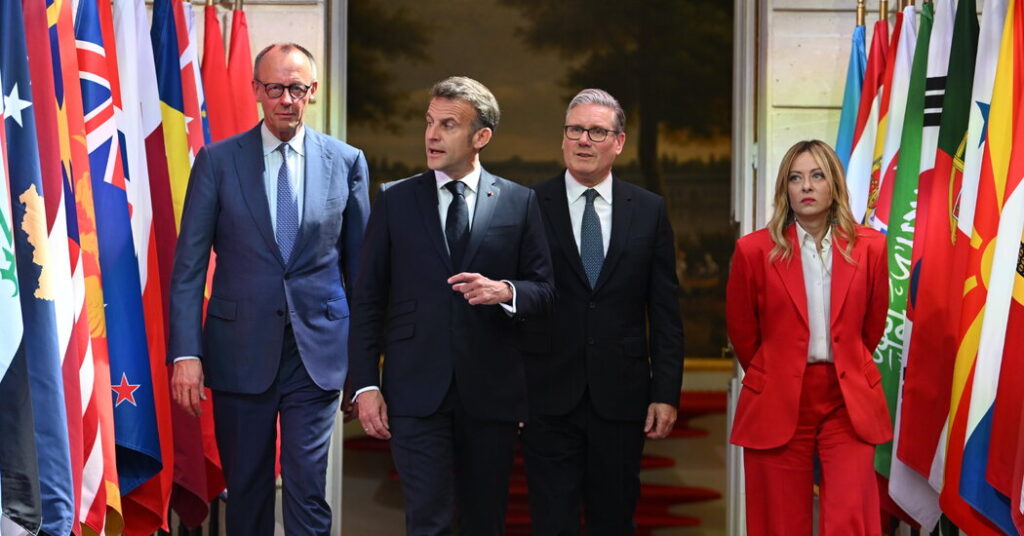
When President Emmanuel Macron of France welcomed the leaders of Britain, Germany and Italy to the Élysée Palace in Paris last Friday, it looked as if Europe had finally found a worthy role to play in the Iran war.
They had gathered for a meeting of nearly 50 countries to discuss how to reestablish freedom of navigation in the Strait of Hormuz, a complex military mission that plays to Europe’s self-image as a guardian of international law in an increasingly lawless time.
Yet after a tense weekend, Europe once again finds itself where it was when the war broke out 52 days ago: watching from the sidelines.
Iran and the United States still call the shots in the strait, a reality underscored even as the European leaders rallied their counterparts in Paris. Midway through the meeting, in Tehran, the Iranian foreign minister announced that his country had reopened the waterway, prompting President Trump to exult on social media that the strait was “READY FOR BUSINESS.”
The two combatants then promptly undercut those statements, with the United States seizing an Iranian-flagged vessel trying to transit the strait while Iran fired warning shots at several ships, including one from France. The strait remains closed, stalling Europe’s postwar plans.
“This has been quite an awful time for Europe,” said Célia Belin, head of the Paris office of the European Council on Foreign Relations. “As long as the Europeans are not willing to play the brutal game, using force to achieve their objectives, they will not matter as much.”
Europe’s lack of influence on the war’s endgame is partly a result of its decision not to get involved at the war’s start. European leaders declined to join the American-Israeli attacks on Iran after being neither consulted nor forewarned.
That decision is politically popular in Europe, but it has imposed burdens on leaders as the conflict inevitably washes up on their doorstep, causing economic pain across the continent. Having spurned Mr. Trump earlier in the conflict, European governments have little leverage over him now.
“Europeans must learn to cope with this new era,” said Arancha González Laya, who served as foreign minister of Spain from 2020 to 2021. “Europe is not following the U.S. in Iran, and the U.S. is not letting Europe play a role in the Iran endeavor.”
France embodies Europe’s predicament. Despite refusing to join the attacks on Iran, it still found itself in the crossfire on Saturday when Iran fired shots at a French ship trying to exit the strait. Mr. Macron blamed “both sides” for the incident, which caused no injuries or damage. He said it was partly prompted by Mr. Trump’s decision to leave an American blockade in place, which caused the Iranians to renege on opening the waterway.
In Europe’s Strait of Hormuz initiative, there is a clear echo of the Coalition of the Willing, the European operation to secure a postwar Ukraine. Both are jointly led by Britain and France; both comprise an unwieldy roster of members; and neither will take effect until the fighting stops, a factor that is out of Europe’s hands.
Thirteen months after being unveiled by Mr. Macron and Prime Minister Keir Starmer of Britain, the Coalition of the Willing exists mainly in blueprints. Some Western diplomats predict the plans will never come to fruition, given the hostility of Russia’s president, Vladimir V. Putin, to the idea of Western troops in Ukraine.
The Hormuz mission is far more likely, experts say, in part because Mr. Trump himself has called on European countries to reopen the strait, by force if necessary. Escorting commercial ships and clearing the waters of mines is laborious and risky, but it is generally considered less dangerous than deploying thousands of European troops to patrol Ukraine within range of Russian drones and artillery.
There is also an economic incentive to act quickly over Iran, given how the strait’s closure has driven up energy costs across Europe. While European leaders agree that the conflict needs to stabilize before they commit military forces, French officials have said that they do not need to wait for a definitive peace settlement, provided they win assurances from Iran that no further ships will be attacked.
Part of the frustration for Europe, analysts say, is that it is not being taken seriously by either side. Iran has said little about the European initiative, focusing on Mr. Trump’s threats. Mr. Trump all but ignored the Paris meeting, instead keeping up his vitriol against NATO, a term he apparently uses interchangeably with Europe, for its lack of support.
“Now that the Hormuz Strait situation is over, I received a call from NATO asking if we would need some help,” he posted on social media. “I TOLD THEM TO STAY AWAY, he said, adding: “They were useless when needed, a Paper Tiger!”
French officials hope that their Strait of Hormuz initiative could help accelerate a broader settlement between Iran and the United States. Mr. Macron said last week it could help the cease-fire “stick in the long term.”
That is in keeping with the French president’s vision of a “third way,” one that seeks to position Europe midway between competing powers. That could mean brokering between China and the United States, when it comes to global trade, or between Iran and the United States, when it comes to the Middle East.
The problem with Mr. Macron’s vision is that it is not fully shared by his fellow Europeans. Chancellor Friedrich Merz of Germany said that he wanted the United States to take part in the operation to reopen the strait. France has pointedly excluded Washington, saying the meeting in Paris last Friday was for “nonbelligerents.”
Britain, too, has shown greater willingness to keep the United States in the loop. Last month, the British sent officials to the United States to help plan military operations to reopen the strait.
That is one of several issues that raise hackles between the partners. British officials mutter that Mr. Macron is grandstanding, while French officials sniff at Britain’s military presence in the region. For now, the British deployment is a small fraction of that of France, which includes an aircraft carrier, six frigates, and 50 fighter jets.
Until last week, the two countries had kept their planning quite separate, according to a Western diplomat, prompting some countries to question whether they had to choose between backing the British or the French approach. The official spoke on the condition of anonymity to discuss sensitive diplomacy.
Nick Childs, an expert in naval security at the International Institute for Strategic Studies, a research organization in London, said, “There has been a challenge in getting alignment on some of these issues.”
Ms. González Laya, now a dean at Sciences Po, a French university, played down the tensions as “different expressions of one reality.”
“At the end of the day,” she said, “we’re all around the table to talk about how to open Hormuz.”
“The skeptics would say, ‘This is all for show,’” Ms. González Laya added. “But people like me, who have been doing this for a long time, would say ‘This is learning how to operate in a world without the U.S.’”
Mark Landler is the Paris bureau chief of The Times, covering France, as well as American foreign policy in Europe and the Middle East. He has been a journalist for more than three decades.
The post Europe Wanted a Say on the Iran War, but It’s Still on the Sidelines appeared first on New York Times.