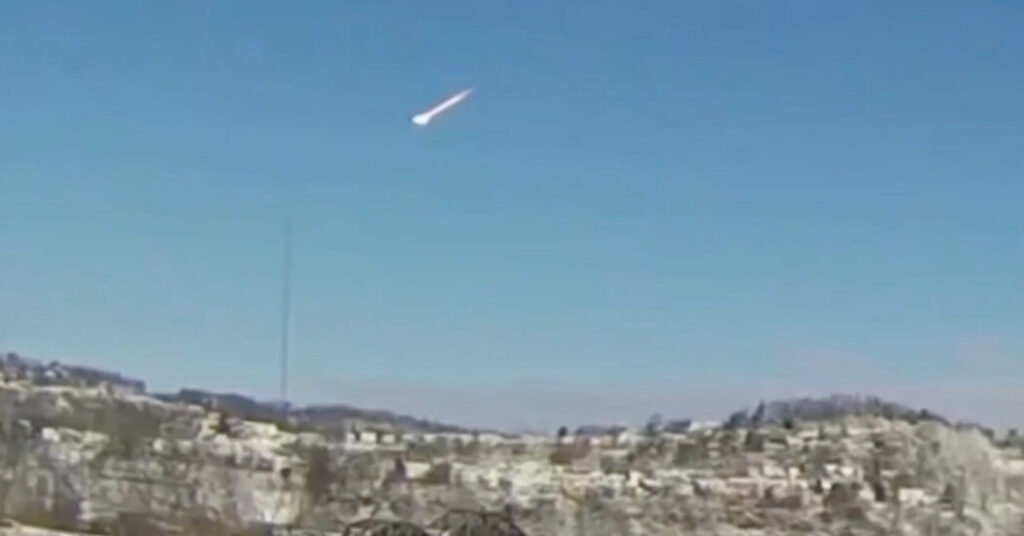
It seems as though stars have been shooting across the heavens far more than usual lately.
In March, fireball after fireball coursed through the skies of North America and Europe. Some of the dazzling apparitions dropped meteorites in their wake. In Ohio, space shards set down in fields and forests. Other rocky visitors smashed through the roofs of people’s homes and ricocheted around their bedrooms.
“It’s a shooting gallery,” said Mike Hankey, an amateur astronomer at the American Meteor Society. “There’s stuff flying all over the place.”
The number of fireballs over the first three months of 2026 was double what is usually reported to the society in the first quarter of other years.
“It does seem unusual, right?” said Bill Cooke, who leads the Meteoroid Environments Office at NASA’s Marshall Space Flight Center in Huntsville, Ala.
Is something peculiar happening in space? Are there more fireballs screaming through the atmosphere than usual? And if so, why?
Space agencies, including NASA, aim to be aware of any sizable asteroids that may strike our planet and cause harm. They use satellites, telescopes, cameras and other government sensors to spot smaller, innocuous asteroids that explode into fireballs. The nonprofit American Meteor Society also runs a reporting system that since 2005 has relied on the public to record observations. If you or your cameras have spied a fireball, they want to hear about it.
In January and February, the society registered a gradual but notable uptick in reported fireballs. In March, that uptick became a spike. In total, during those three months, there were 40 fireballs seen by 50 or more people, twice the January-to-March average of 20 (an average calculated using data from 2021 to 2025).
Of those 40, 33 unleashed thunderclap-like sonic booms — a historic high in the society’s records — suggesting the space rocks responsible were often on the larger side. As an example, the meteor that exploded over Ohio on March 17 did so with the force of 370 tons of TNT.
During a video call, Mr. Hankey showed off a small meteorite from that event, one he had purchased from a local Ohioan when he visited the area. “This is extraterrestrial material in every sense of the word,” he said.
This sort of activity can sometimes be attributed to a major meteor shower. These events, like the Perseids in August or the Geminids in December, are the result of Earth’s flying through the debris trail left in the wake of a comet (or, sometimes, an asteroid).
But none were scheduled during the fireball spike. The first quarter of the year is relatively lacking in known major meteor showers.
In response to growing public interest, a NASA public affairs official said in a blog post at the end of March, “While it may seem like meteor reports and sightings have been more frequent recently, it is not out of the ordinary.” The post explained that from February to April, there is often a 10 to 30 percent increase in the number of extremely luminous meteors — and nobody is quite sure why.
Mr. Hankey said that this 10 to 30 percent increase was already baked into the American Meteor Society tally, and that it doesn’t explain the apparent doubling of fireball sightings in the year’s first quarter.
“I’ve done the best job I can do to make sense out of this,” said Mr. Hankey, who is not formally trained in astronomy or statistics.
If the meteor society’s tally is correct, then what might explain it?
One thing can be quickly dismissed.
“We don’t think it’s aliens,” Mr. Hankey said. And the fireballs are clearly made of naturally occurring stone, judging by all the meteorites people have found.
Could the fireballs be coming from an undiscovered meteor shower?
Peter Brown, a meteor physicist at Western University in Ontario, said there were reasons to doubt this explanation. With one exception — the Taurids, which appear in the fall — meteor showers don’t generally involve the sort of large space rocks that create radiant and long-lived fireballs like those seen this past March.
The meteors in showers also plunge into Earth’s atmosphere with very similar speeds and trajectories.
“If these were part of some sort of coherent stream, from a single source, you would expect them to have very similar directions of arrival from the sky,” said Dr. Brown, referring to March’s fireballs. “That would suggest a common origin. But these don’t.”
Which leads to another potential explanation.
“There’s a lot more attention on the sky,” said Dr. Cooke of NASA.
Over the last decade, there has been major growth in the number of cameras out in the world, from those on smartphones to autonomous shutters on doorbells and dashboards. When several fireballs make headlines, it turns plenty of people into meteor-curious skywatchers.
Perhaps more fireballs are being observed simply because “people’s focus is heightened,” Dr. Brown said. The number of fireballs actually falling from the sky, both seen and unseen, could be normal.
Keen to find out the truth, Althea Moorhead, who works in Dr. Cooke’s NASA office, described a statistical analysis on the fireball data that she had conducted; this analysis has not been published or subjected to peer review. As the meteor society noted, the average number of reported fireballs (seen by at least 50 people) from January through March for the last few years is 20 — half of the 40 seen in January to March 2026.
However, because more people are cognizant of fireballs and are watching out for them, the number of sightings reported to the American Meteor Society has steadily increased since the group’s public reporting system was upgraded in 2010. Instead of looking at yearly averages, Dr. Moorhead wanted to know more about the long-term trend.
She took the reported fireball numbers for the January-to-March periods dating to 2011, made a dot on a chart for each year, and drew a trend line through the dots. It suggested that for certain years, the averages expected based on the trend line were higher than the actual averages based on reported numbers. This was particularly true for the first three months of 2022 and 2025, when the reported number of fireballs was appreciably lower than the expected average.
The number of fireballs seen this year may seem to be far higher than the average. But in reality, it is much closer to the expected average. The number of fireballs being reported “is still high,” Dr. Moorhead said, “but not by an extreme amount,” and far from double the average.
In other words, Earth wasn’t bombarded by fireballs in March. Instead, the planet got an extra pinch of space rock seasoning.
Mr. Hankey was unconvinced by this assessment. “Our report intake has been flat for four years — the awareness growth NASA describes ended around 2020,” he wrote in an email. March, he said, had more reports than any other month in the society’s history.
“What we are seeing is not an awareness trend,” he said. “It is a three-to-four-week surge in large meteoroid activity.”
By April, the possible fireball surge had clearly ended. Astronomers, professional and amateur alike, are still debating March’s meteor madness — but nobody thinks anything particularly odd was happening. “It’s most likely just the natural ebb and flow of debris in the solar system, which is incredibly complex and incredibly random,” Mr. Hankey said.
Sometimes, Earth randomly receives a delivery of extra meteors. In March, thousands of lucky people just happened to get front-row seats to the cosmic fireworks.
The post Where Are All These Meteors Coming From? appeared first on New York Times.