Just three months after Woodstock ’99 — the third iteration of one of the most famous music festivals of all time — devolved into violence and chaos, the Coachella Valley Music and Arts Festival debuted in the California desert. It began as a showcase for some of the day’s biggest rock acts (Beck, Tool and Rage Against the Machine headlined), but dance music was a core part of the proposition (the lineup included Chemical Brothers, Underworld and Roni Size).
After skipping 2000, the event returned in 2001, and in 2003 it found both an identity and a way to make headlines by landing a big reunion: Iggy and the Stooges, playing together for the first time in three decades. The following year, it scored another coup, with Pixies retaking the stage after their contentious ’90s split. In 2005, it was Bauhaus. After a long pause, this strategy returned — along with Mazzy Star, At the Drive-In, Outkast and a handful of others — in the early 2010s.
But in 2006, the seed was sown for Coachella as we now know it: The buzz around the fields was the arrival of a pop star at what had traditionally been a deliberately unglossy event. Madonna did a quickie six-song set anchored by her 2005 LP “Confessions on a Dance Floor,” and in the spirit of that album — a shimmering love letter to the club — she didn’t take the main stage, but performed in a tent where the D.J.s held court. She brought her band, a handful of dancers and a video screen backdrop, but the moment somehow maintained an aura of low-keyness. Madonna had performed on the festival’s terms; pop had come to the desert, but it hadn’t overtaken it.
In the early 2010s, the festival market in the United States exploded. Artists began playing so many of them in a summer circuit that even events known for specific booking strategies (like Bonnaroo, with roots in the jam scene) began flattening out. In 2012, when I worked at Spin, we gave Gary Clark Jr. a so-called Golden Corndog award for playing a critical mass of them in a single season: nine, including Coachella, Bonnaroo, Hangout, Sasquatch, Summerfest, Orion and Lollapalooza. The big talker at Coachella that year — the first of its expansion to two consecutive weekends — was the appearance of Tupac Shakur, who had died in 1996, in the form of a projection, or “hologram,” during Dr. Dre and Snoop Dogg’s headlining set.
By 2016, the biggest U.S. festivals were so generic — and had become a place to be seen, rather than to see music — that our pop critics at The Times wrote a mini manifesto explaining why we were no longer covering them one by one. Yet the next year brought the promise of a major shift at Coachella. Beyoncé was announced as a headliner, then withdrew after revealing she was pregnant, and Lady Gaga took the slot in her place. A full-blown pop spectacle touched down on the festival’s main stage (a version of what would become Gaga’s Joanne World Tour), including elaborate choreography, a set with a catwalk and wardrobe changes.
Gaga’s performance had the polish of arena pop, but still maintained some scrappiness. (Her peak was yet to come, with the Mayhem Ball.) But when Beyoncé did headline the next year, she made one of the defining statements of her career and exploded the idea of what any stripe of performer could achieve on a festival stage. The impact of her towering homage to Southern Black musical traditions was so overwhelming, the festival dissolved its own identity into hers that year, becoming known as Beychella.
“There’s not likely to be a more meaningful, absorbing, forceful and radical performance by an American musician this year, or any year soon, than Beyoncé’s headlining set at the Coachella Valley Music and Arts Festival on Saturday night,” the Times pop critic Jon Caramanica wrote at the time, adding that “it obliterated the ideology of the relaxed festival, the idea that musicians exist to perform in service of a greater vibe.”
Crucially, you didn’t have to inhale desert dust to catch Beychella: The event started livestreaming in 2011, but it became essential when Beyoncé’s blockbuster attracted 458,000 simultaneous viewers on YouTube. It was a watershed in “can-you-believe-this” social media reaction that only built anticipation for the second weekend — it demanded to be seen twice.
The subsequent years brought more pop stars to the Coachella stage, with some trying to make each weekend appointment viewing with tweaks to their sets. But the festival didn’t truly redefine itself until this month, when all the elements that have become endemic to it — the influx of influencers in attendance, the Pop Crave-ification of its social media documentation, the stages designed to delight viewers watching the livestream, the pop-star takeover on the main stage — coalesced. Coachella 2026 was a master class in marketing, an essential stop on the rollout calendar and, for the first time in a while, actually newsworthy.
Its signature: bringing out a surprise guest, an idea that is far from new, but is guaranteed to get a click. Addison Rae brought out Olivia Rodrigo. Sombr brought out Billy Corgan. Teddy Swims brought out Joe Jonas, Vanessa Carlton and … David Lee Roth. Young Thug brought out Camila Cabello. Justin Bieber, who has been slowly re-emerging with thoughtful, unconventional performances that stand in contrast to his own shiny past, brought out Billie Eilish, SZA and Tems, among others. (Forbes put the surprise count at 92.)
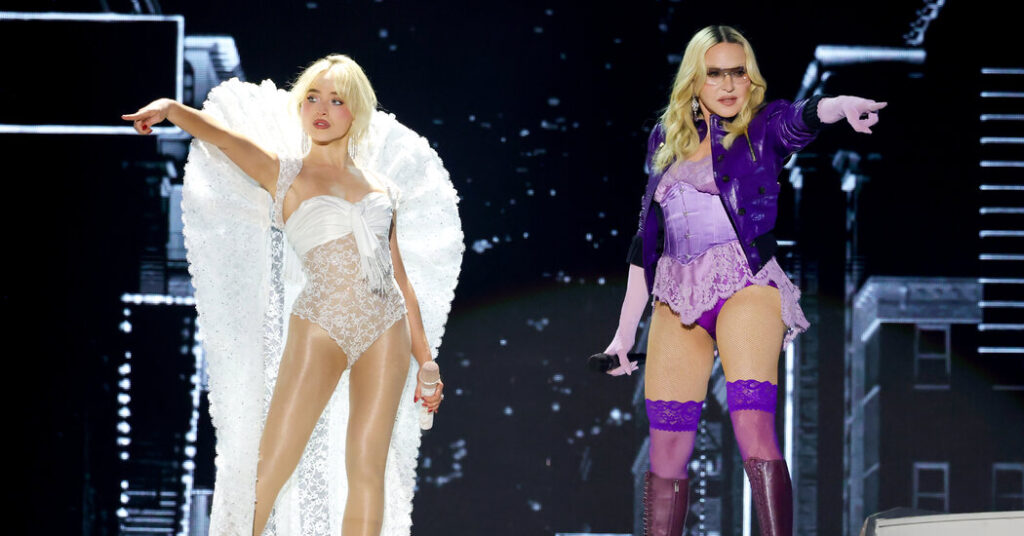
Unsurprisingly, Madonna was a part of this, too. Just days after announcing the follow-up to “Confessions on a Dance Floor,” titled “Confessions II,” she marked the 20th anniversary of her original Coachella performance by appearing during Sabrina Carpenter’s second weekend headlining set for “Vogue,” “Like a Prayer” and a duet fans speculate will appear on the new LP. Pop-star maneuvering is no longer a guest on the Coachella stage; it’s the core attraction.
Caryn Ganz is The Times’s pop music editor.
The post Surprise! Coachella Finds a New Identity appeared first on New York Times.