Painting a floral still life or a landscape is one thing. But harvesting materials in the wild and using them to make your own paint is a next-level devotion to nature for any artist.
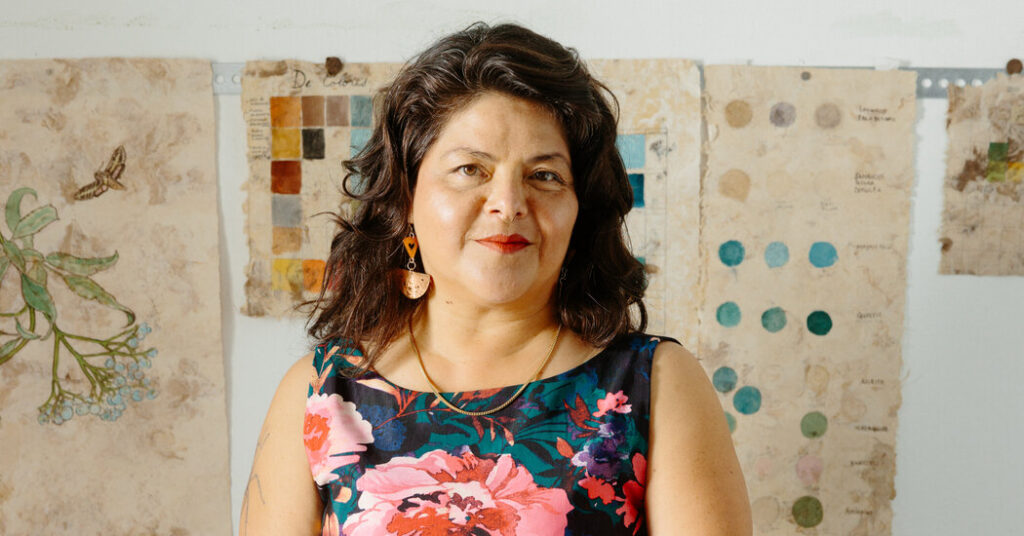
Sandy Rodriguez, a Los Angeles-based artist, is one such devotee: A painter but also, on some level, a scientist, an art historian, a botanist, an outdoorswoman — and maybe even an alchemist.
“I make all my own paint,” said Rodriguez, 50, who can talk for hours about her process, and, more important to her, the history and meaning of all her choices. She does not make the special amate (a traditional Mexican bark paper) for her watercolors — another artisan does that — but she would if she could.
“I cannot get enough of these historic methods and materials,” Rodriguez said. “I get excited.”
A show of her work, “Sandy Rodriguez: Tierra Insurgente,” recently opened at the Hispanic Society Museum & Library in New York (through June 28). The exhibition, organized by Ryan Pinchot of the society, features some 30 of her works — mostly watercolors, a few of which are large maps — paired with objects from the society’s vast collection. “Sandy Rodriguez: Book 13,” an exhibition at the Huntington, the cultural institution and botanic garden in San Marino, Calif., runs through Sunday.
Tales of political and social resistance motivate Rodriguez, who connects them to the colonial conquests of the past, and examines ways museums have recorded and cataloged that history.
From her studio in the Mar Vista neighborhood, Rodriguez talked in a recent video call about her background and her methods. This interview has been edited and condensed.
So you’re a Southern California native?
I’m originally from San Diego, from National City and the Borderlands area. But I’ve been in L.A. all of my adult life. I’m a third generation Chicana painter. I went to art school in the early ’90s at Cal Arts [California Institute of the Arts]. I have that Cal Arts, feminist, Conceptual background. “Painting” was really a bad word then, and there were those of us who insisted upon painting, because that is who we are.
How did your career progress?
I painted on evenings and weekends for the first 20 years. By day, I was running education programs for museums.
And when were you able to prioritize art making?
October 2017. It took about six months of doing a strategic plan to be able to make that exit and switch how I spent my time, still doing lectures and education programs on evenings and weekends.
Your institutional experience seems to lead to these shows where you play off permanent collections.
One of the things that I find really exciting is when my work gets to be in dialogue with these objects from distinct times and places, because I feel like there is almost a charge that happens with the objects in the room.
What’s the origin of the paint making?
I started researching the color preparations and the painting materials that had been traditionally used in the history of image making. Many of them are botanically based and mineral based. And so over the past 10 years, I’ve dedicated myself to learning how to extract color, precipitate a dye, crush minerals, levigate them and clean them.
Where do the materials come from, and where do you do your research?
I’ve gone very in-depth with conducting field study and being off-grid, camping with no Wi-Fi and no creature comforts for three to five days, sometimes 12 days, researching native plants of the Southwest that are endemic to the region and exist nowhere else in the world.
I normally go with one or two people; typically I’ll go with friends who are also plant enthusiasts, herbalists, botanists. This last time, the museum director for the Huntington came with me for the night.
Where did you camp?
We were in the Anza-Borrego Desert, which is part of the Sonoran Desert. Because we’ve had all this crazy rain, things that should not be popping and blooming are gorgeous. The lavender plants, desert lavender, were fully in bloom. The ocotillo is fully in bloom. And it was just what I needed.
What are your most frequently used materials for making paint?
There’s a range. And I’ll say that I’ve moved more toward the mineral-based color, because the plant color is so fugitive. For plants, logwood; and for insects, cochineal.
Tell me about the cochineal.
She’s tiny and she’s beautiful. A small insect also known as nochesley in the Indigenous Nahua language. She eats only paddle-tail cactus. When she eats it, her body digests it and it becomes carmine red.
And it’s a traditional source for red?
It’s what you have in your red velvet cupcakes, in your ketchup, in your lipstick; it’s what British military uniforms were dyed with during the American Revolution. This red changed global art markets from the 16th to the 18th centuries. It became as valuable as gold and silver. It changed all of the palettes of the painters, as well as the textile industry.
What’s the process like?
It is so pH sensitive, this little red. If I use a marble mortar and pestle, it goes almost blackish, dark purple. If I crush it in an aluminum one, it goes a dirty red. When I hit it with some citric acid of a lemon, it goes bright orange.
What’s in the jar you’re holding?
This is creosote bush, which gives that smell of the Mojave after a rain. This is one of the oldest desert plants, and the Spanish called her gobernadora, the governor of the desert. And the oldest creosote in the Mojave King Clone is over 15,000 years old. I use that for an acidy green.
Your colorful diptych “Pronósticos – Borderlands Wildfires No. 5” almost recalls J.M.W. Turner’s fire paintings.
I love Turner. This was a moment for me to really play with gestural abstraction. I was on a ladder, dropping pigment on amate paper, learning to make paintings in a distinctly different way.
Like a number of motifs throughout my bodies of work, fire persists. In the 16th-century Florentine Codex, the book begins before the arrival of the Spanish, and the first omen was a great fire that burned for a year. I thought to myself, what a departure point to use these annual wildfires that we have in California as an omen, foretelling of these past two Trump administrations and what is unfolding now, these great cataclysmic events.
Tell me about “Plantas medicinales para el susto No. 2 (Tlanextia xiuh),” which you describe as a “medicinal watercolor.”
This is a faithful study of an image in the 16th-century “materia medica,” a publication listing all the medicinal plants of the Americas. A Nahua Indigenous physician and his colleague wrote down all of the medicinal plants and their treatments for everything from treating stupidity, to hemorrhoids and goaty-smelling armpits. The one that I found most interesting is for trauma, or “susto.”
If you had experienced a great fright, a big trauma, a Nahua physician would make you a concoction.
And this plant is one element of the recipe?
It’s one of the two elements that I do not have a proper plant ID on. I suspect that it may be an allium or onion-related plant. So I’m fusing European botanical conventions with the more stylized Mexican 16th-century botanical conventions and trying to find the visual language that will communicate a larger history.
What are the helicopters just above it in the image?
Those are my “calavera” copters. I live in Los Angeles. These are immigration, border enforcement helicopters that are used to hunt residents.
Which I assume is the trauma source.
I think all of us who have been living in the United States have witnessed things that have very much affected us. Whether it’s happened to you directly or your neighbor, or you’ve just seen it scrolled across your social media, that is the “susto” I am referencing.
The post An Artist Devoted to the Origins of Paints appeared first on New York Times.