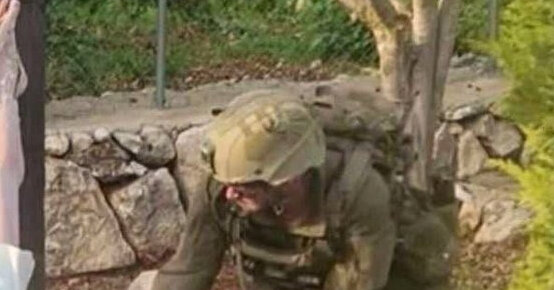
The Israeli military said Monday that it was investigating one of its soldiers after he was photographed in southern Lebanon swinging a sledgehammer at the head of a statue of a crucified Jesus that had fallen off a cross.
The military said it had confirmed that the photograph was authentic and that the statue had indeed been damaged, but said it had not yet determined when the vandalism had occurred. It took place in Debl, a Christian village a few miles north of the Israeli border.
Prime Minister Benjamin Netanyahu condemned the soldier’s actions and said he was “stunned and saddened” by this. He expressed regret for any hurt caused “to believers in Lebanon and around the world.”
He vowed that the military would “take appropriately harsh disciplinary action against the offender.”
The military declared the soldier’s conduct “wholly inconsistent with the values expected of its troops” and said it was working to assist the community in Lebanon to restore the statue to its place.
Late Monday afternoon, the military said it had identified the soldier who wielded the sledgehammer and that an investigation by the army’s Northern Command was ongoing.
Akl Naddaf, the mayor of Debl, said the statue was in the garden of a private home in an area where residents have been barred since they were forced to flee about a month ago by Israel’s offensive.
“We also hope that the Israeli army will open an investigation into the homes they are destroying in Debl and into the breaking of statues of saints inside them,” he said.
Lebanon is home to the largest proportion of Christians of any country in the region. Christians are one of the country’s three dominant demographic groups, along with Sunni and Shiite Muslims.
Christians in Israel said they were shocked by the photograph, which went viral on Sunday night.
“I wanted to believe it wasn’t real,” said Farid Jubran, a spokesman for the Latin Patriarchate of Jerusalem, which oversees Latin Catholics in Israel, the Palestinian territories, Jordan and Cyprus.
“It’s heartbreaking to see such an act of aggression against such an important symbol — the symbol for Christians around the world,” Mr. Jubran added. He called for a firm enough punishment to ensure some measure of deterrence.
Mr. Netanyahu said in a social-media post that “Israel cherishes and upholds the Jewish values of tolerance and mutual respect between Jews and worshipers of all faiths.”
Yet Israeli attacks on Christians and Christian places have become increasingly commonplace since the Hamas-led attack on Israel on Oct. 7, 2023, which set off the two-year war in Gaza and prompted a rightward lurch among many Israelis.
An annual report by the Rossing Center for Education and Dialogue, an interreligious group in Jerusalem, documented “a continued and expanding pattern of intimidation and aggression” of harassment or violence directed at Christians in Israel by Israeli Jews in 2025.
It described 155 incidents, including 61 physical attacks on people and 52 attacks on church properties. The most common expression of hostility was spitting at churches and clergy members, often in broad daylight or even in front of police officers, the report found.
Such hostility stems in part from Jewish concerns about Christian proselytizing and from a belief among some that Christianity is idolatry, the center wrote in a separate report.
The center noted a sharp rise in cases of verbal harassment, which it said reinforced the perception among Christians that they are seen as “unwanted guests” in Israel rather than a legitimate and integral part of the Holy Land’s religious and social fabric.
Hana Bendowsky, who leads a Rossing Center project to teach Israeli Jews about Christianity, said that hostility toward non-Jews was being fueled by the rise of Israeli nationalism, and by a growing sense that “the whole world’s an antisemite, that everyone who’s not us should be rejected and should not be here.”
She cited widespread ignorance and an attitude among some Israelis of “Jewish superiority,” and said that many failed to appreciate that, as the majority in their country, Jews had “a responsibility to the minority.”
Ms. Bendowsky lamented that no one around the soldier stopped him.
“There’s not enough education about how inappropriate and damaging this kind of thing is, not just to our image,” she said. “It’s damaging to our souls, to our identity, to our humanity.”
Dayana Iwaza contributed reporting from Beirut.
David M. Halbfinger is The Times’s Jerusalem bureau chief, leading coverage of Israel, Gaza and the West Bank. He also held that post from 2017 to 2021. He was the politics editor from 2021 to 2025.
The post Israeli Soldier in Lebanon Sledgehammered a Statue of Jesus appeared first on New York Times.