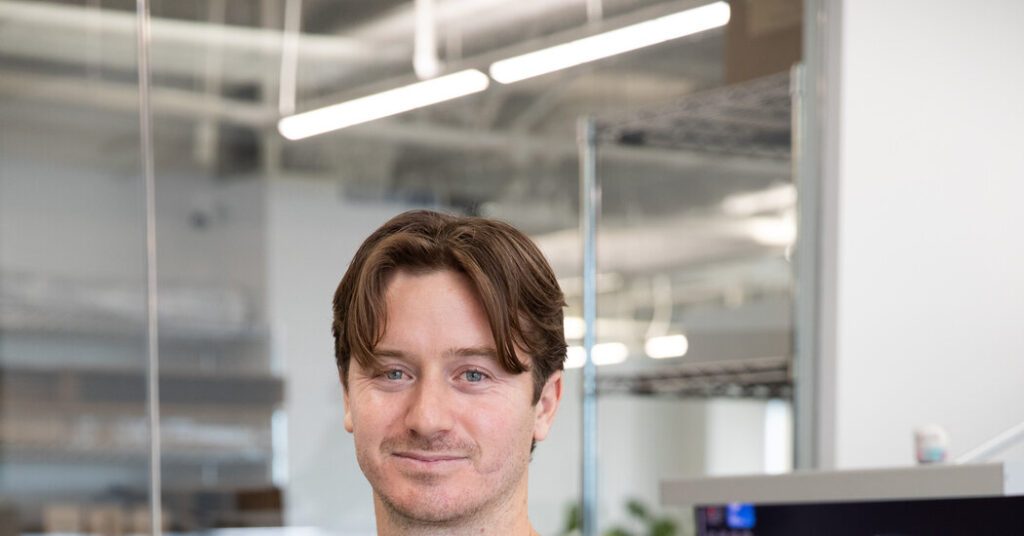
Quaid Walker, chief executive of Bezel, an online marketplace for pre-owned luxury watches, was in a celebratory mood. “We announced a billion dollars in listings today,” he said on a video call last month from Los Angeles.
For the 31-year-old, the milestone was personal. In 2019, while he was working at Google, he began searching for a pre-owned Rolex Submariner model nicknamed Hulk.
After months of research, Mr. Walker eschewed the industry’s two oldest and largest resale platforms, Chrono24 and eBay, and bought the watch from a dealer an acquaintance had used. But he could not stop ruminating on the complicated experience.
“It felt so cumbersome and challenging to buy this thing,” he said. “My thinking was, ‘I don’t get nervous when I spend thousands of dollars on sneakers on the GOAT and StockX apps. Why is this so concerning for watches?’”
Mr. Walker was not the only tech-savvy watch enthusiast intrigued by the seemingly risky business of buying a secondhand timepiece. Since 2021, when Bezel was founded, a flurry of start-ups have set up shop, intent on solving the two biggest challenges in the market: a lack of pricing transparency and concerns about authenticity.
Together, they are developing services and tools, including using artificial intelligence, to transform what has been described as the Wild West of the used watch business into a more structured marketplace.
With annual sales estimated from $25 billion to $30 billion, the secondary market is about half the size of the primary market, but experts said that over the next decade, sales of used watches were likely to eclipse sales of new ones.
“A watch can only be sold new once, but it can be sold used an infinite number of times,” Charles Tian, founder of WatchCharts, a provider of data about pre-owned watches, said by video last month from his office in Austin, Texas.
An opportunity for outsiders
With the exception of a few independent watchmakers and Rolex, which introduced a certified pre-owned (C.P.O.) program through its global network of authorized dealers in late 2022, the pre-owned watch category — unlike the used car business — lacks brand-endorsed options. The Swiss watchmaker Audemars Piguet has hinted that its own C.P.O. program is coming soon, but most brand executives continue to cite challenges.
“We can’t even supply the demand for our new watches,” Wilhelm Schmid, chief executive of A. Lange & Söhne, said on a video call last month. “For every 10 new watchmakers that we train — and that’s a five-year program — one or two end up in after-sales service. If we would now start buying back watches from the market to refurbish them — we just don’t have the capacity.”
But a raft of newcomers is capitalizing on the opportunity with the help of A.I. Kamran Razavi, a tech entrepreneur in Los Angeles, teamed up with the watch wholesaler Jamie Thomas in 2022 to found Reklaim, a pre-owned watch and handbag platform. It supplies retailers — including Amazon and Nordstrom in the United States and Selfridges in London — with pre-owned Rolex watches that have been vetted, according to Mr. Razavi, at Reklaim’s global network of service and distribution centers.
“The core of this company is a very sophisticated machine-learning and A.I. interface that ingests $10 billion worth of pre-owned luxury bags and watches,” Mr. Razavi, Reklaim’s chief executive, said by video recently from Malibu, Calif. It identifies them, then gives each item a stock keeping unit, or SKU (a tracking approach used by retailers to manage stock and monitor sales).
The system gives retailers “authenticity, trust,” he said. “You know exactly what you’re buying.”
Bezel, which sells only in the United States, is also using A.I. to help screen watches before staff members authenticate them at its Los Angeles headquarters. “We build it like a technology business and authenticate everything in house so you can trust that overall process,” Mr. Walker said.
Digital collector tools
Pricing secondhand watches requires an understanding of factors such as rarity and condition and is even trickier for vintage timepieces, where comparable sales data can be difficult to come by. Complicating matters even further, industry terminology is not standardized. Many buyers and sellers have relied on Chrono24 listings to determine a model’s market price, but critics point out that such listings are the asking price, not what was finally paid.
When Mr. Tian founded WatchCharts’s pricing index in January 2019, he “was genuinely shocked that nothing like it existed,” he said. “I would have thought, given how big the market is, that it would have existed 10, 20 years ago.”
Giovanni Prigigallo, a former biomedical engineer who in 2023 co-founded EveryWatch, a platform that aggregates data on what pre-owned luxury watches are worth and where to buy them, came to a similar conclusion.
In March, EveryWatch, under the leadership of chief executive Ben Horesh, introduced a set of digital tools that allows collectors to manage watches “the way serious investors manage any asset class,” according to a company statement.
“We have built a set of features that don’t just track your collection,” Mr. Horesh said by video from London.
He highlighted the platform’s new EveryWatch Passport, a digital record of purchase receipts, service records and other documents that help establish provenance. “When it comes time to sell the watch, being able to sell it with that history is important,” said Mr. Horesh, who joined the company a year ago from the computer games industry.
Tim Bender, a vintage watch dealer from the San Francisco Bay Area, has built something similar for Collected.io, a fintech-style platform that he and Zach Scott, a Bay Area design executive, introduced in November after realizing that dealers and consumers in the secondary market needed more safeguards.
“I started to analyze the friction points of the industry,” Mr. Bender said on a recent call. “You have dealers concerned with being defrauded, and then the consumer on the other side of the screen saying, ‘I hope this is OK,’ right before they hit send on a $50,000 wire transfer.”
He emphasized that while Collected offered watch listings as well as tools that allow collectors to save invoices, sales agreements and ownership history, its chief point of distinction is its underlying infrastructure, which includes features like standardized contracts and a community board with Instagram-like profiles of members.
The real game changer
Oliver R. Müller, founder of the watch consultancy LuxeConsult near Lausanne, Switzerland, said the new digital players were bringing greater trust and liquidity to a once-chaotic category.
“The real game changer is Rolex C.P.O.,” he said of the program.
Rolex, the privately owned Geneva watchmaker, dominates the primary market. In 2025, the brand had an estimated $20.6 billion in retail sales, representing about a 33-percent market share, according to the Morgan Stanley Swiss Watchers report in February.
But the brand’s share of pre-owned sales could be even bigger: “If we say that the total secondary market is $30 billion, Rolex on its own is probably close to half of that,” Mr. Tian said. (Rolex, one of the most secretive watch companies, does not announce its revenue.)
Through the brand’s C.P.O. program, secondhand Rolexes are inspected and refurbished. Those that meet its minimum standards are sold at about 130 authorized dealers around the world at a 20-percent to 30-percent premium over their noncertified counterparts. Despite the higher prices, the program, according to experts, has taken off.
“We estimated $500 million in transaction value for 2025 compared with about $300 million in 2024” for Rolex’s C.P.O. sales, Mr. Tian said. EveryWatch’s estimate was even higher: $590 million in 2025.
The mere existence of such data marks a new era for the watch trade, but many dealers, especially those who cut their teeth in the early 2000s when transactions were mostly done offline, see limits to what technology can do.
“There’s a lot of money and effort being spent on new tech, but a lot will fail because they’re dealing with the same problem that the vintage and pre-owned market has always had,” said James Lamdin, vice president of vintage and pre-owned at Watches of Switzerland USA.
“I’m not an advocate for keeping this marketplace in the Stone Age,” he said by phone recently from New York, “but because there’s no agreed-upon language — what does ‘refinished’ actually mean? — we’ve got a long way to go.”
The post Tackling the Trust Factor in the Secondary Market appeared first on New York Times.