WHEN WE SEE YOU AGAIN, by Rachel Goldberg-Polin
He was a vegetarian who ate no vegetables or fruits, preferring beige food. At 13, he identified the dishwasher, racks removed, as a place where one could hide a small refugee. He picked his pimples and had smelly armpits. When he kissed his parents goodbye he would say “luboo” for “love you,” a holdover from toddlerhood. He was imperfectly helpful around the house, never quite getting the cutting board clean.
He was left-handed, and everything below his dominant elbow got blown off by terrorists. He preferred his hair long, and after he was executed with six bullets fired at close range, it was dusted in gunpowder.
Born Oct. 3, 2000, in Oakland, Calif., Hersh Goldberg-Polin will be eternally 23. He was one of the Beautiful Six, as they were named by their bereaved: Jewish hostages killed 66 feet underground in a Gaza tunnel on Aug. 29, 2024, a.k.a. Day 328, after they were seized by Hamas-led militants from the Nova Music Festival and a nearby kibbutz in southern Israel.
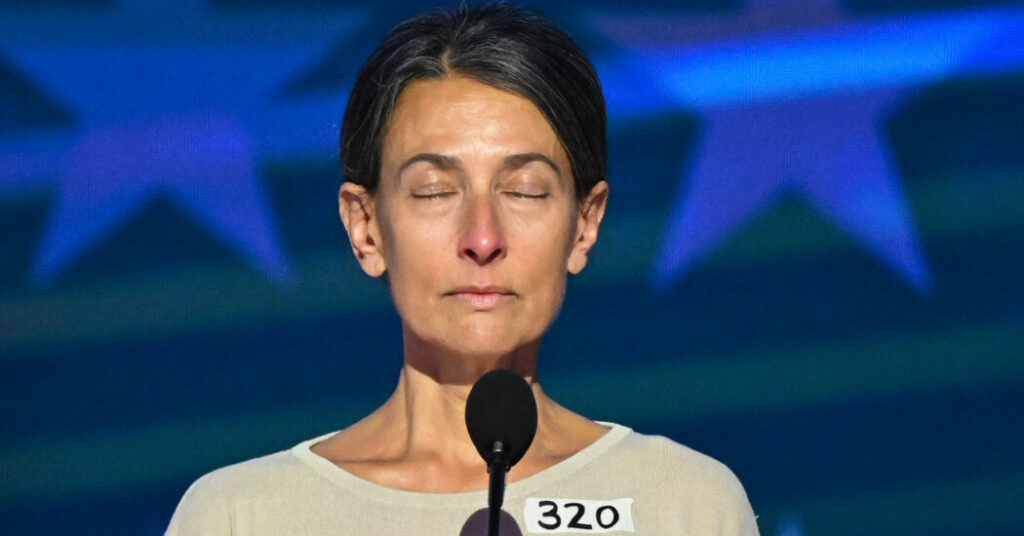
Eight days before, his father and mother, Jon Polin and Rachel Goldberg-Polin, had pleaded for their release at the Democratic National Convention. Like bricks in a fortress around her grief, his mother stacks such numbers in “When We See You Again,” her new memoir that is, in essence, a homage to Hersh.
The grief itself is shapeless, endless, contra Kubler-Ross stageless; and Goldberg-Palin explains, in painful economy, exactly how. “It is not going anywhere,” she writes. “It is infinitely painful and determined. Steadfast, in the worst way. It sits in the fluorescently lit waiting room filled with vinyl couches and outdated magazines. With a dusty plastic plant in the corner that somehow has an errant fake leaf on the floor next to it.”
If you know someone who has buried a child, she makes clear, the past tense is inaccurate. It is still happening to them and will always be happening to them and they will never get over it.
Memoirs of mourning and faith are often described as “raw.” This one is refined, precise and finely carved. “It was the start of my acting career,” Goldberg-Palin notes wryly, of having to deal with people’s reactions when Hersh was first kidnapped. She describes herself as “a knot of flailing muddlement,” “a colossal, coriaceous, brittle, breathing, talking, blinking and swallowing scar” and an “ailing empty balloon of existence,” reinflated by a surviving hostage giving her details of Hersh’s last days.
These included him quoting Victor Frankl’s “Man’s Search for Meaning,” and carrying around “Shadow and Bone,” a fantasy novel by Leigh Bardugo that was the only reading material made available in his captivity.
“When We See You Again” is a book of books, testament to the Jewish tradition of continual learning. Raised an only child in Chicago, where she attended Orthodox schools, Goldberg-Polin did not fall in love with literature until taking a gap year in Israel before Brandeis, when she discovered “The World According to Garp” and “The Godfather.” Shown prisoner videos including Hersh after his death, she sympathizes with Michael Corleone in the last of the film trilogy: “Just when I thought I was out, they pull me back in.”
She compares herself to Jean Valjean of “Les Misérables,” counting the days since his capture, jailed by her torment. She examines the myth of Sisyphus as interpreted by Albert Camus. She cites other authors of parental bereavement: Yiyun Li and David Grossman. She relates deeply to the threadbare Velveteen Rabbit.
Goldberg-Polin recalls being put on a plane alone to visit her grandparents when she was 4 and fantasizing about becoming a stewardess (planes are one of the only places she feels within striking distance of OK now). She became a teacher. Jon, whom she met in high school, worked in brand management and they began their life together, after the Bay Area, in Richmond, Va., before moving to Jerusalem. These recollections are like Kodachrome slides yanked from a broken projector.
Passover, a celebration of freedom, becomes a particular ordeal. Numbly Polin-Goldberg describes meeting with Important Congresspeople, and Powerful, Wealthy, Prominent Men — all ineffectual, and at least one careless. Prime Minister Benjamin Netanyahu’s name is notably absent.
Two younger sisters, Leebie and Orly, survive Hersh. The fractured family is now divided into the Before and a never-ending After, when people try so ineffectually to help what cannot be helped, bearing too much lasagna and too many platitudes. (There are also glimmers of a fairytale-like Ever After when, as the book’s title suggests, they might be reunited.)
Their lives were beautifully ordinary until they were not. Another lesser-known book Goldberg-Palin cites is “All but My Life,” by Gerda Weissmann Klein, about her time as a teenager during the Holocaust. She missed being bored in the living room with her family. “Let’s have a Gerda Weissmann Klein boring night at home tonight,” Jon used to say. Still capable of a dad joke, he addresses an afterword directly to his son, “like a junior screenwriter adding a few sentences to the end of ‘Gone With the Wind.’”
Hersh’s memory is a blessing, and the blessing is messy in the way of most men hardly out of adolescence. “When We See You Again” brings the miracle of the everyday into sharp relief. It is a paean to pain; a difficult gift.
WHEN WE SEE YOU AGAIN | By Rachel Goldberg-Polin | Random House | 288 pp. | $30
Alexandra Jacobs is a Times book critic and occasional features writer. She joined The Times in 2010.
The post A Mother Remembers One of the ‘Beautiful Six,’ Abducted on Oct. 7 appeared first on New York Times.