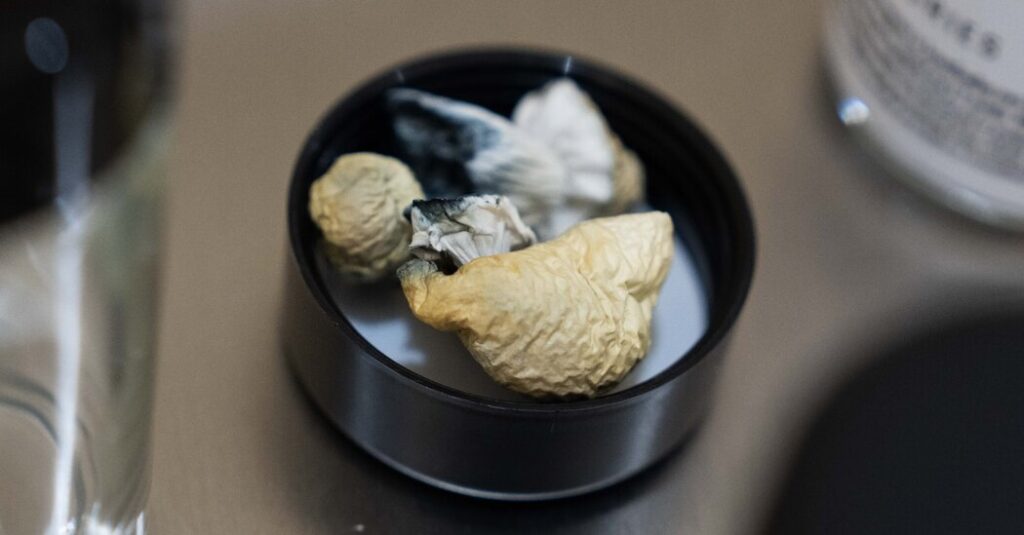
President Trump on Saturday signed an executive order seeking to hasten research into the therapeutic benefits of LSD, Ecstasy, psilocybin and other mind-altering drugs by ordering federal agencies to ease restrictions that have long limited the ability of scientists to study them.
The measure also provides $50 million for state-level research into ibogaine, a powerful psychedelic made from the root of a Central African shrub that has been drawing interest from researchers for its potential to treat opioid use disorder and other forms of substance abuse.
The funding will most immediately benefit Texas, which has already committed $50 million to studying ibogaine but recently failed to secure matching funds from a private drug developer.
“I’m pleased to announce historic reforms to dramatically accelerate access to new medical research and treatments based on psychedelic drugs,” Mr. Trump said from the Oval Office, where he was joined by a number of top cabinet officials and the podcaster Joe Rogan.
The move, long anticipated by researchers and drug reform advocates, aims to recast the government’s largely adversarial relationship with psychedelics, most of which have been illegal since President Richard Nixon launched a war on drugs in the 1970s.
The strict prohibitions have remained in place even as a growing number of studies suggest that psychedelic compounds can be effective in treating a range of mental health challenges, from severe depression and anxiety to post-traumatic stress disorder and the existential distress of a terminal illness.
Most psychedelic compounds are considered Schedule 1 drugs — those with “no currently accepted medical use and a high potential for abuse” — making it difficult for scientists to conduct clinical trials. Researchers have long bridled at that categorization, noting the many studies suggesting that the drugs have significant therapeutic value.
The executive order directs the Food and Drug Administration, the Drug Enforcement Administration, the Department of Justice and other federal agencies to reduce the red tape and restrictions that have long stymied researchers in the field.
It also paves the way for seriously ill patients to receive investigational drugs that have completed early clinical trials but have not yet been approved by the F.D.A.
Melissa Lavasani, founder of the Psychedelic Medical Coalition, an advocacy group, expressed guarded optimism about Mr. Trump’s executive order.
It does not change the need for rigorous evidence, she noted, nor does it provide immediate or widespread access to the millions of Americans desperate for effective mental health treatments.
“The next phase will depend on the strength of the clinical data and how these therapies are integrated into the existing health care system,” she said.
One component of the executive order aims to expand participation in clinical trials by directing federal agencies to collaborate with the Department of Veterans Affairs, which is already funding research into psychedelic-assisted therapies for veterans with PTSD, depression and alcohol use disorder.
The executive order would not immediately result in the rescheduling of any drugs, but it creates a mechanism for easing restrictions on those that have successfully navigated most of the F.D.A.’s yearslong approval process.
That provision could most immediately apply to MDMA, the drug better known as Ecstasy or molly, which the F.D.A. is considering as a treatment for PTSD.
The first psychedelic compound to come before the agency, MDMA is currently undergoing an additional Phase III clinical trial, after the F.D.A.’s rejection nearly two years ago of an application by the drug’s sponsor, Lykos Therapeutics.
That rejection was widely criticized by many researchers in the field.
Administration officials, citing the epidemic of opioid deaths and the soaring number of veteran suicides, said the administration was committed to speeding up the approval process for compounds that demonstrate efficacy in treating such conditions.
In an interview shortly before the announcement, Dr. Marty Makary, the F.D.A. commissioner, highlighted one element of the executive order that would bring psychedelics into an F.D.A. pilot program that boosts promising drugs targeting unmet public health needs.
The goal of the program, he said, was to accelerate the approval process from years to weeks.
“This is a clear statement from the administration that we’re taking the mental health crisis very seriously, particularly given what we’re hearing from veterans,” Dr. Makary said. “We need to have the same urgency in evaluating potentially promising treatments as we do with H.I.V., cancer and other debilitating conditions.”
Researchers who study ibogaine were especially gratified by the administration’s decision to single out that substance, which is largely unknown to most Americans. Ibogaine has a long history of medicinal and ritual use in Gabon, and has drawn increasing interest from addiction experts and veterans groups in the United States.
Although much about the drug remains unknown, several small studies have found that up to two-thirds of the people who were addicted to opioids or crack cocaine were effectively cured of their habits after just a single ibogaine session.
Another study published last year found that ibogaine therapy could reduce accelerated brain aging in veterans with traumatic brain injuries.
The drug, however, is not for the faint of heart. An ibogaine psychedelic journey is intense and can last many hours, and it carries significant cardiac risks. To obtain the drug, most Americans travel to clinics in Mexico, Costa Rica, Portugal and Brazil.
At $5,000 to $15,000 per session, ibogaine therapy is unaffordable to most of those who might benefit.
The drug appears to provide two seemingly distinct benefits. It quells the agony of opioid withdrawal and then gives patients a zeal for sobriety, some studies suggest.
Deborah Mash, who was among the first American researchers to study ibogaine in the early 1990s, said she was gratified the drug was finally gaining wider attention. She had received F.D.A. approval to conduct human trials for her research, but could not obtain federal funding.
“I’ve been a lone soldier for more than 30 years with my scientific beliefs and data,” said Dr. Mash, whose company, DemeRx, recently submitted a new drug application to the F.D.A. for an ibogaine-like compound called Noribogaine.
“All I’ve ever wanted is this to get into patients, to prove that either the drug works or it doesn’t,” she said.
Among those who attended the Oval Office announcement was W. Bryan Hubbard, the chief executive of Americans for Ibogaine, an advocacy group that has been pushing state governments to fund research into the drug.
In addition to Texas, more than a dozen states are considering measures that would spend taxpayer dollars to research its therapeutic potential.
Mr. Hubbard has been instrumental in drawing national attention to ibogaine, and he recently appeared on Mr. Rogan’s show to make the case for federal intervention.
Mr. Hubbard credited Mr. Rogan with persuading the White House to issue the executive order on psychedelics. “Prohibition of psychedelics in America is over,” he said.
Andrew Jacobs is a Times reporter focused on how healthcare policy, politics and corporate interests affect people’s lives.
The post Trump Loosens Restrictions on Psychedelic Drugs appeared first on New York Times.