This month, Vogue did something it had never done before, something most people thought it would probably never do: It put two 76-year-old women on its cover.
Sure, they weren’t just any 76-year-olds. They were Meryl Streep and the Vogue overseer Anna Wintour, and they were there in a meta way to discuss the mythology around “The Devil Wears Prada 2,” in which Ms. Streep plays a version of Ms. Wintour. But still, 76.
“Actually groundbreaking,” went one comment on the magazine’s Instagram post.
The irony is that in breaching the age barrier, Vogue actually made itself seem not old but of the moment. These days, as Ms. Wintour wrote in the magazine, “I feel age is actually an advantage.” Or so it is beginning to seem in fashion.
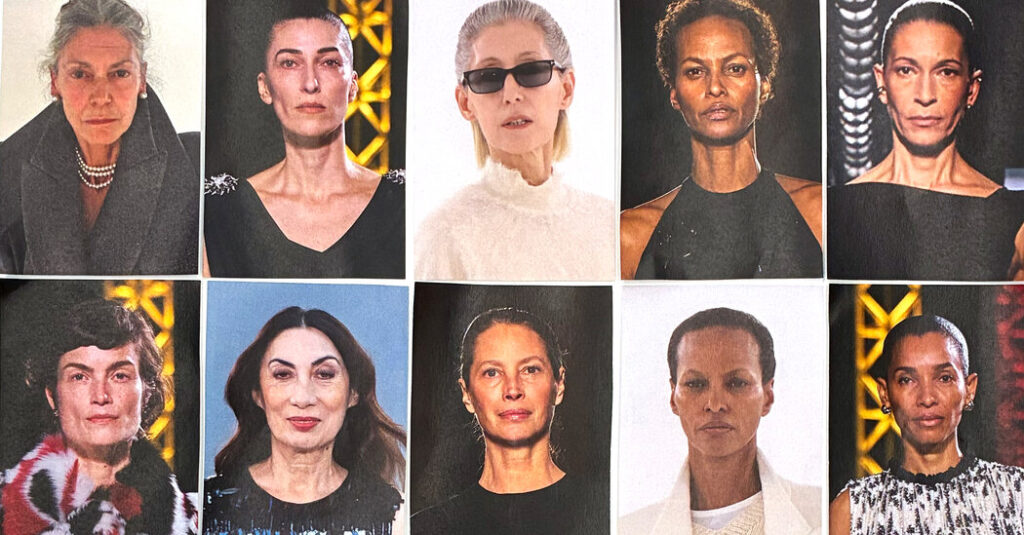
The most recent round of fashion shows, which ended last month, were notable not only for the almost total lack of size diversity on the runway, but also for the fact that they were, at the same time, taking one giant step forward when it came to another aspect of inclusivity: Age.
The Chanel show opened with 50-year-old Stephanie Cavalli, who was one of 15 models over 40 on its runway. Bottega Veneta had nine older models. Tom Ford, nine (women and men). Givenchy, eight. Balenciaga, five. Louis Vuitton, four. And this isn’t counting the famous older models, like 52-year-old Kate Moss, who appeared on the Gucci runway; 57-year-old Gillian Anderson, who closed Miu Miu; and the seven art-world insiders, including 79-year-old Ming Smith and 52-year-old Amy Sherald, who walked at Carolina Herrera.
Put another way, according to data from the fashion search engine Tagwalk, 5 percent of the top 20 brands included at least one curve, or plus-size, model in their runway shows, but 100 percent included an older model.
In fashion-speak, “older” is defined as merely over 30. But, said Alexandra Van Houtte, the founder and chief executive of Tagwalk, “what we’re really seeing is that brands are increasingly embracing models with visible signs of age, such as gray hair or wrinkles” — signifiers that tend to appear closer to the 50-year mark.
And not just on the runway. At Celine, the designer Michael Rider invited 77-year-old Joan Juliet Buck, the French Vogue editor turned Substacker, actor and radio host, to sit front and center for the show, along with the 50-somethings Naomi Watts, Sarah Paulson and Tracee Ellis Ross. At Loewe, Jack McCollough and Lazaro Hernandez’s star guest list included 76-year-old Sissy Spacek, making her first appearance at Paris Fashion Week.
“Age has become something brands seem genuinely proud to highlight,” Ms. Van Houtte said.
Even beyond the runway, a movement has burgeoned in which fashion, or fashion-adjacent, people choose to emphasize, rather than erase, their age. The former supermodel and current Estée Lauder ambassador Paulina Porizkova, 61, has been spearheading the discussion on Instagram, where she reveals her laugh lines and age-related weight gain in makeup-less photos and underwear videos to her 1.4 million followers.
Joining her is Ms. Buck, who posted a close-up bathroom mirror selfie before the most recent Celine show, captioned, in part, “the face I never thought I would have.” The shot, she said, inspired more positive feedback than pretty much anything else she has done. And then there is the recent discussion of menopause and perimenopause that has supercharged a new segment of the beauty market and that is led by women like Ms. Watts, Halle Berry and Gwyneth Paltrow.
It’s a striking shift in an industry that has long been famous for fetishizing youth. And it stands out in a world where viewers are inundated with images in which every sign of age — every wrinkle, hollow, age spot — has been filled in, tightened, filtered, lifted or otherwise erased. Speculating on the work someone has had done, even someone in her early 30s, has become a parlor game everyone can play, and artificial intelligence has made constant modification and reinvention a part of our visual diet.
There’s a backlash brewing to the airbrushed age.
Courting the Silver Dollar
“There’s a practical reality agencies and the industry have to face: that older women have the purchasing power to buy the stuff being presented, and they have a desire to see themselves and their lived experiences in these spaces,” said Romae Gordon, a 52-year-old former model who returned to the catwalk a year ago.
Ms. Gordon began modeling as a teenager in Jamaica in the early 1990s. She found some success, but her career never really took off, and she stopped after only a few years to finish college and then manage a modeling agency. A year ago, after her partner died, a friend convinced her to step in front of the camera again.
In September, she was booked for Dario Vitale’s first (and only) Versace show, and in January, she walked the Chanel couture runway, followed by the Chanel ready-to-wear show. Now, she said, she is having her best season ever. And she isn’t alone.
“We recently scouted a woman who was over 60 in the supermarket in the countryside outside Paris because we’re seeing more of an uprise” in demand for older models, said Talisa Carling, the director of IMG Models. The currently popular term (or euphemism) for such mature models is, she said, “generational.”
Pointedly, when Pierpaolo Piccioli, the creative director of Balenciaga, was trying to cast a broad spectrum of people for his most recent show in Paris, he said it was easier to find older models than plus-size ones. (“Two years ago, it was common to see the girls with different shape of the bodies,” he said. “Now it’s over. This year, I had to fly them in.”)
Even though economists have been talking for decades about the power of what is referred to as the silver dollar or the gray market, fashion has generally given the idea short shrift in its public-facing initiatives — until now.
“The reality is that half of the spending power is in the 50-plus cohort, and half of the growth in spending power is in the 50-plus cohort,” said Gemma D’Auria, the global co-leader of the fashion, luxury and specialty retail practice at the McKinsey consulting firm. At a time when the growth of luxury has slowed or stalled, ignoring a major consumer group is simply not good strategy.
Indeed, according to the Federal Reserve, more than 70 percent of all the wealth in the United States is concentrated in the over-55 age group, which is also responsible for more than 45 percent of consumer spending.
This is reflected in part in what Ashley Mears, a model turned professor of sociology at the University of Amsterdam and the author of “Pricing Beauty: The Making of a Fashion Model,” called “the new visibility of older women in public.” See, for example, Martha Stewart on the cover of Sports Illustrated at 81 or Demi Moore at 61 on the awards circuit for her role in “The Substance.”
Yet, Ms. Mears said, “it’s a paradox because they don’t look their age. For women who are successful in their fields and need to be visible, which usually happens later in life, the message is: You need to do work to look good.” And that’s expensive, connecting youth with class and wealth, and creating further barriers to entry at a time when fashion needs to take them down.
That may be why Matthieu Blazy, the artistic director of Chanel, said he felt it was important that when it came to the models in his Chanel show, “we didn’t change their looks or try to make them younger.” He wanted his message to be more “come as you are.”
Ms. Gordon, who has not had any cosmetic work other than facials, said this approach was common across her shows. “They don’t want to put any makeup on me,” she said. “I’m grateful they think my skin is in good condition, but a little eyelash won’t kill anybody.”
Mr. Piccioli added: “We all want to show powerful women, even in their vulnerability. And pride in showing your age is a symbol of strength and power.” To cover that up or disguise it is to subvert the very idea fashion is now supposedly selling.
Coveting the Old Stone House
Fashion has had moments of embracing age. In 2024, Batsheva Hay put on a show featuring only women over 40, and Olivier Rousteing sprinkled his Balmain runways with mature models. White-haired models like Carmen Dell’Orefice and Maye Musk have had long careers. This time around, the consensus is that the phenomenon may signal systemic change.
“I don’t actually think it’s a trend,” Ms. Carling of IMG said. “I think it’s structural.”
In part, this may be because embracing at least some of the realities of age is a relatively easy way for fashion to demonstrate its awareness of the wider world. “Age inclusivity is a relatively safe space for fashion because it doesn’t challenge the core aesthetic, which is around a relatively thin model,” said Emily Huggard, an associate professor at Parsons School of Design and co-director of its Size Inclusion in Fashion Lab. “Size inclusivity demands a more structural change around production.”
But this is about more than just money.
Ms. Buck started acting again when she was in her 50s, after a career as a writer and editor of French Vogue. She was cast as a French culinary school administrator in the 2009 film “Julie & Julia,” after which, she said, “one of the producers came over and said: ‘It’s so great you haven’t done anything to your face. You’re going to get so much work because that’s so rare.’”
More common, at least in public, is the message coming from influencers and celebrities, where being transparent about your cosmetic work has become a trend in itself. Consider 70-year-old Kris Jenner, who told Vogue that her new face lift — the one that made her look almost the same age as her daughters — was her version of “aging gracefully.”
“There’s always two poles in any movement,” Ms. Buck said. “There’s this pull toward being post-human, shinier, newer, cloned, etc., the sense that people have elevated the lacquered surface of the machine over the body.”
On the other hand, she said, there’s a corresponding pull toward “I’m real.”
“I think we’re like old stone houses,” she continued. “We have the value of antiquity. If you haven’t tweaked yourself, it’s like you have a working fireplace that’s been going since 1680. We’re authentic.”
Authenticity is, of course, one of the current buzzwords not just in fashion, but in culture generally. It’s a reflection of the fear that individual style has been lost to the algorithm.
“Everything is so overdone and velvety and well arranged because of Instagram culture, where everyone lives in the same apartment with the same chair, that being yourself became the ultimate luxury,” Mr. Blazy said. He felt a “hunger,” he said, for difference.
It’s not just influencers and celebrities who have become the vehicles for this version of ageless sameness. It’s political figures, too, and there the trend is even more fraught. As many MAGA women have embraced the plumped and smoothed “Mar-a-Lago face,” it has become an expression of a larger social swing toward exaggerated norms and old-fashioned patriarchal gender roles rather than simply a cosmetic fad.
Ms. Buck put it this way: “For all women, there’s that line between choosing to be malleable and pleasing and to conform with the collective norms or refusing it.” More and more, she said, they are saying, “No, I’m not playing that game.”
Vanessa Friedman has been the fashion director and chief fashion critic for The Times since 2014.
The post Why Fashion Suddenly Loves Older Women appeared first on New York Times.