Mayor Zohran Mamdani stood in front of a camera along one of New York City’s most exclusive strips of real estate with a message for his constituents: “Today we’re taxing the rich.”
Before he outlined a new plan to tax multimillion-dollar pied-à-terre properties that dot the city’s luxury towers, he moved uncomfortably close to the camera, looked into the lens and pecked at it with his finger.
But the mayor was tapping into something much bigger. On the city’s streets, an anti-rich current has been building, highlighted by the election of the mayor himself who ran on an affordability platform. And this week, a mix of events appeared to indicate new levels of intolerance for New York’s über-wealthy.
On the same day that Gov. Kathy Hochul proposed a new pied-à-terre tax backed by the mayor on second homes with assessed values of $5 million or more, doormen, superintendents and others who typically earn a salary of $62,000 a year and enable the trappings of a luxury life threatened to go on strike. Then on Thursday, Mr. Mamdani confirmed to Hell Gate that he and his wife planned to snub the Met Gala, a springtime rite of celebrities and the wealthy, criticized for its annual display of elitism. (This year, the billionaire Jeff Bezos is sponsoring the event.)
Inequality is part of the rhythm of the city, on full display in places like Billionaires’ Row, where on a recent afternoon whiffs of the perfumed lobbies of the luxury towers wafted toward a man in ragged clothes sprawled across the concrete.
“In New York we all live together. You have much more class overlap than in other places,” said Marissa Thompson, an assistant professor of sociology and the co-director of the Center for the Study of Wealth and Inequality at Columbia University. “All of that has come to a crescendo. People are feeling the squeeze of inequality.”
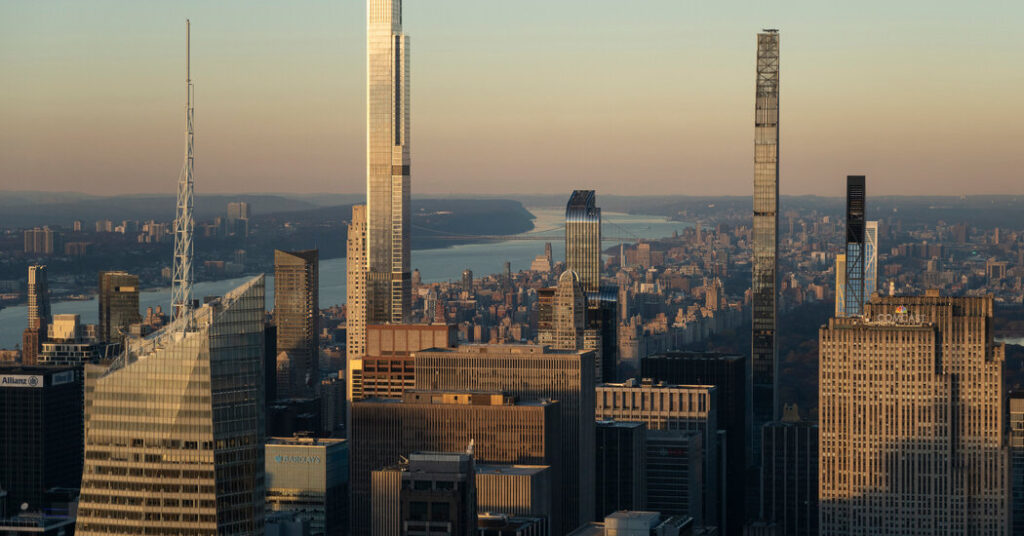
The image of the city’s ultra wealthy class looms in the sky, hovering over the rest of New York in supertall luxury apartment towers.
Down on the streets, residents have marched outfitted in “eat-the-rich” T-shirts alongside groups like Trillionaires for Trump, mocking the superrich in “No Kings” protests. “It dovetails with a frustration that the levers of government are at the hands of the extremely wealthy and the rest of us are left to eat the crumbs,” said the Manhattan borough president, Brad Hoylman-Sigal, who as a state senator 12 years ago proposed a pied-à-terre tax that fell flat.
Back then, Mr. Hoylman-Sigal noted, the concept of Billionaires’ Row, the name for a stretch of luxury high rises near to and along 57th Street, barely existed.
But many New Yorkers worried the new moves against the rich could upend livelihoods. Agents working in real estate, a major driver of the city’s economy, were eager to hear more details about plans for a second-home tax.
“The natural reaction is to have a kind of freak out moment,” said Jade Chan, a high-end real estate broker for Douglas Elliman. “We’re trying to stay calm and pray for the best that it doesn’t happen.”
The city has seen a steep increase in extremely high-priced apartments, while many low-cost units have disappeared. Over a 30-year period ending in 2023, New York lost more than 600,000 units with rents of $1,500 or less and a net increase of about 75,000 units with rents of $5,000 or more, according to city data. (The figures were adjusted for inflation.)
Thousands of those apartments have absentee owners. They are on display in the city’s night skyline of darkened supertall towers with multimillion dollar apartments belonging to residents who are there only a few days or weeks a year.
In the mayor’s social media video, which had more than 45 million views on X as of Friday evening, Mr. Mamdani looked up at the apartment building on Central Park South where the hedge fund billionaire Ken Griffin owns a penthouse he bought for $238 million. Under the pied-à-terre plan, it most likely would be subject to more taxes.
Mr. Griffin did not return a call for comment, but another billionaire financier, Bill Ackman, defended him on social media saying Mr. Griffin should be applauded for spending money in the city.
“The Ken Griffins of the world make NYC high end development viable, driving high-paying construction, brokerage, legal, marketing and other jobs in NYC,” he wrote in a post on X.
Mr. Ackman complained the mayor’s policies will hurt the very constituencies he’s trying to help.
Earlier this week a team of workers in Carhartt jeans was furiously polishing the braided, brushed-metal handles of the door to Mr. Griffin’s building as an impeccably coifed woman passed by, pushing a small dog in a pale pink quilted stroller.
A few blocks away on 57th Street, Brendan Feehan, a building superintendent, was posted at a podium, greeting anyone who entered. He shrugged as he watched people walking by with shiny Gucci shopping bags slung over their shoulders and fancy watches dangling from their wrists. He believes everyone eventually benefits from the wealthy.
“They pay taxes — a lot more than I do,” he said. “The reason I’m working is that someone has a billion dollars.”
Mihir Zaveri contributed reporting.
Dionne Searcey is a Times reporter who writes about wealth and power in New York and beyond.
The post New York’s Anti-Rich Current Reaches Apex With Second-Home Tax Plan appeared first on New York Times.