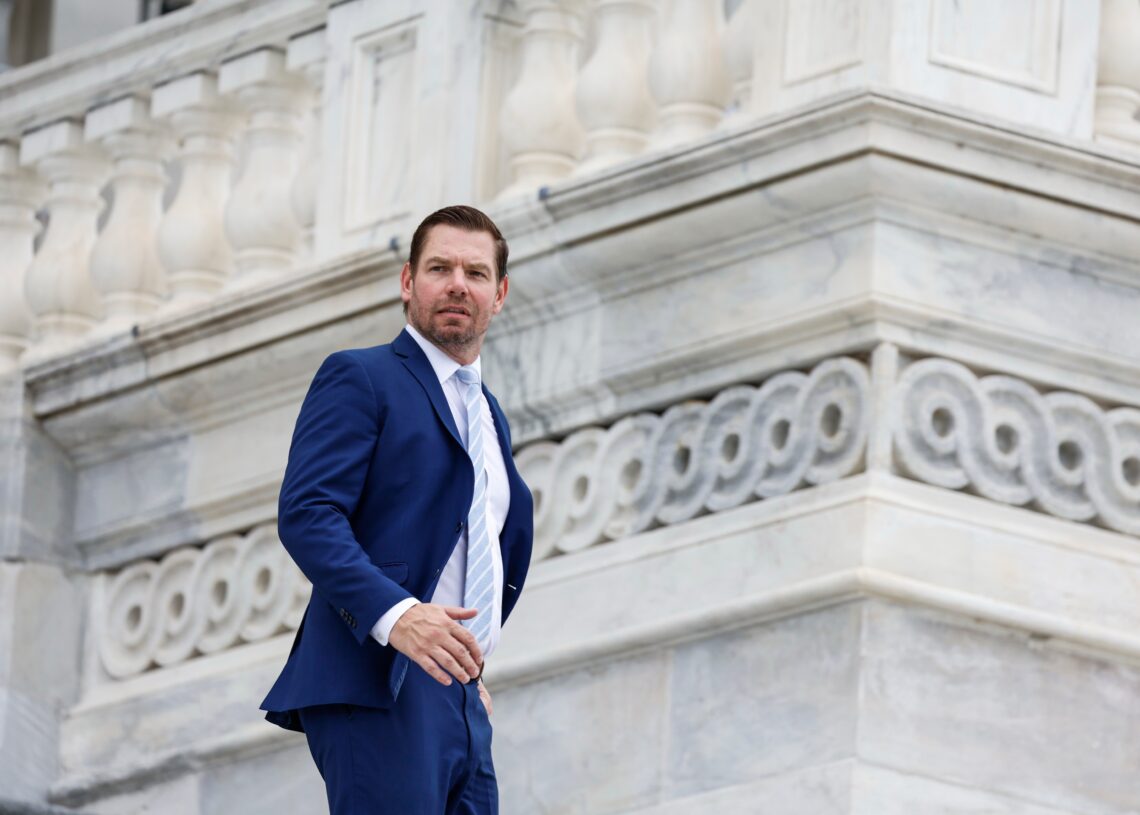
When Rep. Teresa Leger Fernandez (D-New Mexico) realized she could now refer to Eric Swalwell as a former congressman, she let out a squeal of joy.
“I’m going to start saying that: ‘Former!’” she exclaimed.
Swalwell, a California Democrat, and Tony Gonzales, a Texas Republican, each facing allegations of sexual misconduct, turned in their letters of resignation from Congress on Tuesday — shortly before their colleagues could have voted to expel them.
But to some lawmakers, the episode also highlighted how Congress fell short during the #MeToo movement when trying to revise how it handles sexual assault and harassment cases. Now they see a chance to build on those changes — and this time, get it right.
But conversations are in the early stages. House leaders have not endorsed new rules, and not everyone is on the same page about expediting misconduct investigations.
Unwilling to wait for prolonged internal probes, Leger Fernandez, who chairs the Democratic Women’s Caucus, and Rep. Anna Paulina Luna (R-Florida) led the bipartisan push to oust Swalwell and Gonzales.
“This has now sent a signal to everybody in Congress, male or female, Republican or Democrat, who thinks it’s all right to sexually harass, sexually abuse your staffers,” Leger Fernandez said in an interview. “It’s not all right, and there are enough of your colleagues who are going to vote you out. You better stop, and you better not run for reelection.”
She has her eyes on bigger change: Speeding up how the House Ethics Committee tasked with policing lawmakers investigates harassment.
“To deprive women staffers of their ability to serve is not right, and that’s what I want to address,” Leger Fernandez said.
Rep. Alexandria Ocasio-Cortez (D-New York) called this week’s resignations “an important turning point,” showing that abuse of power by those in office should not be accepted.
She described this moment as a reset for the institution, but cautioned that real change isn’t a given.
“I don’t want this to just be a situation where we have two resignations, and then we forget about it until it happens again,” she told reporters, adding that victims “deserve institutional change.”
Congress faced similar calls early in the #MeToo movement largely ignited by allegations against Hollywood producer Harvey Weinstein. As the world underwent a widespread reckoning over the sexual abuse and harassment women face, people on Capitol Hill came forward with their own stories about a culture that left staffers, particularly young women, vulnerable. Nine lawmakers lost their jobs in six months over allegations of sexual impropriety or related workplace misconduct.
Against this backdrop, Congress adopted reforms that included streamlining the complaint process and forcing members to personally pay for harassment and retaliation settlements.
The institution’s handling of sexual misconduct came under scrutiny again in recent weeks. In early March, Gonzales admitted to an affairwith a staffer who later set herself on fire and died. Sexual relationships between lawmakers and staff violate #MeToo-era House rules, but Gonzales faced no immediate discipline. The San Francisco Chronicle published a report April 10 that a former staffer to Swalwell alleged that he sexually assaulted her, which he has strongly denied.
As Swalwell’s career began to collapse, Leger Fernandez and Luna, a staunch MAGA Republican, formed an alliance in Congress to draft expulsion resolutions against both men.
When lawmakers returned to Washington on Monday, the House Ethics Committee, which was already investigating Gonzales, announced a probe into the assault allegations against Swalwell. That evening, both Swalwell and Gonzales quit the House under the threat of expulsion.
Gonzales’ case underscored the need for the Ethics Committee to work faster because the evidence against him was “overwhelming” and had been public for months, Leger Fernandez argued.
Leger Fernandez said Gonzales’ own admission to the affair should have been enough to remove him from office under House rules. But House GOP leaders — who have a razor-thin majority in the chamber — did not move to oust Gonzales, citing the ongoing Ethics Committee investigation, despite calls to do so from some Republicans.
Lawmakers on both sides of the aisle agree the House needs to change how it handles accusations of sexual misconduct against lawmakers.
Rep. Lauren Boebert (R-Colorado) is working on legislation to strip Swalwell and Gonzales of their pensions. Rep. Jamie Raskin (D-Maryland) said he worries that victims of misconduct from lawmakers do not “feel sufficiently empowered or protected to come forward in the process.” Rep. Michael Lawler (R-New York) said a “fear factor” keeps congressional staff from reporting misconduct.
Rep. Pramila Jayapal (D-Washington) believes Congress needs an independent body with subpoena power and the ability to work faster than the Ethics Committee.
“If we have clear evidence, they’re out,” Jayapal said. “I don’t even know that it needs to go to a vote of the House.”
But House leaders in both parties suggested that it’s premature to advance potential reforms.
House Majority Leader Steve Scalise (R-Louisiana) cautioned against speeding up ethics investigations. “It’s one of the few places in Congress where it has to be bipartisan for something to move forward, so they’re very deliberate,” Scalise said.
Rep. Pete Aguilar (California), chairman of the House Democratic Caucus, told reporters on Wednesday that Democratic leaders had not yet discussed how to reform the misconduct reporting process but said he’s open “to whatever that might look like.”
Lawmakers still have to contend with the case of Rep. Cory Mills (R-Florida), who faces accusations of sexual misconduct and violence against an ex-girlfriend. Mills, who has said he will fight those and other allegations, is under investigation by the Ethics Committee.
Nearly a decade after the start of the #MeToo movement, a new national conversation on sexual assault is underway because of intense public interest into the crimes of convicted sex offender Jeffrey Epstein. Victims of Epstein have visited Capitol Hill repeatedly over the last year and were seated in the House chamber in November when the House passed legislation to release most documents related to the case.
Several lawmakers brought up Epstein when discussing the resignations of Swalwell and Gonzales. The Epstein scandal helped create a more supportive community for survivors of sexual assault on Capitol Hill, Jayapal said, which she believes will be helpful in her effort to reform the way cases are processed.
While further changes are necessary, Jayapal said, she believes part of the problem is cultural — including members partying with staff and drinking in congressional offices.
“I just think that there is a presumption that if you’re going to be successful here, that you have to do those things,” Jayapal said. “The enforcement is going to help make it clear that that’s not going to be tolerated anymore.”
The post As sexual misconduct allegations rock Congress, some push for new rules appeared first on Washington Post.