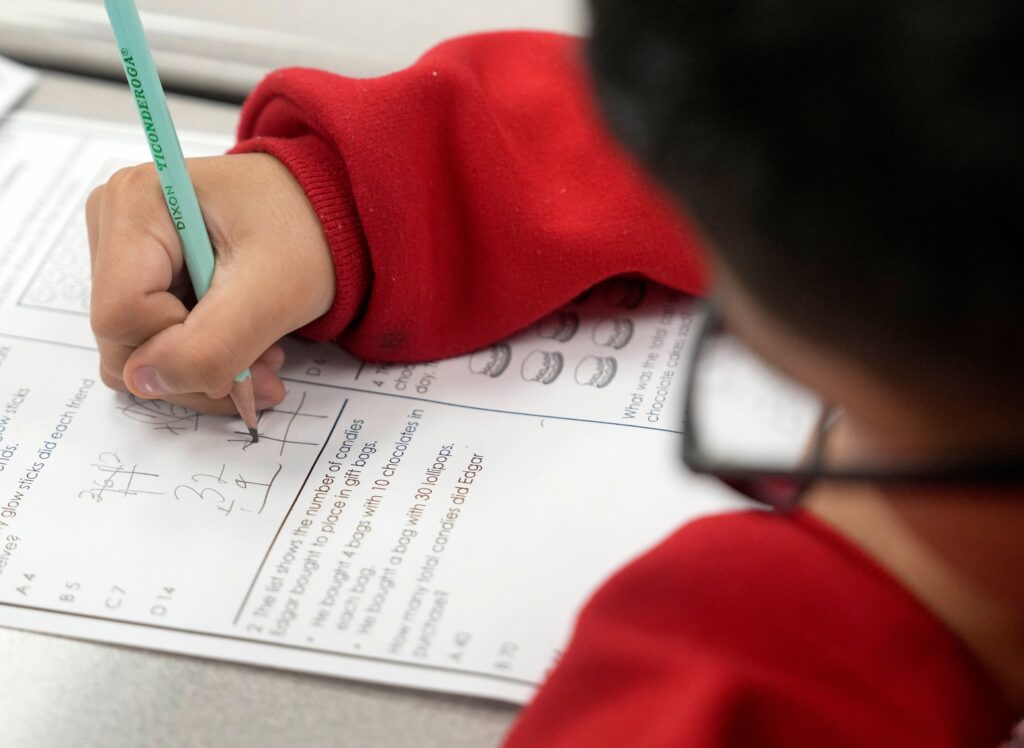
Average math scores for 9- and 13-year-olds in the U.S. remain lower than they were 10 years ago, according to 2025 federal testing data released Wednesday — a warning sign not only for schools, but also for the economy, according to some researchers.
While academic performance slumped during the pandemic, math scores have been stagnant since 2012, complicating narratives about why so many children are performing below grade level in core subjects.
“We can clearly see that this isn’t just a pandemic story,” said Matthew Soldner, acting director of the Institute of Education Sciences and acting commissioner of the National Center for Education Statistics, which administered the tests.
The findings come from the National Assessment of Educational Progress’s long-term trend test, which has measured 9- and 13-year-olds’ math and reading performance since the 1970s. Children are graded on a scale from 0 to 500, though most score somewhere between 150 and 300.
The latest results paint a complex picture of American education.
The scores for 9-year-olds showed slight improvement in math, while reading levels rebounded to pre-pandemic levels. The average reading score nudged up from 215 to 218, reflecting an uptick consistent across several groups, including boys, low-income children and students with disabilities.
Meanwhile, math and reading achievement among 13-year-olds has barely budged since the last time the test was given, in 2023, signaling a brewing crisis.
“The lack of progress among 13-year-olds raises huge questions and ought to serve as a catalyst for change,” said Lesley Muldoon, executive director of the National Assessment Governing Board. “As a nation, we have to bring more focus to the middle school years.”
She added that among the lowest-performing 13-year-olds, math scores are “statistically equivalent” to the lowest-scoring students in the early 1970s. “And that is really jarring,” Muldoon said.
Many of the 13-year-olds who took the assessment last year are now in high school or preparing to enter high school. Some economists estimate they will earn less than their predecessors because they have fewer skills.
“People with more skills earn more,” said Eric Hanushek, senior fellow at Stanford University’s Hoover Institution.
Today’s graduates stand to earn on average 8 percent less throughout their lifetimes than the Class of 2013, Hanushek said. He estimated the combined effect of those losses will cost the U.S. $90 trillion through the year 2100.
“People don’t get very concerned about this, in part because it’s sort of like blood pressure. It’s the silent killer you don’t notice until you notice it,” Hanushek said of the way math achievement will affect the economy. “What it comes out to is a huge number that we have to pay attention to because it affects our position in the world, frankly.”
Other scholars have reached similar conclusions. Researchers from Harvard University and Dartmouth College predicted that 48 million children enrolled in public schools during the 2020-21 school year could lose $900 billion in lifetime earnings because of pandemic learning losses.
In the short term, some students may have a difficult time succeeding in certain careers, said Courtney Brown, vice president of impact and planning for Lumina Foundation, a higher-education nonprofit.
“If students are struggling with basic, foundational math, it’s really going to narrow the range of credentials they can pursue,” Brown said. A recent survey by Lumina and Gallup found more than half of employers are having a hard time finding candidates with the right skills.
Math is essential for jobs in health care, business, information technology, advanced manufacturing and more, Brown added.
The current scores are a continuation of a trendline in math that dates back to the mid-2010s. After a period of progress between 2000 and 2012, math scores started to slump.
The 2000s were defined by high-stakes standardized testing, rigid teacher evaluations and other federal accountability standards that researchers say had positive effects on math achievement.
“By no means were these policies perfect or even sufficient,” said Brian Jacob, a University of Michigan professor of education policy and of economics. But, he added, “focused attention gave clear targets and provided some incentives.” His research suggests schools saw increased funding during this period.
Since then, states have been given more flexibility in setting their own accountability metrics. Schools have become increasingly focused on issues including mental health, attendance and digital devices.
“It may be schools just need to focus on some of these other issues before they’re going to have the bandwidth to get back to kind of measuring student learning,” Jacob said.
Meanwhile, some experts see the growth that happened more than a decade ago as proof that students can improve.
“I take from it that we have seen high performance is indeed possible, and is something that we can achieve again in the future,” Soldner said.
Todd Wallack contributed to this report.
The post Why low U.S. math scores are concerning researchers and economists appeared first on Washington Post.