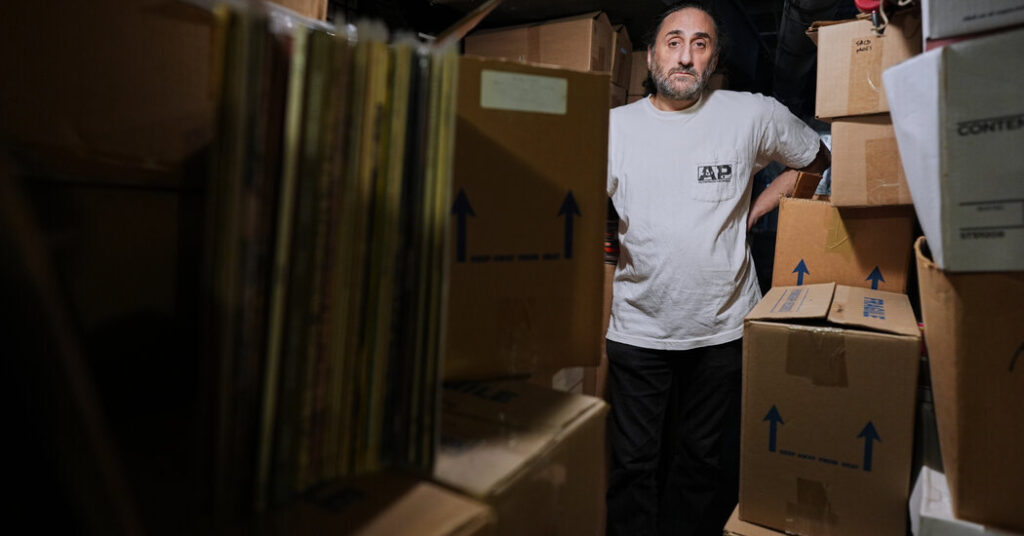
For the last two years, friends of Aadam Jacobs have diligently been at work uploading his more than 10,000 concert recordings to the Internet Archive, a digital repository.
Jacobs, 59, is a Chicago institution. Beginning in the mid-1980s, he was a regular at concerts in the city, hanging out near the soundboard and taping shows. In that time, he recorded all kinds of acts, ranging from forgotten bands who were together for only a couple of months to Nirvana, before they were famous. In 1994, The Chicago Tribune wrote that Jacobs was: “A) A tireless audio documentarian. B) An eccentric but harmless mascot to the local indie rock scene. C) A freeloading pest.” (The article strongly hinted that he was, in fact, “D) All of the above.”)
After the release of a 2023 documentary on Jacobs, volunteers from the Internet Archive reached out to ask him if he would consider digitizing and uploading his collection of tapes.
The archive, known as the Aadam Jacobs Collection, now has thousands of Jacobs’s concert recordings, and a team of about 10 volunteers is working to upload more every day. The process will take years. But the early results present an extraordinary snapshot of how the Chicago music scene evolved over four decades.
There are concerts from indie acts in their prime, like Ben Folds Five in 1999, a Phish show from 1990, a Reggie Watts show from 2013, a 1986 show by the Replacements and a 1985 Depeche Mode performance, all available for listening, for free, one click away.
The existence of the archive was reported by The Associated Press.
In an interview, Jacobs acknowledged that he had “mixed feelings” about the project.
“It took a lot of, I guess, soul-searching, for lack of a better term — inner strength — to allow this to happen, because this is my life’s work,” he said. “This is why people might talk about me after I’m gone, right?”
Brian Emerick of Des Plaines, Ill., one of the volunteers, said that he saw the archive as a “preservation of history.”
“A lot of these bands, some of them don’t even have an album they ever put out,” he said. “This is the only recording known of them.”
In the interview, Jacobs discussed some of the notable recordings in the archive.
July 8, 1989
Nirvana at Club Dreamerz
Two years before the release of “Nevermind,” a 22-year-old Kurt Cobain and a little-known Seattle band named Nirvana took the cramped stage at Club Dreamerz in Wicker Park. The band played several tracks off their 1989 record, “Bleach,” including “School,” “Love Buzz” and “Blew.”
Jacobs said he recorded the band twice that year, but only one of the concerts has been uploaded so far. He recalled that Nirvana was the opener for both shows — once for the Chicago punk band Precious Wax Drippings and the other for the alternative rock band Eleventh Dream Day.
“I saw a lot of bands then and they were really no different than any of the other ones that were coming through from parts far away,” Jacobs said.
“They didn’t present to me as something that was going to be any bigger than filling a 1000-seat venue, any bigger than the entirety of the career of Mudhoney,” he added, referring to another Seattle grunge band.
In fact, Jacobs said, he thought Nirvana would not be as successful as Mudhoney.
“Mudhoney’s first EP is the gold standard for grunge,” Jacobs said. “And so everybody who was coming after that was just in the wake of that incredible record. And Nirvana was one of those bands. I’m like: ‘OK, this is good. Yeah, that’s not as good as Mudhoney.’ And then things changed.”
May 7, 1988
Tracy Chapman at Cabaret Metro
Chapman’s self-titled debut album had been out only about a month when she took the stage at Cabaret Metro, as the venue was known then. The album features the modern classics “Fast Car” and “Talkin’ Bout a Revolution,” both of which she performed, with Jacobs in attendance.
This is a notable recording. It catches Chapman at the beginning of her meteoric rise, and there are very few official recordings of her performing live. She played some songs that night in Chicago that were never released at all, including “Take It Like It Is” and “I’d Do Anything.” (The archive notes that those are the best guesses for the titles of those songs.)
“I liked the first record, and that’s why I went to see her, and I never saw her again,” Jacobs said. “Not that I didn’t like her music, but I think that Metro was the last small place she played in Chicago. I just have very little interest in going to larger places.”
Sept. 15, 2004
The Ex at the Empty Bottle
Asked to pick a concert he particularly enjoyed, Jacobs chose the underground Dutch band the Ex, which formed in 1979. Two of the band’s shows have been uploaded to the archive, one from 2003 and one from 2004.
“They are a collective,” Jacobs said. “Almost like a communist collective but in a good way and very, very left-wing politically, which works for me, and the records are intense and their live shows are even more intense. Extremely rhythmic, though they’ll bring in these beautiful melodies from folk songs anywhere on the globe.”
Jacobs described the shows as having a “hell of an energy.”
“The two guitars are just amazing at their energy, and it’s really visceral,” Jacobs said. “It’s incredibly visceral, and I like that. Any opportunity to see them live should be jumped at. But, I mean, if you don’t like live, often atonal, not a great deal of melody — you know, like that kind of music — you’re not going to like it.”
Jacobs said he stopped taping shows about three years ago, but still goes to concerts about once a month. He is more focused on his business selling vinyl records online and at fairs. He said that he hoped to find more time to listen to his old recordings, and that he had found solace in sharing them with a wider audience.
“I may have taped someone who is or became very popular, but it doesn’t matter that much to me or at all,” Jacobs said. “I might not even know they became popular, but then these recordings get out there and the fans go gaga and are pleased as punch, and that’s cool because, I mean, there’s no reason for them to be sitting just collecting dust.”
Sopan Deb is a Times reporter covering breaking news and culture.
The post A Chicago Man’s 10,000 Concerts on Tape Are Becoming Digital History appeared first on New York Times.