In 2021, when the world was beginning to stagger out of the global pandemic, Eric Robles developed an animated horror series and pitched it to Netflix. After four months of development conversations, Netflix gave Robles, who had created Nickelodeon’s “Fanboy & Chum Chum,” the news that no potential showrunner wants to hear.
“They’re like, ‘Hey, Robles, we really love your idea, but unfortunately it is too close to something else we’re developing right now,’” he recalled on a recent Zoom call from his L.A. home office, whose walls are painted deep crimson and feature a framed portrait of Boris Karloff as Frankenstein’s monster.
Two months after that breakup of sorts, Robles received an out-of-the-blue email from a Netflix executive, asking him to “come over and see this other thing we’re developing and try to figure it out.”
That other thing turned out to be “Stranger Things: Tales From ’85,” Netflix’s first streaming follow-up to the wildly popular live-action sci-fi saga “Stranger Things,” which ended its five-season run in late 2025. Robles was given a daunting assignment by “Stranger Things” creators and brothers Matt and Ross Duffer: Develop a television season that would unfold chronologically between the stories told in Seasons 2 and 3 of the original drama, without disrupting the established narrative canon.
Basically, Robles and his eventual collaborators had to pull a more complicated “reverse Disney.” Instead of turning a beloved animated property into a live-action film, as Disney has done repeatedly in recent years — see “Moana” with a non-cartoon The Rock, in theaters this July! — they had to match the tone, vibe and visual aesthetic of a cross-generationally appealing series, reimagine it in animated form, and tell a new story without breaking continuity with what had come before.
Okay, but hold on: Why did they have to make another “Stranger Things” show? The main one just ended and there’s already another version that isn’t a prequel, or a sequel, but a mid-quel?
Oh, you sweet summer child, of course there is. The “Stranger Things” universe is arguably Netflix’s most valuable piece of IP, a franchise that has yielded multiple books, video games, a Broadway play, and a plethora of toys, apparel and other products. Every studio and platform in Hollywood wants to squeeze as much juice as it can out of its most recognizable properties. In this climate, Netflix would seem foolish not to try to eke more out of its Demogorgon-infested Hawkins, Indiana, universe.
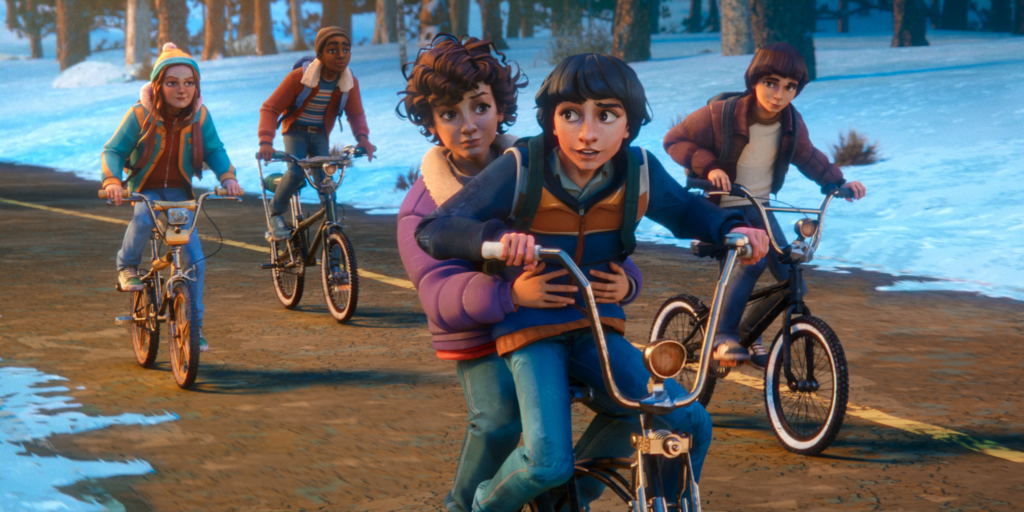
That said, “Stranger Things: Tales From ’85,” landing on Netflix on Thursday, has been made with obvious thoughtfulness and care. “Everybody who worked on this show is a fan of the flagship,” says Rebecca Perez, the animation director who oversaw the visuals across all 10 episodes.
That animation was largely executed in CGI, which allows for a multidimensional quality and dynamic camera movement reminiscent of the original show. But hand-drawn, two-dimensional imagery is part of the mix, too, particularly in scenes that involve effects such as falling snow. (Robles says he was inspired by the work of painter Andrew Wyeth, known for his watercolor depictions of rural landscapes.) That hybrid gives the follow-up a contemporary-yet-nostalgic vibe similar to the aesthetic of its predecessor.
Like the live-action “Stranger Things,” the new show visually and verbally references films from the late 1970s and ’80s, including the Alien, Star Wars and Ghostbusters franchises. But it also draws from less mainstream movies of that era, such as 1985’s “Re-Animator,” a cult favorite about a med student who discovers a chemical compound that can bring dead bodies back to life.
That film, Robles says, directly inspired his approach to the plot of “Tales From ’85,” which had to grapple with the reality that, at the end of Season 2, Millie Bobby Brown’s telekinetically gifted Eleven had closed the gate to the Upside Down, the dangerous, parallel underworld beneath Hawkins. That meant that the town should be sealed off from invasion by otherworldly monsters until Season 3 picks up in July 1985. So how could the new show, set during January of that year, possibly include more Demogorgons? “I asked [the Duffers] that question,” Robles recalls. “I’m like, ‘So what are you guys thinking?’ And they’re like, ‘Oh, that’s your problem to figure out.’”
So — spoiler alert — Robles came up with a scenario in which particles from the Upside Down have escaped and begun to mutate across multiple plant species in Hawkins, resulting in the reanimation of more gnarly beasts that Eleven, Mike, Dustin and the rest of the gang have to battle. (Writers from the original series also consulted on “Tales From ’85” to help make sure the canon stayed intact.)
The new monsters, which possess the same Venus flytrap-esque yaps as the Demogorgons from the original series, assume various forms, including that of a snow shark (imagine “Jaws,” but in winter) and zombie-fied pumpkins that wouldn’t look out of place in an animated film by Tim Burton. Again, visually, you can see the DNA of the original “Stranger Things” while recognizing that “Tales From ’85” is its own, um, newly mutated organism.
The animators also strived to make sure that the characters felt accurate and reflected the actors who played them. There were extensive discussions, for example, about how Steve Harrington’s famously luscious head of hair should look in cartoon form.
“There was definitely a conversation about not just how big, but how much movement we do with his hair,” Perez says. “It was all about referencing what the show gave you and then caricaturing it.” For the record, cartoon Steve — who, like all the characters, is voiced by a new actor (Jeremy Jordan in lieu of Joe Keery) — has an appropriately voluminous, floppy mop.
Ultimately, though, it’s the overall tone of “Stranger Things: Tales From ’85” that may win over anyone dubious about dipping back into this world after having left it just a few months ago. The latter couple of seasons of “Stranger Things,” made with more robust budgets, could sometimes feel overwhelmed by their own ambitions. “Tales From ’85” is a return, literally and metaphorically, to the show’s roots, when the elements of the coming-of-age genre mingled more blatantly with the business of battling creepy, crawly aggressors. Robles says he has already thought about how to approach future seasons, assuming Netflix decides to make more. (The cliffhanger nature of the Season 1 finale suggests that is the plan.)
“I don’t want to overstay my welcome in this thing because I love things that just feel like, ‘Man, that was a great ride and then that was it,’” Robles says, adding, “I think we can expand it if they want to keep expanding.”
In other words, expect more seasons of “Stranger Things: Tales From ’85” — not to mention more opportunities to sell Funko pops and T-shirts inspired by it.
The post Animated spinoff turns the ‘Stranger Things’ aesthetic upside down appeared first on Washington Post.