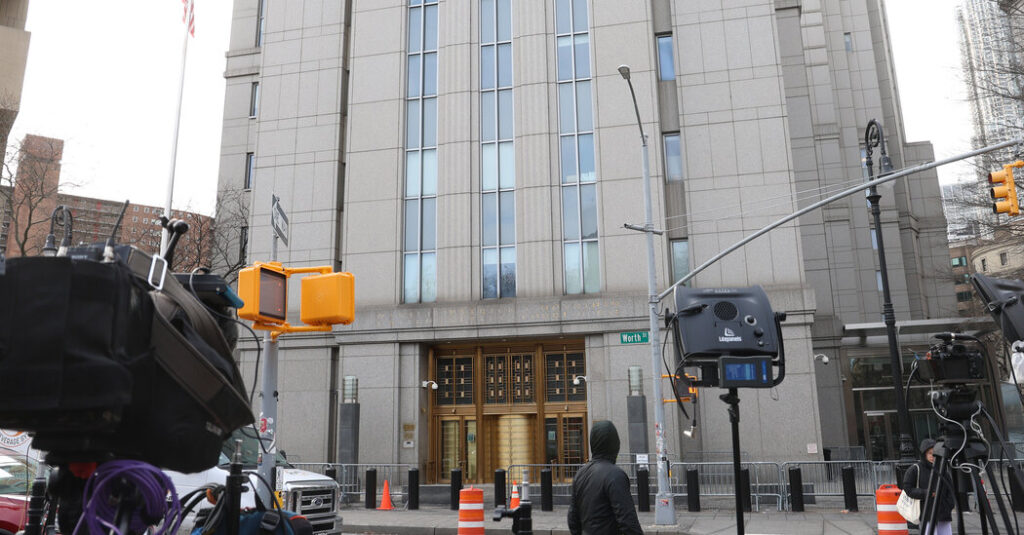
A private investigator accused of running a global hacking-for-hire operation that targeted environmental activists on Friday made his first appearance before the federal judge who would oversee his eventual trial in Manhattan.
Amit Forlit, 58, of Israel, was indicted in 2022 on charges of conspiracy to commit computer hacking, conspiracy to commit wire fraud and wire fraud, which could result in up to 45 years in prison. Prosecutors said his crimes generated “tens of millions of dollars” in unlawful proceeds.
He was arrested in London in 2024 and extradited to the United States this month. He has pleaded not guilty and was released on bail after his arrival in New York.
The indictment alleged that Mr. Forlit was contracted by a Washington lobbying firm that was working for an unidentified major oil and gas corporation headquartered in Texas.
The alleged hacking came amid a burst of lawsuits targeting oil companies, seeking damages for the costs of climate change and accusing the industry of covering up what it knew about the dangers of global warming. Those cases continue to wind their way through the courts, and the Supreme Court is scheduled to hear oral arguments in one of them, brought by Boulder, Colo., in the fall. Prosecutors allege the hacking aimed to collect material that could be used either in lobbying or in legal proceedings.
Mr. Forlit’s lawyers in Britain identified the lobbying firm as D.C.I. Group and the corporation as Exxon Mobil. The lobbying firm has called the allegations “false and unsubstantiated” and Exxon has denied any involvement in, or awareness of, hacking.
Prosecutors said Mr. Forlit worked closely with Aviram Azari, who was arrested in 2019 and later pleaded guilty to similar charges in the same court in New York. Mr. Azari was released last year after six years in prison, according to federal records.
Mr. Forlit’s British lawyers vigorously fought his extradition, arguing that the case would advance “the politically motivated cause of pursuing Exxon Mobil, with Mr. Forlit a form of collateral damage.”
He is being represented in New York by Sabrina Shroff, a longtime public defender who was in the news late last year when she represented a man who threw a sandwich at a federal agent in Washington in protest against President Trump’s deployment of troops there. The man was acquitted, marking a significant loss for Jeanine Pirro, the U.S. attorney in Washington.
During the short appearance on Friday, Mr. Forlit, a tall, stocky man who wore a blue button-down shirt, did not speak. He remains free with location-monitoring and other conditions, with his bail bond partly secured by an Israeli-American real estate investment firm.
Olga Zverovich, a prosecutor with the U.S. attorney’s office for the Southern District of New York, said she expected the case to involve “voluminous” amounts of evidence, much of it resulting from search warrants for email accounts controlled by Mr. Forlit and his unidentified co-conspirators. Additional information would come from a subpoena issued to the Washington lobbying firm, she said.
She also laid out how the plot is alleged to have worked. Mr. Forlit engaged Mr. Azari, who hired an Indian group that carried out the hacking using a technique called spear phishing, or sending emails that appear to be from sites like Google or Facebook to get victims to enter their credentials, she said.
The judge, Jesse M. Furman, asked if she anticipated that others would be charged. “That’s something I’m unable to comment on,” she replied.
Confidential business and personal information was stolen from more than 100 victims between at least 2012 to 2019, according to court documents. Judge Furman instructed Ms. Zverovich to make sure victims were notified of the court proceedings.
The next hearing was scheduled for Aug. 13.
One of the groups targeted was the Union of Concerned Scientists, which has long researched the fossil fuel industry’s role in what it calls climate science disinformation. Kathy Mulvey, the group’s accountability campaign director, called the case “a key opportunity to uncover further evidence of who was behind this illegal intimidation operation.”
She noted that the fossil fuel industry is now supporting bills at the federal and state level that would shield it from liability in climate-change lawsuits. Tennessee became the second state to enact such a law on Thursday, joining Utah.
And on Friday, Representative Harriet Hageman, Republican of Wyoming, announced a bill called the “Stop Climate Shakedowns Act of 2026.” The bill would prohibit climate liability lawsuits and void “state energy penalty laws” such as the new “climate superfund” measures passed recently in New York and Vermont, and under consideration in a number of other states. Ted Cruz, Republican of Texas, has introduced a companion bill in the Senate.
Karen Zraick covers legal affairs for the Climate desk and the courtroom clashes playing out over climate and environmental policy.
The post Suspect Accused of Hacking Climate Activists Appears in Court appeared first on New York Times.