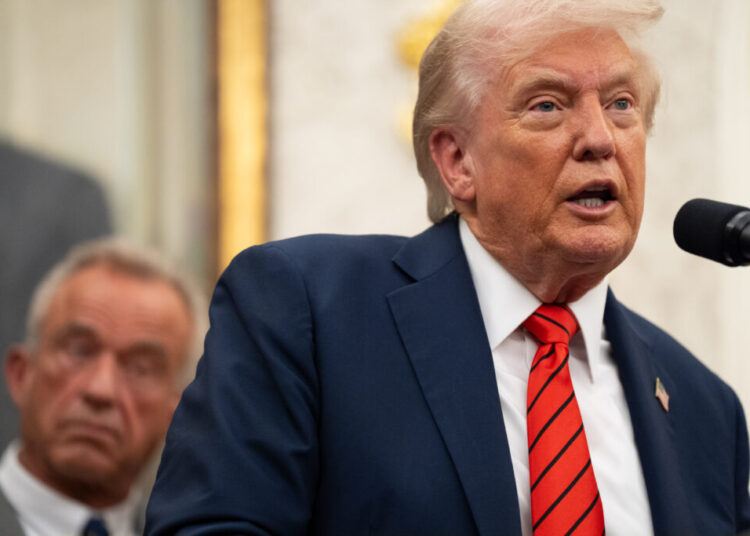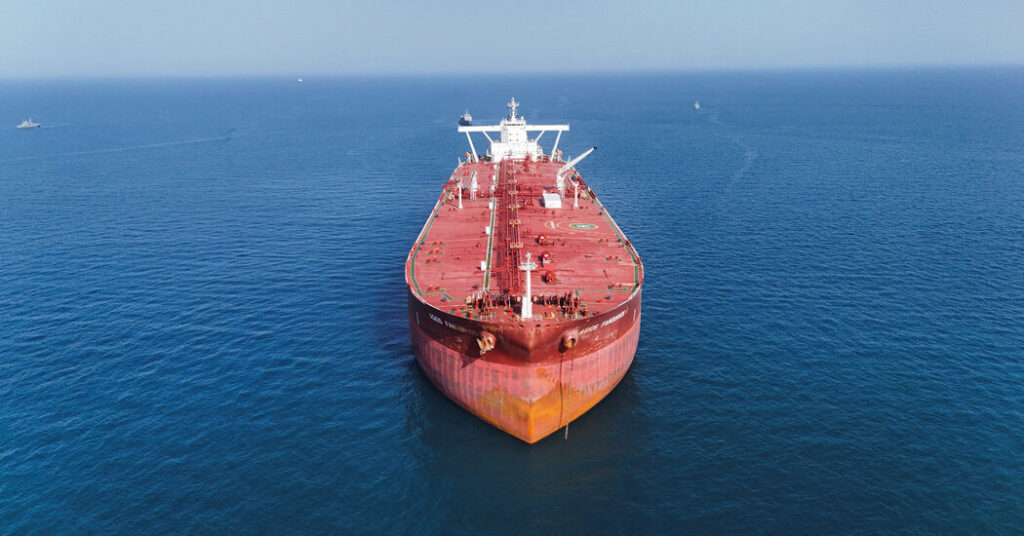
President Trump’s announcement that Iran had agreed to “completely open” the Strait of Hormuz bolstered hopes that the two governments were keeping alive a cease-fire agreement reached last week and nearing a framework for further negotiations to reach a lasting peace deal.
The announcement came a day after Mr. Trump said U.S. and Iranian teams would probably meet this weekend for a second round of talks, as Iranian officials said the sides were nearing agreement on a document that sets a formal framework for negotiations.
It also followed Israel’s agreement on Thursday to pause its military campaign in Lebanon, which Iran had called a violation of its cease-fire deal with the United States.
Mr. Trump said on Friday that with the Strait of Hormuz reopened, the process of clinching a final peace deal with Iran would “go very quickly.” But analysts called that unlikely.
“We’re still miles away from a comprehensive agreement,” said Ali Vaez, an Iran expert with Crisis Group, a global conflict resolution organization.
Writing on his Truth Social account on Friday, Mr. Trump also said that the naval blockade he placed on Iranian ports this week would remain in place until his negotiations with Tehran are “100% complete.” It is unclear how that ultimatum might change Iran’s negotiating posture. The U.S. military affirmed that the blockade would last until Mr. Trump ended it.
The path to a deal continues to run through Pakistan, whose army chief, Field Marshal Asim Munir, has been encamped in Tehran since Wednesday. Mr. Munir has been facilitating talks over a three-page memorandum of understanding that establishes a general framework for a deal, according to three senior Iranian officials, who spoke on the condition of anonymity because they were not authorized to speak publicly about sensitive diplomacy.
Pakistan hosted a first round of direct talks between U.S. and Iranian officials last weekend, and the sides nearly reached agreement on the document, according to Iran’s foreign minister, before the session ended in public acrimony. The White House has not confirmed that claim and did not immediately respond to requests for comment.
The Iranian and Pakistani officials said the memo would set a 60-day window for further talks to resolve matters including the Iran’s nuclear program, which Mr. Trump wants halted, and Iran’s demands for relief from U.S. economic sanctions.
But even two months is most likely an unrealistic time frame, experts said, if only given the technical complexity of matters like retrieving Iran’s 970 pounds of highly enriched uranium — at least some of which is believed to be buried under the rubble of U.S. airstrikes last summer.
“Making these deals durable requires rigor and clarity, which takes expertise and time,” said Jon Finer, who spent countless hours negotiating a 2015 nuclear agreement with Tehran as chief of staff to Secretary of State John Kerry. “The risk of rushing is that you don’t sweat the details and miss something important or you don’t actually have a meeting of the minds at all, and it unravels.”
Mr. Vaez added that the Trump administration’s diplomatic track record shows little skill at nailing down the fine points of complicated negotiations. In Gaza, Ukraine and the Democratic Republic of Congo, the Trump administration’s efforts to settle conflicts faltered over misunderstandings and ambiguities.
“They need to pin down every single detail. And that requires the kind of diplomacy that this administration has demonstrated again and again it is not adept at,” Mr. Vaez said.
Israel also remains a wild card in the Iran talks, a day after Mr. Trump appeared to force a reluctant Prime Minister Benjamin Netanyahu to accept a cease-fire in Lebanon in order to secure Iran’s agreement to reopen the Strait of Hormuz.
U.S. officials deny any connection between the Iran talks and Israel’s war against Lebanon-based Hezbollah, Iran’s most important proxy force. But analysts called that implausible, saying that Mr. Trump clearly decided his needs in Iran outweighed Mr. Netanyahu’s determination to smash Hezbollah.
Mr. Trump only bolstered that view when he wrote on social media on Friday of Israel’s attacks on Lebanon: “They are PROHIBITED from doing so by the USA. Enough is enough.”
Mr. Netanyahu “had no choice,” said Aaron David Miller, a veteran Middle East negotiator now with the Carnegie Institute for International Peace. Mr. Miller noted that Mr. Netanyahu was counting on Mr. Trump’s support ahead of Israeli elections expected this fall. “He couldn’t say no, let alone cross Trump.”
“Netanyahu, who played such a critical role in the beginning and start of this war, is going to have much less say or influence on how it ends,” he added.
But other analysts said that Iranian leaders remain suspicious of Mr. Netanyahu, who supports continuing the joint U.S.-Israeli war on Iran, and fear that he might try to scuttle Mr. Trump’s peace efforts.
Mr. Trump made several heady claims of diplomatic progress on Friday, saying in an interview with Axios that he believed he could achieve a deal with Iran “in a day or two” and telling a NewsNation reporter that Iran had agreed to stop enriching uranium. But Mr. Trump has made numerous exaggerated claims over the course of the war about the state of his negotiations with Tehran.
It is possible that Iran has offered to suspend uranium enrichment — the process that refines the fissile material needed for a nuclear bomb — for a finite period of time. Iran has previously offered to stop enrichment for 5 years. But Mr. Trump has demanded that Iran permanently agree to “zero enrichment” on its own soil, a position Iran has rejected for decades.
The Iranian officials said that Iran has agreed to suspend its enrichment activity for only 10 years, followed by another 10 years of minimal enrichment for laboratory research.
Iran has also agreed to dilute the stockpile and either keep it on its own soil under the watch of international inspectors, or ship it to Russia. Dilution would also take place in phases sequenced to the release of Iranian funds, and lifting of American sanctions, the Iranian officials said.
Iran is also seeking access to an estimated $27 billion in assets frozen by the United States, mostly in the form of oil revenues held in Iraq, Qatar, Japan, Germany and China.
Even if the sides can reach an agreement in theory, it remains unclear how they can overcome the extreme mistrust between them and commit to action. Mr. Trump has depicted Iran’s leaders as “crazy” and “lunatics.” Iranian officials say that Mr. Trump has repeatedly burned them, and some say it would be folly to trust his word.
They note that in his first term, Mr. Trump unilaterally exited the 2015 nuclear deal even though Tehran was complying with its terms, and imposed heavy economic sanctions on Iran.
In June and then again in February he began diplomatic talks with Tehran over its nuclear program only to launch military strikes without first declaring those negotiations dead.
Eric Schmitt contributed reporting.
Michael Crowley covers the State Department and U.S. foreign policy for The Times. He has reported from nearly three dozen countries and often travels with the secretary of state.
The post Optimism Rises for Iran Talks, but Hard Work Awaits appeared first on New York Times.