The whale’s tail waved on Friday morning, before the big crowds arrived. It raked the water back and forth, then rose and slapped down with a splash. For the German faithful watching on livestream, it was a sign.
Timmy still had a chance.
“The animal is still alive,” Marco Thomas, 50, who had driven hours to see the whale, told me. “The animal is still fighting,” Mr. Thomas said, his emotion occasionally brimming into tears.
It was the third day of what is likely to be the final chapter in the nearly monthlong saga of a stranded humpback whom Germans have nicknamed Timmy. The story has captivated a nation through an extraordinary series of unsuccessful rescue missions, evoking anger, argument and, for some, an unexpected sense of purpose.
As one Berliner told me this week, ordinary Germans often feel powerless over war in the Middle East or spiking energy prices. But maybe, just maybe, they might save this whale.
That hope has helped turn a quiet waterfront lane in northern Germany, about 60 miles northeast of Hamburg, into a hive of curiosity.
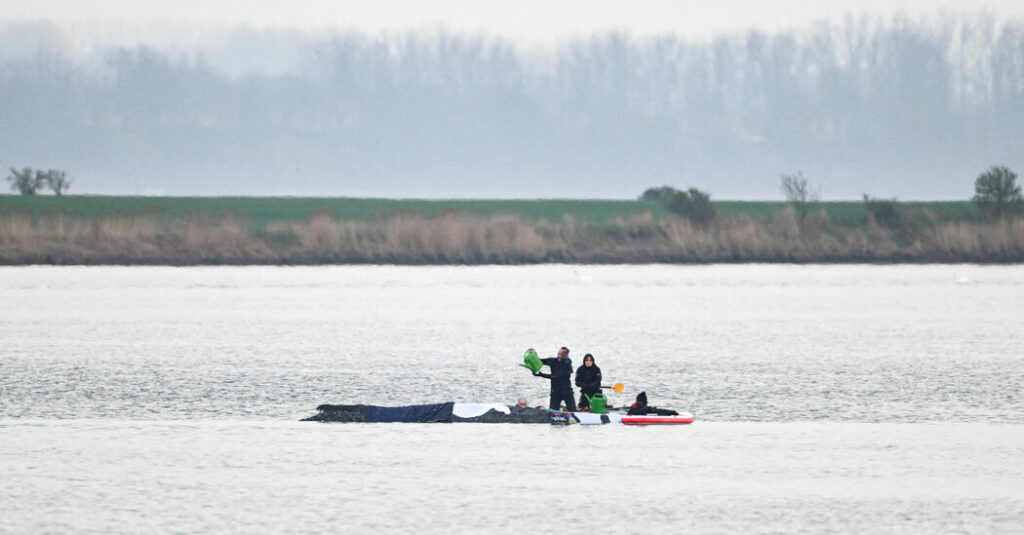
Rescuers set up camp on the shoreline of Poel Island, where the whale has remained, rarely moving, with part of his back sticking out of the shallow waters. Reporters swarmed a wheel-rutted dirt road across a field from that camp, setting up cameras next to some bales of hay and a herd of cattle. They beam continuous feeds across the internet of the whale, which, seen through the long-lens cameras, generally looks like a bobbing, whitish blob.
Locals and tourists, from far corners of Germany, gather daily behind a police blockade, farther back from the water than the news or rescue teams. They watch the whale through telephoto lenses and high-powered binoculars, having biked, scootered or walked the thousand or so yards between the viewing area and a second police barricade that keeps cars out.
“What touches me so much about it, I think, is this helplessness” combined with the whale’s clear signs of intelligence, Nele G. Phillip of Hamburg, 53, explained as she stood behind one of the barricades, with Timmy a large dot on the bay before her. “One has the impression he is looking for a way out here and he can’t find it.”
The whale was first stranded off the Baltic coast late last month near the city of Wismar. It wasn’t supposed to be there — whales aren’t usually found in the Baltic Sea, unless, as may have been the case with Timmy, they get lost following prey or are confused by ships or sounds made by humans.
Rescuers tried for days to free him. They removed a fishing net that had partly ensnared the whale, and they dug a trench with heavy machinery to open a channel for it to swim away. It worked. But almost immediately, the whale stranded himself again, in a softer silt that appeared far more difficult to free himself from.
On April 1, the state environment minister called off rescue efforts. Officials shifted to a sort of maritime hospice, watering Timmy’s back in an effort to ease pain, and discussed and discarded plans to euthanize him.
Uwe Müller, 63, who lives across the island, heard the whale before he saw him. It was Easter Sunday, soon after Timmy had become stuck again. “He cried quite heartbreakingly,” Mr. Müller said on Friday. “I’ve never heard whales before, but to me it was more like suffering. He practically howled out his suffering.”
Many Germans howled at the decision to break off rescue efforts. Others said it was time to let the whale die. A public controversy erupted around a biologist — a sort of social media whale-fluencer — who spent hours in the water alongside the whale during the first rescue effort but claimed he was excluded from future efforts, which state officials denied. One woman jumped off a boat and into the bay to reach Timmy, but officials stopped her.
The tale flipped again this week, when the state approved a rescue plan privately funded by a pair of multimillionaires. It involves air cushions, pontoons and a tarpaulin, and the hope is that it will end with the whale being towed back to sea, possibly to the Atlantic Ocean.
The rescue team wanted to finish that effort this week, but it fell days behind schedule. Workers spent Friday preparing for what reporters and onlookers speculated would be a Saturday attempt to lift and tow the whale. The team offered no updates.
In the bay, Timmy has tired. Since he first ran aground, spring has arrived in the surrounding area, and trees have sprouted green leaves.
On Friday, sunshine warmed 50-odd people who had come to see what most hoped would be a rescue. Workers had cloaked the whale in salt-soaked white towels, partly as a shield against the sun.
The crowd was beginning to thin around midafternoon. Suddenly, a small cry went up.
The tail, someone with binoculars said, had moved again.
Tatiana Firsova contributed reporting from Poel Island, Germany, and Christopher F. Schuetze from Berlin.
Jim Tankersley is the Berlin bureau chief for The Times, leading coverage of Germany, Austria and Switzerland.
The post The Long, Slow Race to Save Timmy, Germany’s Favorite Whale appeared first on New York Times.