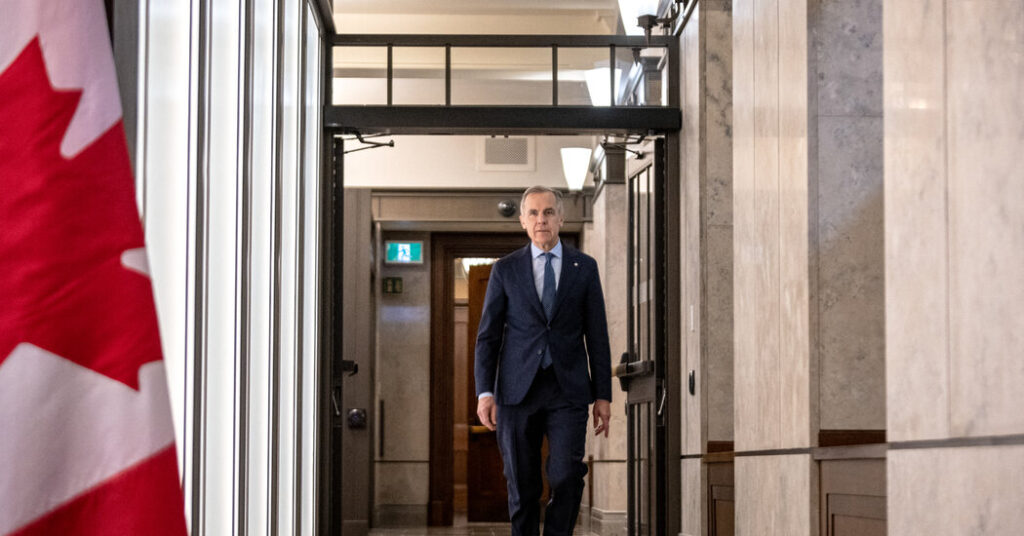
Prime Minister Mark Carney said on Friday that he would host a meeting of investors and executives in September, seeking to attract 1 trillion Canadian dollars, about $730 billion, in investment in Canada.
The investment plan is part of Mr. Carney’s ambitious efforts to reduce Canada’s economic dependence on the United States in response to President Trump’s trade war with his country.
Mr. Carney also hopes to exploit shifts in global energy markets brought about by Russia’s attack on Ukraine and the American and Israeli strikes on Iran.
“Canada has what the world wants,” Mr. Carney said in a statement announcing the meeting, which will take place in Toronto. “We’re an energy superpower, with the most educated work force in the world and rock-solid fiscal strength.’’
The meeting, he added, “will capitalize on those advantages to help drive billions of new investments into Canada.”
Mr. Carney has called Canada an “energy superpower,” and the country is the United States’ largest source of imported oil.
But there is widespread agreement that Canada needs to not only attract more investment from abroad but also keep investment money within its borders.
In a report released this week, the Royal Bank of Canada calculated that Canada has experienced a net loss of $1 trillion in investment over the last decade.
“For every dollar invested in Canada from abroad, two dollars exited,” the report said. It found that pension and asset funds in Canada control about $10 trillion in assets, much of which is invested abroad, and suggested that more of that could be kept within the country.
After working as the head of central banks in Canada and England, Mr. Carney was vice chairman of Brookfield Asset Management, a subsidiary of Brookfield Corporation of Toronto, which manages about $1 trillion of investments.
Since becoming prime minister, Mr. Carney has targeted delays in the approval of major projects, like pipelines, as a major factor in deterring investors from putting money into Canada. He set up a special office to review and approve projects of “national interest” within two years.
That plan has already encountered some resistance from Indigenous leaders, particularly over potential pipelines through their territories. The Supreme Court of Canada has ruled that Indigenous communities must be consulted on any development that crosses their traditional lands.
Environmental groups plan to challenge in court any federal plans they view as shortcuts of environmental laws.
Ian Austen reports on Canada for The Times. A Windsor, Ontario, native now based in Ottawa, he has reported on the country for two decades. He can be reached at [email protected].
The post Seeking 1 Trillion Dollars, Carney Invites Investors Summit to Canada appeared first on New York Times.