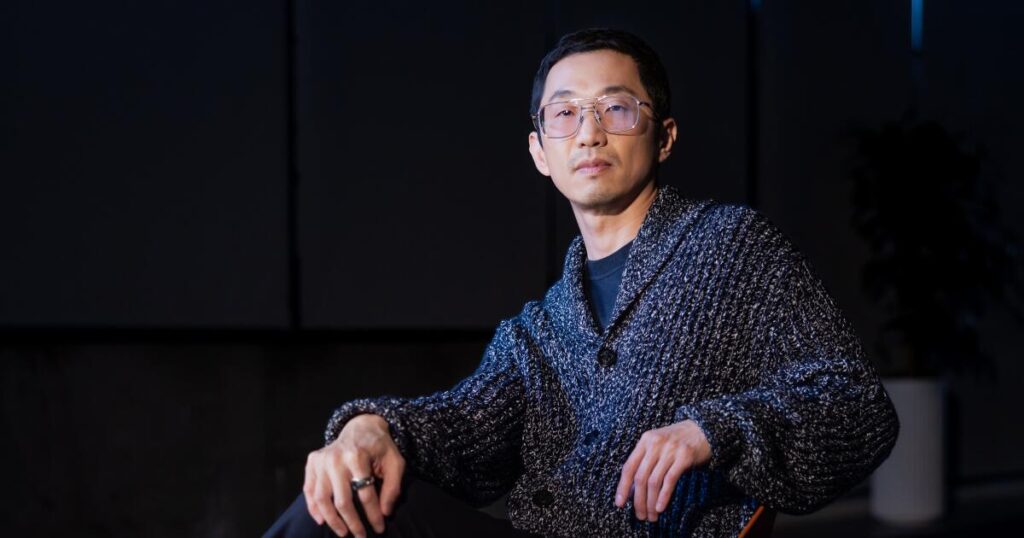
There’s a couple somewhere in Los Angeles who unknowingly inspired the second season of “Beef.”
Lee Sung Jin, the creator of Netflix’s anthology drama that swirls in the consequences of class struggles, resentment and the absurdity of life’s curveballs, once again found himself inspired by a tense interaction playing out before him. A road rage incident at a stoplight in Hollywood a few years ago, triggered by Lee’s delayed response to a green light, became the catalyst for the first season. An early idea to write about a men’s doubles partnership gone awry lost its luster after “Challengers,” Luca Guadagnino’s drama about a love triangle between tennis pros, came out. But a heated argument coming from a house in Lee’s neighborhood became the next spark that lit a narrative fuse.
“I told the story to people — it caused a little stir in the neighborhood,” he says. “And what I found fascinating was the different reactions. When I told younger folks, I’d get, ‘Did you call the police? Should you go check on them again?’ Very concerned, having an ideological view on relationships. When I told the story to older friends and couples, they were just kind of like, ‘Who among us hasn’t?’ I thought the idea of juxtaposing these couples at different stages felt like ripe ground.”
The overheard in L.A. moment inspired the eight-episode season,
The twist-filled, darkly comic thriller kicks off when a young couple, Ashley and Austin (Cailee Spaeny and Charles Melton), who work at a Montecito country club, witness the explosive altercation between their boss Josh (Oscar Isaac) and his wife, Lindsay (Carey Mulligan), an interior designer, the night before the club’s new Korean billionaire owner, Chairwoman Park (Youn Yuh-jung), takes over. She has her own mess to tend to involving her husband (Song Kang-ho), a doctor whose health is affecting his work on patients. The calamities each couple faces spin out into a web of favors and coercion in this tale of broken systems and characters going to great lengths to get what they want.
“The idea of cycles felt interesting,” he says. “A lot of shows and movies cover marriage through the lens of one couple, you don’t really see that multigenerational juxtaposition.”
Speaking from his office on the Raleigh Studios lot in Hollywood, Lee discussed the season’s Montecito setting, the financial anxiety that drives the story and the four-legged breakout star of the show. These are edited excerpts from the conversation, which includes many spoilers.
Why did you want to set this season in Montecito?
Just writing what I know. My goddaughters — their parents are my best friends. They live in Montecito. The dad is my oldest friend in LA. He has a membership to Montecito Club, which is where we shot the exterior of our show. I was house-sitting for him during the writing of all this. He let me use his membership. I remember when he told me about the membership, I was like, “You pay how much? That’s insane, dude.” But then you start using the membership. This idea of hedonic adaptation — how humans so quickly adapt to this new comfort, this new stimulus — it felt like an interesting thing. I was observing how all the members seemed to be mostly boomers and Silent Gen; then all the workers were Gen Z and millennial. I thought: What a perfect metaphor for society right now. No matter how hard the Gen Z and millennials work, they’re never going to get to be members of this club because, as Austin says, “everyone grabbed the bag before they could.” That’s what made me want to set it at a Montecito country club.
That feeling of survival and resentment and entitlement really looms over this season. There’s speeches about love, but also capitalism. The anxiety about finances is so prevalent right now.
We certainly didn’t set out to make a season about capitalism. But if you’re constantly trying to chase truth as writers, I don’t know how you say anything in the modern era, in 2026, and not have capitalism be a huge variable because it permeates every aspect of life. It’s like going to get gas. Gas is almost $7 right now. You have to fill your tank and there goes $140? That’s crazy. And relationships face so much stress — everyone is being hit by all these curveballs and trying to keep your head above water — how can you enjoy each other?
It became very obvious to us that if you’re going to write a season about marriage and love to these two couples, financial implications have to be a big factor. There’s a lot of talk about the disappearance of the American dream right now. Birth rates are declining. No one’s owning homes anymore. But then you also see headlines about everyone’s scamming. CVS has everything locked down. You’re like, “Yeah, no wonder.” Everything’s connected. We wanted to really show how that survival instinct, the desperation, is starting to come for everyone. I don’t think it’s going to get easier, especially with AI moving on the horizon, and with leaders who refuse to put checks and balances in place.
Part of Ashley’s story is using the video of the fight between Josh and Lindsay as blackmail to get health insurance so she can afford treatment for her endometriosis. And that moment where she’s waiting in the ER for hours and it’s not until she collapses that they realize she needs emergency surgery — her big concern is whether she has to pay the deductible.
I wrote that episode in a literal day because it was based on an experience I had in an ER with my daughter’s mother. She had this illness fall upon her. We spent 12 hours at the ER and, the whole time, I had my Notes app out and was just writing down everything I saw. Almost everything in that scene is stuff that happened in real life. Our healthcare system is absolutely insane. It’s, again, unhinged capitalism and … felt like it really unlocked so much of the season.
There’s a moment where Josh has to sell some of his prized possessions to pay a gambling debt. Have you been there, needing to sell things to cover your financial obligations?
I’ve been there multiple times. I obviously struggled to find my way for a long time, even after becoming a writer. If you’re in a writing partnership, in a staff job on a show — first of all, this is what the guild has been fighting, trying to get these longer-term employment windows because these jobs sometimes are only … maybe eight to 12 weeks. You’re splitting a staff salary in two [if you’re in a partnership], and you probably haven’t qualified for health insurance by the end of that run. Sure, you’re a working writer, but I remember [by the time I landed at] “Always Sunny in Philadelphia,” my first real writing job, I had amassed so much debt, half of which were from parking tickets. I just didn’t have the money to pay these tickets, and so I just let them run rampant. So, yeah, I’ve been there. There’s this one guitar that I loved; it was the first guitar I bought with my own money after college — it was a Fender Telecaster. I think I bought it for $1,200. I ended up selling it for $300. I’ve sold collectibles. I’ve sold anything that had gold in it. I’ve scrapped to just find anything because you’re desperate.
You directed this season. Is there a moment that stands out with this cast?
A peak of my career that I think about daily is the moment in Korea where we were shooting at Amorepacific. It’s one of the most beautiful buildings in Seoul. I’m shooting the scene between the great Youn Yuh-jung and the great Song Kang-ho — two of not only my favorite Korean actors, but favorite actors period. They have never been in a scene together in any Korean film ever. They’ve been in a movie together, but never acted together. And here we are making Korean history by having them shoot that breakfast scene and, while I’m in the middle of shooting that scene, director Bong Joon Ho surprises us on set. He comes over laughing, pulls up to me, looks at my monitor, gives me stage fright, then elbows me and says, “You sure you want to frame it like that?” He was teasing. Then we started shooting the scene, it’s all in Korean, and I look back at video village and Bong’s just doubled over in laughter. He is just cracking up. Younger me, and present me, is looking around like: Here I am in Korea, in this building I’ve always wanted to shoot in, two of the greatest living actors and the greatest living director — what is happening? What a crazy sentence to say. It just makes me feel like a little kid again. It stops feeling like work and starts feeling like play.
How did you want race and identity to figure into this season, particularly through Austin?
Charles was the first piece of the whole thing. After Season 1, I got to go to Korea multiple times. I shot a music video for one of the members of BTS. I was experiencing Austin’s journey of being courted by this level of Korea that I’d never been exposed to before and feeling warm and allured by it — I’m having dinners with K-pop idols, like what is happening? So, I knew I wanted to have that element of elite Korea involved. The writers and I discussed a lot whether it should be a Korean American that’s being pulled. We had covered a lot of Korean American ground in Season 1, [but] one of the things we didn’t get to cover is the half-Korean experience. Several of the writers on staff are either half-Asian or half-Korean. We don’t want to repeat things, but let’s do explore a half-Korean character who is about to have a child suddenly get this pull toward Korea.
There are some pretty gross, petty and violent acts of revenge. One is Ashley swirling her period blood in Josh and Lindsay’s pitcher of orange juice. The other takes place during a flight — Lindsay wiping gunk from the toilet seat and transferring it to the rim of the cup Ashley drinks from. Please explain how you arrived at these acts. Were there any left on the cutting room floor?
Episode 4 was pouring out of me. And I remember I got to the point where Ashley snooping through the house [where Lindsay and Josh live]. Initially, I had her scratching up the trophy. She opened Josh’s pomade and blew a snot booger into it. I was thinking of juvenile things. But I had the thought of her going to the kitchen and having the thing that happened to her being the expression of her revenge. I remember I was so nervous to show the [writers’] room. The way I wrote it, I had her crouching over the pitcher and Anna Moench, as the main female writer on the show, was like, “Sonny, I don’t think you know this works.” So, we revised it. That’s how the OJ one happened. With Episode 7 [and the toilet seat], we wanted to have a bodily episode on a plane, and there’s just such limited ways to get revenge on a plane. But given the OJ drink — there’s so many mirrors between the two couples, we thought it’d be fun to mirror that with a drink from Lindsay to Ashley. The only place to do that on a plane is bathroom. We shot it on stage with a fake toilet and Carey was almost vomiting. She came to me after that scene, and she goes, “Sonny, in all my years in this business, that is the most vile, disgusting thing I’ve ever had to do.”
The final moments of the finale jumps eight years. Did you always know you wanted a time jump? And did you always know Ashley and Austin were going to repeat the cycle?
The Ashley and Austin side, I knew the inverse graph for both characters would be very satisfying — to me, at least. I didn’t know whether that happened in a time jump or not. That’s something we discovered later. There was great debate in the room. I had a couple writers plead with me, “Why aren’t you ending with the kiss? It’s so sweet. It’s so good. I feel so good at the kiss. Can we just end it at the kiss?” I took it very seriously, but then it felt very similar to Season 1’s ending. Taking two people who start apart and they finally discover that connection but too late. I didn’t want to leave with the same feeling. How we can make it different is the “what happens next?” Life comes at you fast. He’s [Josh] still in prison. She’s [Lindsay] got to move on. Once I started heading down that thought experiment, I’m like, “Whoa, you could do a whole coda showing the literal theme of the show, the cycles, that’s where we can show Ashley and Austin becoming Josh and Lindsay.” That’s where we show, even though they found a connection, it’s lost between Josh and Lindsay — even if they’re still hanging on to the past a little bit. You show Troy and Ava still together [laughs] — they have it all figured out. Then you show the billionaire who, even with all the money in the world, is crying at the graveside of her first love, filled with regret.
We didn’t see where Eunice (Seoyeon Jang) ends up.
I wanted to leave it open. I’m very curious what people think. She really put her neck out there. Austin burned her bad. I don’t know where Eunice is at but it’s probably not good.
We can’t talk about “Beef” without discussing the needle drops. When you have Austin listening to Billie Eilish’s “What Was I Made For?” it was over for me.
The needle drops are usually pre-picked even before we shoot. The source music that’s playing diegetically, usually we discover in the edit. Before, as scripted, it had him scrolling Instagram and it was [the song playing on] his Instagram feed — you know how those Reels have music overlayed on a POV? It just wasn’t that funny to me in the edit. He’s so down and out and I wanted to find different source music in there. One day, I told my editor, “Can you rip ‘What Was I Made For?’ And can you just temporarily do it where, as she opens the door, he’s like, pressing the volume up, being like ‘sh— … sh— …’ [intending to make the volume go down]?” Our AE [assistant editor] did the ADR temporarily of the “sh—, sh—,” filmed it on my phone and I texted it to Finneas [O’Connell, the show’s composer, who is Eilish’s brother and collaborator] being like, “Hey, is it cool if we do this?” And he was dying laughing. [O’Connell also makes a cameo in the season.]
Ahead of Season 1, you gifted the writers “The Sopranos Sessions” and also assembled a Letterboxd list of films that served as reference points. What guidance did you provide for Season 2?
I sent another Letterboxd playlist. For inspo, we got “Handmaiden,” “Phantom Thread,” “Force Majeure,” “Eyes Wide Shut,” “The Informant.” For some reason, I have “Margaret” on there, the [Kenneth] Lonergan film. I also had “Michael Clayton,” “Who’s Afraid of Virginia Woolf?” “Burn After Reading,” and lastly, it’s a deep cut, there’s this movie called “Like Crazy,” starring Felicity Jones and Anton Yelchin.
Also, can we take a moment for Burberry’s acting?
Oh my god, Jones! Jones is the best dog actor I’ve ever worked with. He would hit his mark. He would listen. He would look at people when he’s supposed to be looking. It was his first time acting. Crushed it. A24 is making Burberry merch. There’s going to be a Burberry shirt.
The post ‘Beef’ Season 2: The creator breaks down how he depicted petty revenge with OJ and a wiener dog appeared first on Los Angeles Times.