After aerospace startup Space Kinetic was spun out of UC Berkeley in 2022, the company headed to New Mexico and its famous Los Alamos National Laboratory.
One of the founders had a fellowship there to further develop the firm’s cutting-edge technology: a craft that would propel smaller satellites through space electromechanically rather than by burning rocket fuel.
Space Kinetic still has a facility in New Mexico, but it’s expanding rapidly in its new headquarters and manufacturing space — in El Segundo, where it moved last year.
“It came down to the talent density. There’s a number of folks who have expertise and the disciplines that we need to hire for,” co-founder Ryan Sullivan said. “That paired with the fact that there’s already a kind of well-established deep-tech startup ecosystem.”
Space Kinetic’s decision is not surprising for a new generation of entrepreneurs who are building on the L.A. region’s rich aerospace and defense heritage, following in the path of Elon Musk’s SpaceX.
Hypersonic aircraft company Hermeus recently announced that it also was relocating its headquarters to El Segundo from Atlanta, while two Colorado aerospace companies, True Anomaly and Voyager Technologies, opened large plants in Long Beach.
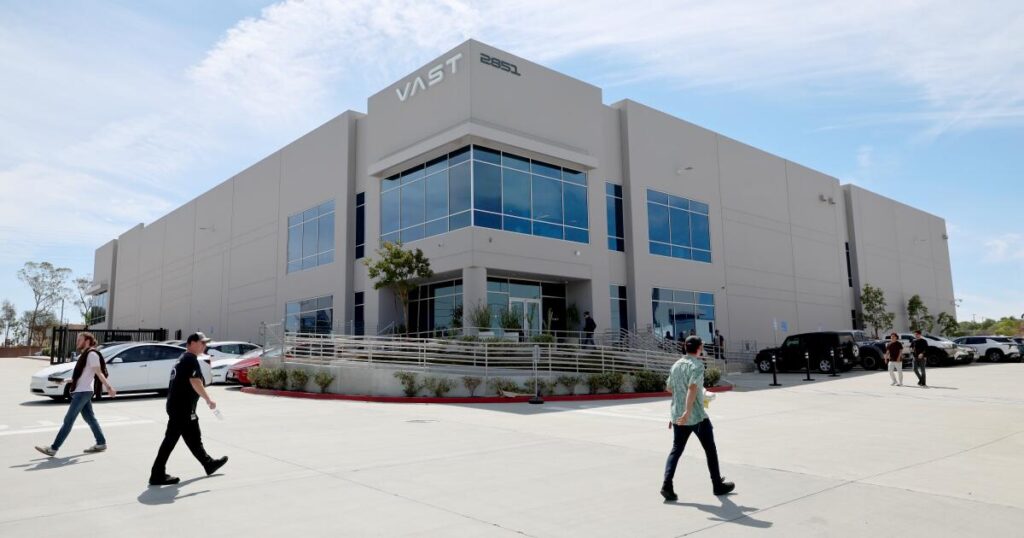
Southern California aerospace startups have doubled down on the region too, opening larger local headquarters as they grow, including space station builder Vast in Long Beach and drone maker FlightWave Aerospace in Torrance.
The decisions by these companies to open or expand headquarters, design or manufacturing spaces in California runs counter to a narrative that has gained national traction — that the state is bad for business and companies are fleeing.
That’s despite the state’s economy growing 5% last year to a record $4.25 trillion, making it larger than all but the U.S., China and Germany — buoyed not only by defense and aerospace but also by AI, where California is the global leader.
The state is home to nearly 400 “unicorns”, or billion-dollar startups — more than any other state, according to CB Insights. It also gobbled up nearly two-thirds of U.S. venture capital last year, with San Francisco Bay Area startups such as OpenAI leading the way, business information platform Crunchbase found.
Still, the negative narrative is persistent, dating to the end of the Cold War era, when Lockheed Martin and other defense contractors left the state — even as they kept many operations behind. And it has continued this decade with the headline departures of Chevron, Tesla and other major corporate offices.
Just this week, K&B Home, one of the largest home builders in California, said it was moving to Arizona, citing the Golden State’s high costs and housing prices.
A study released last year by the Public Policy Institute of California found that there is truth to the idea that an increasing number of companies have moved headquarters to other states.
A surge in new businesses
There were 1,884 companies that moved their headquarters out of state last decade, while 1,095 moved in. However, the net loss of corporations was dwarfed by the number of new businesses founded in California during the same period. That number totaled 7,250, according to the Public Policy Institute.
“There’s clearly a lot of benefits to being in California,” said labor economist Sarah Bohn, a co-author of the study. “We have a really large and productive economy.”
The Public Policy Institute is updating its study with data through 2025, which would capture both the aerospace and defense boom, as well as the explosion of AI startups in the Bay Area.
Still, Bohn said that last year’s study points to challenges California faces that are not going away, including the higher taxes and tougher regulations faced by businesses.
“We’re in an era when our population growth is slowing and costs have increased,” she said. “We’re at a point where looking at that competitiveness and the factors that contribute to it is really essential.”
Space Kinetic’s relocation to El Segundo was prompted by $12 million in seed funding it received from Balerion Space Ventures. In July, it moved into a 24,000-square-foot space near where another aerospace company is expanding.
The company plans to rapidly prototype its Whirlwind spacecraft there and eventually start production. It will be the “center of gravity” of its engineering team. “We’re expanding like crazy,” Sullivan said.
The dynamics that caused Space Kinetic to relocate its headquarters to El Segundo are similar to what convinced Hermeus to move to the city, where it is opening a new headquarters, design and prototyping facility.
The move to Southern California puts it in a hotbed for hypersonic research. In Long Beach, Rocket Lab has military contracts to launch hypersonic payloads, while Stratolaunch at the Mojave Air and Space Port in the high desert is testing hypersonic vehicles for the military.
“If you think about Los Angeles, it’s a sort of heart and soul of American aviation innovation, and it’s the current heart and soul of high speed, heavy hardware iteration,” said Zach Shore, Hermeus’ president.
The startup, which recently announced a $350-million funding round, plans to retain its 110,000-square-foot manufacturing facility in lower-cost Georgia, the site of other aerospace plants.
Hermeus’ announcement came just one month after the opening of Voyager Technologies’ 140,000-square-foot “innovation lab” in Long Beach, where it will use artificial intelligence to speed development of new tech.
The Denver startup is building a commercial space station and has other aerospace, as well as defense and national security businesses. It will operate a circuit board assembly line in Long Beach that will enable it to rapidly iterate designs for the critical electronics, said Matt Magaña, president of defense and national security.
The location also is close to the facilities of two partners, including True Anomaly, which makes reconnaissance satellites. The company said it cannot disclose what it is building in the 90,000-square-foot factory.
“There’s years and years of history and understanding [here] of what it takes to build critical systems,” Magaña said.
Costa Mesa autonomous weapons maker Anduril Industries is the other partner. The most prominent of Southern California’s new defense tech companies, it was the recipient of a $2.5-billion funding round last year and is valued at more than $30 billion.
Anduril is building 1.2 million square feet of offices and research and development space near Long Beach’s airport for prototyping and other advanced engineering. The first building in the complex will open next year.
“As we look at the next five to 10 years of growth for the company, we’re going to be embarking on a whole bunch of new programs. That means we’re going to need to hire people,” co-founder Matt Grimm told the Times in January.
High costs in California still a challenge
But as impressive as the Long Beach expansion is, Anduril is one of several of the new aerospace and defense startups that already are expanding outside California.
Anduril started drone production this year at a “hyperscale” manufacturing plant in Columbus, Ohio, that is expected to eventually span 5 million square feet and produce a variety of weapons.
Anduril also makes solid-rocket motors in Mississippi, autonomous submarines in Rhode Island and has other factories around the country and internationally.
Ohio’s attractions include an existing aerospace workforce, a U.S. Air Force operations and research base, NASA facilities and other military operations.
Hadrian, a Torrance-based manufacturer of defense and aerospace parts using AI-automated machinery, opened a second facility in its home city last year to do research and development.
But this year, the startup also opened two massive plants out of state: a 290,000-square-foot factory in Mesa, Ariz., where it make a variety of products and a $2.4-billion plant in Cherokee, Ala., to build submarine components for the Navy.
“Both [states] offered strong industrial talent, proximity to key customers, and a supportive local environment that allowed us to move quickly,” said Hadrian spokesperson Mac Bohannon.
Two years ago, Castelion, a Torrance startup, was looking to build a large plant where it could safely test and mass produce the rocket-powered hypersonic missiles it is developing.
It looked around for 1,000 acres in Southern California and finally settled for Sandoval County in New Mexico, outside Albuquerque — despite the two-hour plane ride.
“I think we’ll continue to expand here [in Southern California], but I do think it’ll become more of a two poles rather than one [company],” co-founder Andrew Kreitz said.
He cited several reasons, including California’s lengthy regulatory process and higher costs, noting much lower utility prices in New Mexico.
Promoting California’s workforce
Gov. Gavin Newsom, through California’s Office of Business and Economic Development, better known as GO-Biz, has sought to attract businesses from other states and stem the tide of local companies moving or expanding out of state.
The agency released an “economic blueprint” last year that identified four key industries: aerospace and defense, life sciences, agriculture tech, and semiconductors and microelectronics.
The state is spending hundreds of millions of dollars promoting California’s workforce and other advantages while funding job training, grants, tax credits and other programs.
Last year, the CalCompetes program awarded tax credits to 21 companies choosing to expand or relocate in the state, spurring $2.56 billion in capital investment and creating nearly 4,600 jobs, according to GO-Biz.
Jerry Nickelsburg, faculty director of UCLA’s Anderson Forecast, is skeptical that incentives can be effective when states have far lower land and labor costs and might be seeking to manufacture.
But for tech companies seeking an advanced labor pool California can be very attractive. “You want to be where the talent is and for some industries you are going to locate in California,” he said.
He noted that companies also move for strategic reasons, citing defense contractors Northrop Grumman and Lockheed Martin, which wanted to be closer to the Pentagon.
Also unclear is the economic effect of any losses of headquarters.
The Public Policy Institute study found that the net loss of jobs from California headquarters relocations last decade averaged less than 8,000 annually and that many companies kept in-state operations.
SpaceX moved it headquarters to Texas in 2024, for example, but retains large operations in Hawthorne and is expanding launches from Vandenberg Space Force Base. Its former employees also have founded scores of local startups.
Still, economist Enrico Moretti, a professor at UC Berkeley, said when headquarters pull out, service workers that support the offices also take a hit. He is in favor of the state taking more steps to improve its competitiveness.
“It’s unlikely that any policy will make land in L.A. abundant and cheap like land in the desert of New Mexico, but I could see the possibility of lower corporate taxes or personal income taxes,” he said.
Long Beach Mayor Rex Richardson is promoting a statewide program that would provide incentives for startups to keep their operations in California as they grow.
“Let’s say you got to that threshold where now you need to hire your first 1,000 employees. We want to incentivize that growth and say, ‘If you hit these benchmarks, here’s the incentives for you,’” he said.
Dee Dee Myers, director of GO-Biz, said the state is “painfully aware that it can be more complicated to site and build projects in California” and has taken step to quicken environmental approvals.
“But some of it is just the way business works. Sometimes it’s cheaper to do scale manufacturing in other places. Some of it is the way supply chains work,” she said.
Myers said she has had some preliminary talks with Richardson about his proposal to improve the state’s incentive programs — and welcomes others.
“If anybody’s got a good idea, we are totally open to it,” she said.
The post The truth about business in California — the Golden State hasn’t lost its luster appeared first on Los Angeles Times.