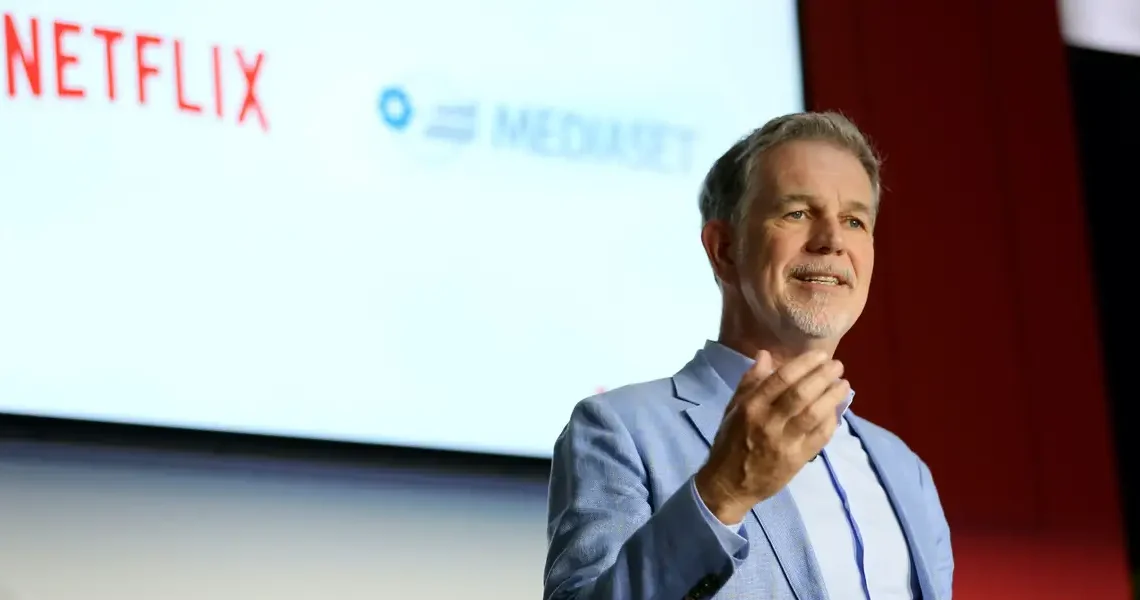

Editor’s note: This story was originally published in 2020 and has been updated to reflect Hastings’ planned departure from Netflix’s board.
As the cofounder of Netflix, Reed Hastings built one of the most iconic companies — and corporate cultures — of our lifetimes.
Hastings stepped down as CEO in 2023 and plans to exit the board in June, the company said on April 16.
Founded in 1997, Netflix has grown to a $445 billion market cap. The company is a staple of the media and entertainment industry, with original productions such as “Stranger Things,” “Bridgerton,” and “KPop Demon Hunters.”
Netflix and Hastings have made waves for their approach to a culture that powered that growth. Former Facebook chief operating officer Sheryl Sandberg said that Netflix’s culture deck, or set of slides outlining the company’s core values, “may well be the most important document to ever come out of Silicon Valley.”
Some organizational systems under Hastings proved controversial, like the practice of sending emails around when employees are fired about why they were let go.
Working with the author Erin Meyer, Hastings unpacked his leadership philosophy in the 2020 book, “No Rules Rules: Netflix and the Culture of Reinvention.”
After digging through the book, here are three details of Netflix culture that stood out.
1. Think of the company as a team — not a family

Colleagues at a company are often compared to a family unit, but this can be a faulty metaphor, Hastings wrote. While families are often seen as a lifetime commitment, Hastings approached Netflix as a sports team, where the coach can swap and trade players periodically to make sure that they’re all the best fit for their positions.
That’s why one of the most controversial parts of Netflix’s pitch deck, under Hastings, read: “Like every company, we try to hire well / unlike many companies, we practice: adequate performance gets a generous severance package.” As in: If an employee is simply adequate, rather than exemplary, they’re cut from the company and replaced with someone who can perform even better.
It seems like such an approach would prevent employees from feeling safe enough at the company to take risks. But this was a pillar of Netflix’s ethos since the internet bubble burst of 2001, when the company had to lay off a third of its workforce. Hastings found that, after cutting the less-than-stellar performers, the best workers spurred each other’s best work. Performance, after all, is infectious, and adequate performers could encourage adequate work from other employees.
The company’s 2024 culture memo does not mention severance, but emphasizes “maintaining a high-performance culture.”
Hastings wrote in the 2020 book that at companies like Walmart, people greeters are primed to think of themselves as part of the “Walmart family.” And a former National Public Radio employee said in the book that NPR employees who stayed for more than 3 years were usually there for life.
This also means that when employees begin to fall short or lose their excitement about their jobs, they still stay on at the company and do less-than-stellar work — and their attitudes can spread to their colleagues.
“A fast and innovative workplace is made up of what we call ‘stunning colleagues’ — highly talented people, of diverse backgrounds and perspectives, who are exceptionally creative, accomplish significant amounts of important work, and collaborate effectively,” Hastings wrote. And the best way to cultivate a workplace of stunning colleagues at Netflix? Cut the employees who fall short of that.
The takeaway: An effective people strategy is not purely about retaining talent, but optimizing talent.
2. Create a culture of honesty

After attending marriage counseling with his wife of more than 30 years, Hastings said that honesty helped to repair his relationship.
“Giving and receiving transparent feedback helped us so much,” Hastings wrote. “I saw I’d been lying to her. While I was saying things like, ‘family is the most important thing to me,’ I’d been missing dinners at home and working all hours of the night. I see now that my words were worse than platitudes. They had been lies. We both learned what we could do to be better partners, and our marriage came back to life.”
He brought that same approach to the office shortly after that chapter in his marriage.
Hastings began not only providing honest feedback to his employees, but also set an example by encouraging employees to give him feedback.
At Netflix, the authors said, it was almost considered disloyal if employees held back from expressing a certain viewpoint or different take on a topic. Successes and failures alike need to be discussed honestly and dissected, so that the team can learn from mistakes.
Under Hastings, Netflix even explained its reasons for letting an employee go in an email to the staffer’s department, which could be hundreds of people.
Honesty always sounds good in theory — but Netflix’s level of honesty could be daunting to implement. In conventional corporate culture, where employees might worry about offending a colleague or suspect their idea will be overlooked altogether, it’s harder to employ than it may seem.
But Hastings kept corporate honesty as the best policy. This allowed the team to get past polite protocols that would prevent them from providing real constructive feedback and becoming accountable to each other.
Introducing such clear honesty “pushed performance to new levels,” Hastings wrote.
3. Remove the controls

It might be intimidating for companies to loosen rules, but under Hastings, Netflix had very few of them. During Hastings’ tenure, Netflix had no vacation policy, no limit to how much employees could expense, and no need for approvals on most creative decisions, as long as the manager was kept in the loop.
For Hastings, the benefits of this freedom outweighed any extra costs that could be incurred from a lack of control.
“If you limit their choices by making them check boxes and ask for permission, you won’t just frustrate your people,” Hastings wrote, “you’ll lose out on the speed and flexibility that comes from a low-rule environment.”
In other words, controls kill creativity. Removing the controls allows employees to design the conditions in which they can do their best work.
It’s also all about trust. Since the company’s hiring approach ensures that everyone on the team is the perfect fit for their role, Hastings and other Netflix executives could let employees take the reins.
“I believe the most successful quarter I could have as CEO is one where I don’t make a single decision,” Hastings wrote in a 2020 op-ed for Business Insider.
Under Hastings, Netflix employees could take a day off in a year or a month of vacation leave, the book says; they could choose to expense a first-class plane ticket, or they could stay in coach. The only thing the company asked is that they “act in Netflix’s best interest.”
So it might be best thought of not as a loss of control, but a shift of control into the hands of the creative minds who need it.
“We’d found a way to give our high performers a little more control over their lives, and that control made everybody feel a little freer,” Hastings wrote.
Read the original article on Business Insider
The post Reed Hastings is leaving Netflix. These are 3 of the biggest takeaways from his leadership book. appeared first on Business Insider.