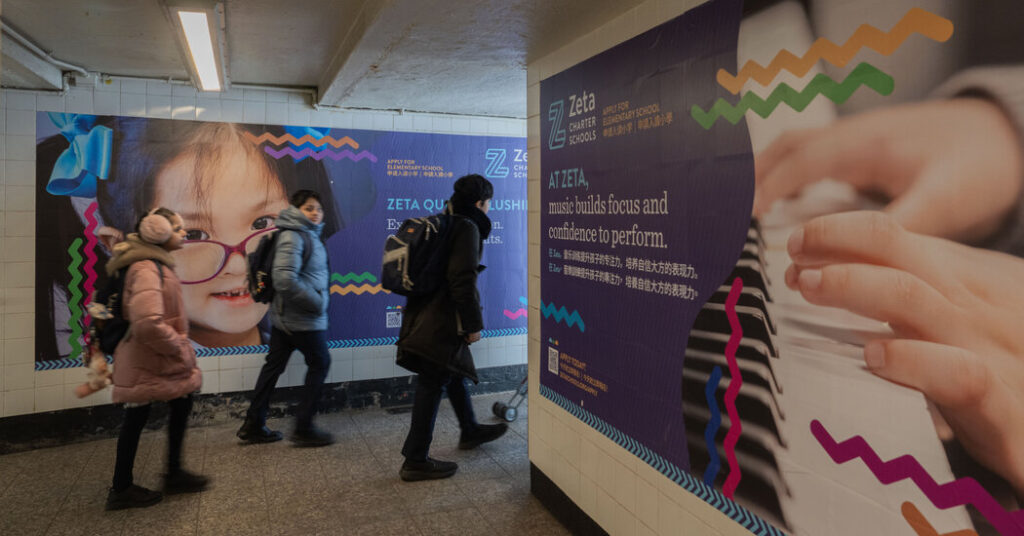
Step into a subway station or a bus stop, and next to ads for StreetEasy, you can see a far different pitch. Your family is welcome at your neighborhood school — and a seat is waiting for your child.
Open up TikTok, and you can scroll past a video of a fourth grader dancing as she praises her teachers at the charter school down the block.
On Facebook, a mother might tell you that the Catholic school a mile away helped her son discover his love for the saxophone.
Schools across New York City — the largest education system in the United States — are trying to stand out and compete at a time when many urban districts are facing a crisis: a dwindling population of children.
The number of New Yorkers under the age of 20 fell about 155,000 from 2020 to 2023, according to revised census figures released last year. It rose only a small number, about 224, between 2023 and 2024, according to the most recent figures available.
Cue the race for children.
The pressure to fill classrooms — and the marketing rush — are not entirely new. Many charter and private schools have long seen a need to sell themselves, sometimes printing directories in The New York Post and spending millions of dollars to stuff apartment mailboxes with leaflets during admissions season.
But in more than a dozen interviews, education leaders said that they felt a greater urgency to attract families and were looking for fresh ways to fill their classrooms.
Curtis Palmore, who runs United Charter High Schools, a network of seven college prep campuses where enrollment has fallen, recalled the days — long gone — when schools often talked about lengthy waiting lists.
“The demand was just vastly different,” Dr. Palmore said. “All we needed to do was get a flyer out, and we had packed auditoriums.”
“You can’t do that in this day and age,” he said. This year, United Charter is expanding its outreach to teenagers at nearby middle schools with invitations to student-led visits at its campuses and advertising on iHeartRadio, the radio and streaming network, to boost its profile.
The new tactics illustrate how much has changed since the explosion of school choice. Birthrates have plunged, and about 10,000 fewer children were born in 2024 in New York City than before the coronavirus pandemic. During the second Trump administration, a national drop in immigration has further depressed school enrollments.
New York and other big urban areas have also experienced a spike in families moving out between 2020 and 2023.
In recent years, several charter and dozens of Catholic schools have closed, struggling to afford rent and other costs as enrollment has fallen. Mayor Zohran Mamdani’s administration has sought to merge or close several district schools on Manhattan’s West Side, angering parents.
Now, more schools are ramping up digital marketing blitzes on video platforms such as Hulu and Tubi, crafting personalized pitches or offering financial carrots to help persuade parents to enroll.
It comes as dozens of other large and midsize districts across the United States are taking the unusual step of hiring consulting firms to recruit students in a move akin to how political canvassers try to persuade undecided voters.
“The big shift here is from a surplus of kids to a scarcity,” said Aaron Pallas, a sociology and education professor at Teachers College at Columbia University.
At more than a dozen New York City schools, the entire first grade is just 15 or fewer students.
“I look at that and I think, ‘This isn’t sustainable,’” Mr. Pallas said. “But in the meantime, I think there also is a logic in trying to advertise and recruit kids in ways that can slow down that process.”
During the past five years, Coney Island Prep was among the only charter schools in the city to experience an increase in enrollment without adding new grades. Still, it is not immune from the declining population of children. Coney Island Prep used to have waiting lists across all grades. No more.
The school’s leaders said that while word of mouth has been the most effective method to recruit students, they have been forced to deploy new techniques.
They have increased the school’s marketing budget to $80,000 a year, buying YouTube and Facebook advertisements that target families in South Brooklyn, and partnered with nearby day care centers to raise the school’s profile among parents with young children, said Eugene Wood, an administrator at Coney Island Prep.
The school has started a social media campaign called “Share the Love,” enlisting the families of its students to promote Coney Island Prep during the school application period.
And it’s not just charter schools: New York City spent at least $21 million during the administration of Mayor Eric Adams on a public school ad campaign that appeared on buses and trains and at small businesses — an effort to address a loss of 100,000 students during the pandemic. While the city’s public school system overall has lost more than 88,000 students during the past five years, schools in some middle- and upper-middle-class neighborhoods remain in high demand.
Still, many families remain in the dark about all the opportunities that the school system offers, according to a recent report commissioned by the Jordan Family Foundation, a philanthropic organization.
The city’s Education Department declined a request for an interview. But Chyann Tull, a spokeswoman for the public school system, said in a statement that the city has reached families from many angles, including social media campaigns, emails, text messages and letters put in students’ backpacks.
Some education experts argued that families rarely made decisions based on a brochure alone and said that money would be better spent improving school quality.
For charter schools, gaining students, or at least retaining them, is especially important: They receive public funding for every student added — and lose it when one leaves. The sector’s enrollment has climbed during the past five years as more campuses have opened. Today, they educate more than 150,000 students.
Enrollment has fluctuated in recent years at Uncommon Schools, one of the largest charter networks in the city, and hit a low two years ago. School leaders adjusted. They refocused on connecting with families at community events, health fairs and parades, and on expanding offerings such as sports and after-school programs.
School leaders also found that most families who had left the network in recent years had cited the cost of living in the city as the main reason, so they started working with community groups to help families find social and financial assistance.
Enrollment is still lower than it was five years ago. But Uncommon has 900 more students than it did two years ago, and the number of applicants for next school year has increased 10 percent. “It tells us we are heading in the right trajectory,” said Michael Blake, the chief of operations for schools at Uncommon.
At Success Academy, the city’s largest charter network, robust marketing has always been a hallmark. Still, Success has experienced declining enrollment in several of its schools in recent years.
A decade ago, Success had a reputation for rigorous, strict classrooms where students sat at their desks, with hands clasped and eyes tracking the teacher. But recent TikTok and YouTube ads showcase a different experience. The message: Children enjoy far more play time than families may think.
The network also sends out so-called scholar recruiters to chat with parents and encourage them to apply. “You can’t really fulfill the promise of parental choice if you don’t meet families where they are,” Eva Moskowitz, the network’s founder, said.
Ray Domanico, a senior fellow at the Manhattan Institute, a conservative think tank, said that he “got the first inkling that something different was going on” when he began seeing more posters for Success on the train.
New York’s first charter school opened in 1999, and the sector flourished in largely low-income Black and Latino areas including Harlem, the South Bronx and central Brooklyn. Today, many of those neighborhoods have lost families or have been gentrified.
“Their core constituency is declining,” Mr. Domanico said. “They are going to need to create a broader appeal for their schools.”
YouTube ads for Zeta Charter Schools, a network that has had schools in Upper Manhattan and the Bronx for nearly a decade, show a girl high-fiving her teacher after solving a math problem and another starting the day with daily affirmations. Enrollment is up.
And in August, the network will open what appears to be the first charter school in Flushing, Queens, one of the largest hubs of Chinese and Korean Americans in the United States.
It’s especially notable because Asian students make up less than 5 percent of pupils at charters, but are among the city’s fastest growing demographic groups.
At the same time, new schools are trying to introduce themselves. This fall, Strive Charter School will open in the South Bronx for 12 hours a day, seven days a week, a potentially alluring benefit to working parents.
Still, Strive leaders expect to spend about $200,000 on marketing before the first day of class, including more than $100,000 on public transit ads and thousands each month on social media.
Recruitment is likely to continue through the summer. The stakes are high: The school has substantial expenses, most notably annual rent of $2.1 million.
“For us, this is genuinely a life or death issue,” Eric Grannis, the chief executive, said.
Troy Closson is a reporter for The Times covering children, teenagers and young adults in New York City.
The post As Enrollment Dips, School Administrators Turn to TikTok to Advertise appeared first on New York Times.