Officials have failed to halt pervasive fraud in the hospice industry despite promises of reforms five years ago after learning of widespread corruption that targeted vulnerable patients.
California authorities promised to crack down after a Times investigation in late 2020 revealed that a cohort of mostly older Americans was being targeted by unscrupulous providers who would bill Medicare for hospice services and equipment for patients who they said were terminally ill, but who were in fact not dying.
The hospice industry, particularly in Los Angeles County, had exploded in size, outpacing public need.
One of California’s first moves was to put a moratorium on issuing new hospice licenses to give officials time to strengthen oversight. State officials and industry representatives crafted emergency regulations that they said would address gaps in hospice licensing requirements to weed out bad actors.
But years later, those regulations have still not been enacted. And problems that have plagued the industry persist despite highly publicized enforcement efforts by the state and federal government, experts say.
The Trump administration has seized on California hospice fraud in recent months with a series of new arrests while blaming state officials for dropping the ball. California rejects the criticism but last week announced a major investigation of providers that officials said bilked taxpayers out of more than $260 million.
“This is not a red versus blue issue,” said Sheila Clark, president and chief executive of the California Hospice and Palliative Care Assn. “This is not political. … We care about the beneficiary and the benefit, full stop. That is who we are protecting.”
Although fraud has been present in the industry for years, the scope of the problem became clear five years ago, with reporting by The Times and a subsequent state audit in response.
The audit report, published in 2022, called for a series of emergency regulations to be implemented within one year to “protect the health and safety of current and prospective hospice patients.”
The regulations included setting limits on the distance and time hospice agency staff may travel to see patients, establishing ratios of patients to nurses, ensuring that hospice management had hospice-specific training, verifying that hospice management was actually affiliated with the agencies on the applications and verifying medical licenses.
The proposed regulations also called for an initial site visit to the hospice to ensure it’s set up to care for patients, as well as unannounced follow-up visits.
The state has already launched a fraud task force to share data among departments to address complaints about hospices.
But, four years later, those emergency regulations aren’t in place. Clark, who heads up the California Hospice and Palliative Care Assn., has been struggling to get clarity on the issue.
“I’m perplexed. My membership is perplexed as to why they didn’t go into effect because we knew that this was going to help. We’re at a standstill right now,” Clark said. “If we don’t have these regulations, it’ll be open season again on hospice.”
A spokesperson for the California Department of Public Health said the draft regulations, which under state law were supposed to be implemented by Jan. 1, 2026, are being revised after “valued stakeholder feedback” it received.
“In the meantime, CDPH continues to enforce the moratorium and take action to prevent and address fraud,” the agency said.
The measures, once enacted, will make it more difficult to obtain a license as a hospice and force hospices already operating to come into compliance, said Susan Fanelli, chief deputy director with the California Department of Public Health.
“I think the best way to fight fraud is to partner not only with the state but with the federal government and share information so that we can really work together to stop fraud,” Fanelli said. “We all have an interest in quality of care and making sure dollars are getting to those patients that need it.”
Hospice fraud reemerged as an issue in January when Dr. Mehmet Oz, administrator for the Centers for Medicare and Medicaid Services, visited what he calls “ground zero” for hospice fraud — a series of corridors in the Van Nuys area of the San Fernando Valley. In a video shot from the second-row passenger seat of his SUV, Oz pointed to the medical signs on a stretch of Victory Boulevard and noted that in the immediate area, there were 42 hospices registered.
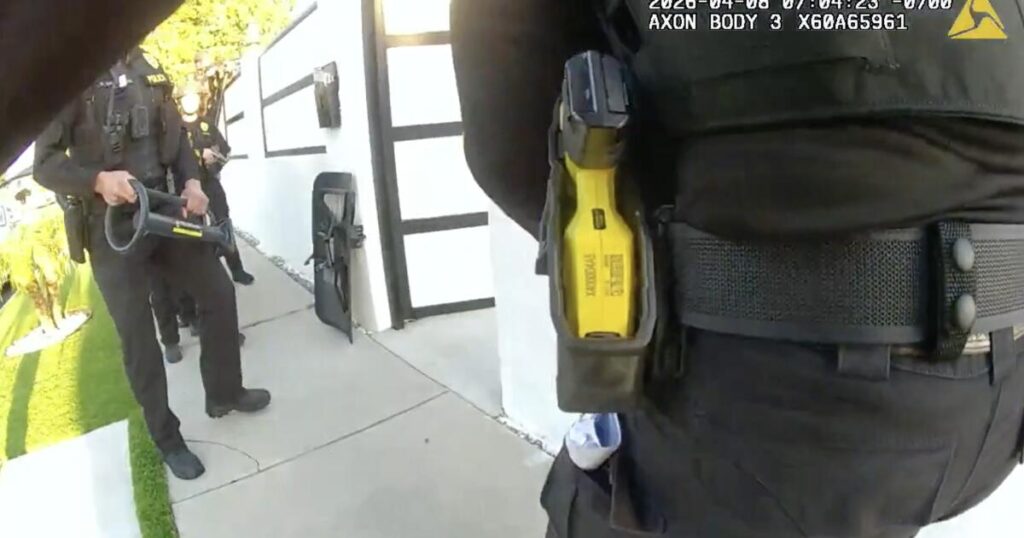
This month, he returned to go on a SWAT raid to apprehend two individuals in part of a sweeping investigation into a host of hospice owners accused of bilking taxpayers of $50 million in false claims.
A political football was kicked, with the state and federal governments each casting blame on the other for not doing enough to stop fraud.
First Assistant U.S. Atty. Bill Essayli accused California of not vetting hospice providers when administering licenses.
California officials fired back, with Gov. Gavin Newsom writing on X that “the Trump Administration — home to the biggest fraudsters on Earth — is trying to blame California for issues with their federal programs.”
Edo Banach, the former head of the National Hospice and Palliative Care Organization, the largest U.S. trade group for hospices, said both the federal and state governments have a role in preventing bad actors from operating in the industry.
“The federal government, despite going after providers in California, has a role in determining whether entities can bill Medicare to begin with. So it’s not just the state. It is everybody’s problem,” he said.
A spokesperson for the Centers for Medicare and Medicaid Services said the agency routinely monitors for abnormal billing patterns and complaints to identify fraud.
For years, the hospice industry, which was designed to provide comfort and guidance for dying patients and their families in their final days, attracted scammers enticed by large Medicare payments, officials say.
Authorities allege such operators engaged in a series of illegal practices, including kickbacks to shady doctors and recruiters who targeted prospective patients at assisted living facilities and other venues with promises of equipment, nursing care and other necessities.
In reality, patients who unknowingly enrolled in hospice discovered they couldn’t get any curative care, meaning access to certain medications and life-sustaining treatments like dialysis was immediately cut off.
And not just in California. Hospice fraud has been an issue across the nation, including in Texas, Georgia, Ohio, Nevada, Arizona and New York.
But the hospice industry’s rapid growth in Los Angeles County has drawn particular scrutiny.
State Assemblymember Alexandra M. Macedo (R-Tulare) questioned the repeated delays in getting the problem under control, pointing to previous reporting from The Times that showed that a lack of oversight gave fraudsters the opportunity to cash in.
“Delays only hurt vulnerable patients and their families, foster fraud and cause problems for legitimate operators that provide essential services, especially in rural and disadvantaged communities,” she said.
From 2010 to 2020, hospices in Los Angeles County multiplied sixfold, accounting for more than half of the state’s roughly 1,200 Medicare-certified providers and massively outpacing the region’s needs, according to the Times analysis of federal healthcare data.
California officials have balked at the Trump administration’s insinuation that they’re not combating fraud.
Atty. Gen. Rob Bonta last week announced arrests in a $267-million hospice takedown.
The state has shuttered about 280 hospices in the last two years and is investigating 300 others, according to the California Department of Public Health, which oversees hospice licensing in the state.
A spokesperson for the Centers for Medicare and Medicaid Services said this week that the federal government’s task force has suspended 447 hospices and 23 home health agencies suspected of fraud in the Los Angeles area since March.
But those shuttered hospices represent a sliver of the massive industry in L.A. County. The county is home to 1,584 hospices, more than half of the entire state’s hospice industry as of March. There are hundreds of facilities in the Van Nuys area alone, according to the state’s medical facility database.
The Valley neighborhood got significant attention in January when Oz posted a video from a complex in Van Nuys where a onetime hospice operated.
“What we have learned, there’s roughly $3.5 billion of fraud taking place here in Los Angeles, in hospice and home care. It’s run, quite a bit of it, by the Russian Armenian Mafia. You notice the lettering and language behind me,” Oz says in the video, with the signage of an unrelated lavash bakery visible over his right shoulder.
Newsom called the allegations against the Armenian community “baseless and racist.”
A few blocks away sits a building well known to investigators.
There are 89 licensed hospices located in a single two-story building in a small medical plaza at 14545 Friar St. in Van Nuys that billed Medicare for more than $38 million in 2023, according to the most recent available data from CMS.
The location housed a hospice operated by Jessa Zayas, who was charged with six felony counts by federal prosecutors alleging she scammed $2.5 million from the federal government. She is accused of collecting signatures of people in Bakersfield retirement homes who weren’t dying and enrolling them in hospice. Zayas has pleaded not guilty to four counts of healthcare fraud and two counts of aggravated identity theft. Her attorney did not immediately respond to a request for comment.
A source familiar with the matter confirmed that federal investigators are looking into other operations on Friar Street.
The building has also been in the sights of state investigators for years. Officials said 56 state licensing and federal investigations have been conducted at the complex since 2021 and the state has revoked 14 licenses.
Last week, about 80 surveyors and investigators from several state agencies gathered on Friar Street to conduct compliance reviews. The result of the investigation was not immediately revealed, but officials said 109 businesses attempting to use the address had never been issued a state hospice license.
Two days later, Bonta announced the results of a separate investigation that identified 14 licensed hospice businesses that he alleges fraudulently billed $267 million to Medi-Cal using stolen identities. One of the hospices had been based on Friar Street.
Officials allege scammers purchased identifying information for people who live outside California on the dark web and enrolled them in Covered California. A number of hospice companies were then bought and began billing Medi-Cal for nonexistent services using stolen identities, according to criminal complaints.
The defendants were able to get around the state’s moratorium by purchasing hospices that had existing licenses, authorities alleged.
The post California was warned of shocking hospice fraud. Inaction allowed problems to persist appeared first on Los Angeles Times.