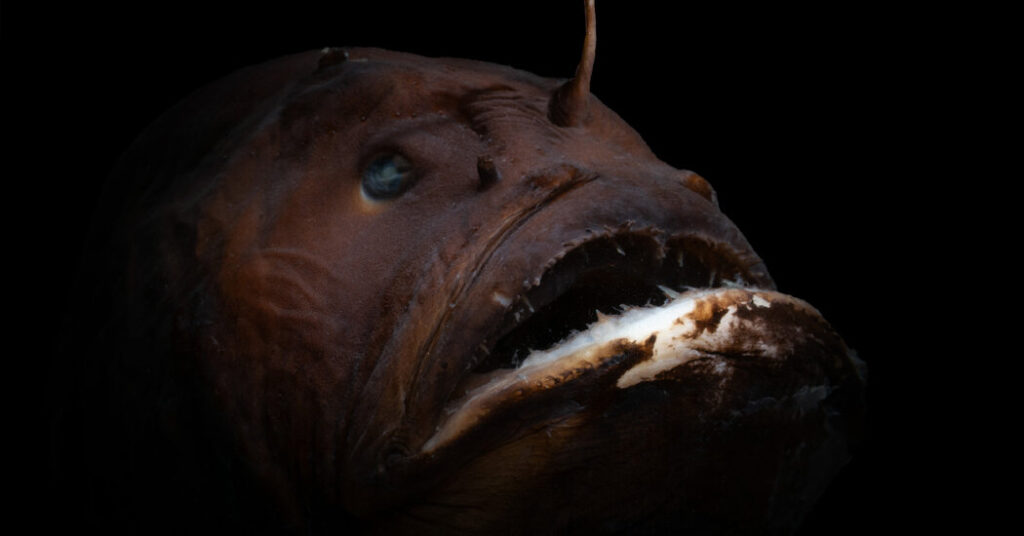
When Alex Maile, a biologist, perused the jars of anglerfish pickled in alcohol at the Natural History Museum of Los Angeles County, he found himself hooked by their lures.
“I got to see all these beautiful anglerfishes for the first time in my life, and the first thing that blew me away was, why is there so much variability in the lures?” said Mr. Maile, a Ph.D. candidate at the University of Kansas.
There are more than 400 species in the anglerfish family. Some are like the toothy, glowing sea devils made famous in “Finding Nemo,” which can mate for life with tiny males that attach themselves to the females’ bodies. Another, the warty frogfish, scoots along shallow seabeds on stumpy fins. Many of the fish in this family, especially the females, have evolved specialized dorsal fins that they use like fishing lures to bait their prey.
Some anglerfish lures glow with bioluminescent bacteria, while others twitch enticingly. Still other members of the family have lures that extend “like a slide whistle,” Mr. Maile said, poking out of the skull and spraying a jet of chemicals that attract their invertebrate prey.
Mr. Maile wanted to know why the fishes’ lures came in so many sizes and shapes, and why they had so many different capabilities. After all, he reasoned, “why change something that works?”
In a study published last month in the journal Ichthyology and Herpetology, Mr. Maile and Matthew Davis, a scientist at St. Cloud State University in Minnesota, examined more than 100 species of anglerfish in museum collections. By comparing the anglers’ preserved bodies and their DNA, the researchers created a comprehensive anglerfish family tree. Their genealogy hints that the variety of glowing lures may have evolved in order for females to attract not just meals, but also mates.
The deep sea habitats of bioluminescent anglerfish make them difficult to observe in the wild, and nearly impossible to keep in aquariums. “Some of these are so rare, they’ve never been seen alive,” Mr. Maile said. But preserved specimens in museum collections provided the researchers with a glimpse at anglerfish diversity.
The anglers’ lures provided some of the most critical evidence for the researchers’ family tree, Mr. Maile said.
Fossil anglerfish helped the team calibrate the family tree by providing evidence of when different traits emerged. The researchers hypothesize that the first anglerfish with lures evolved 72 million years ago, near the end of the age of dinosaurs. These early anglerfish’s lures most likely did not light up. But about 40 million years later, several species emerged that were probably bioluminescent. This evolutionary trend has continued.
Mr. Maile said their analysis “showed that the bioluminescent groups are actually diversifying at a higher rate compared to the non-bioluminescent ones.” This phenomenon suggests that the fishes’ glowing lures can be linked to how members of different species tell between each other and find mates.
In the habitat of most glowing anglerfish thousands of feet below the ocean’s surface, the water is inky and frigid, and food is scarce. When a female flashes her lure, she may be signaling to male anglerfish, which are much smaller, but have outsize eyes primed for peering through the darkness.
“You’ve got to eat, and you’ve got to procreate,” said Tracey Sutton, a professor at the Guy Harvey Oceanographic Research Center at Nova Southeastern University in Florida who was not involved with the study. The evolution of glowing lures that can attract both prey and mates “is really an elegant solution to those two problems,” he added?
Dr. Sutton said that by establishing a robust anglerfish family tree, the study’s authors had set the stage for future research into why these fish evolved the way they did.
“Why are there so many of this kind of fish living in what some would say is the harshest environment on Earth?” Dr. Sutton said. “It’s pitch-black, cold, food-poor. It’s hard to imagine a worse place to live. And yet, this group of fishes thrive in it like no other.”
The post How Female Anglerfish Evolved to Have It All appeared first on New York Times.