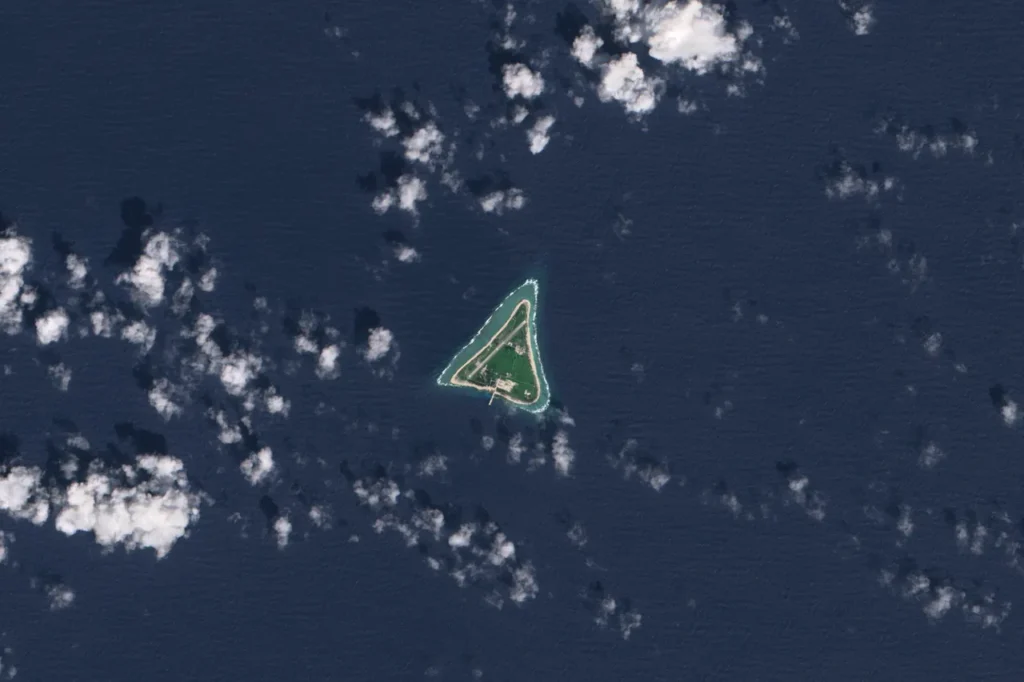
It’s called Minamitorishima, and it’s a small atoll in the Pacific Ocean. It is one of the most remote islands in Japan’s vast archipelago, so much so that it lies nearly 2,000 kilometers southeast of Tokyo. Yet from the depths of the surrounding seas may come a tremendous gift for the country’s economy.
It is there, as deep as 6,000 meters undersea, that a group of Japanese researchers succeeded in a veritable mission impossible: the recovery of sediments containing rare-earth elements from one of the most promising underwater deposits discovered in recent years.
The feat is set to strengthen Japan’s role in the increasingly crucial rare earths sector, a central element in the trade war between China and the United States. Indeed, Japan is the only major industrial country that, while remaining partially exposed, has managed to significantly reduce its dependence on Beijing.
The “Mission Impossible” in the Pacific Seabed
The Minamitorishima operation, conducted with the scientific deep-sea drilling vessel Chikyu, represents the world’s first attempt to sample at such depths.
The Japanese government called the result “a significant milestone in terms of economic security and overall maritime development,” stressing that ongoing analysis will now have to determine the precise quantity and quality of elements present in the extracted samples. But beyond the technical aspect, the value of the undertaking is above all strategic.
Rare earths are a group of 17 metals critical to advanced technologies. They go into the production of high-strength magnets for electric vehicles, wind turbines, electronic devices, semiconductors, radar systems, missiles, and more. Elements such as dysprosium and yttrium, of which the area around Minamitorishima contains estimated reserves of 730 and 780 years of consumption, respectively, have become critical materials for modern industry and defense. According to some estimates, the Japanese submarine deposit could contain more than 16 million tons of rare earths, shaping up as the world’s third-largest reserve.
The Shock of 2010 and the Strategic Shift
Tokyo’s race toward mining self-sufficiency didn’t begin today. It has its roots in 2010, when a diplomatic crisis with Beijing bluntly exposed Japanese vulnerability.
After an incident between a Chinese fishing boat and two Japanese coast guard units near the Senkaku Islands, China blocked rare earth exports to Japan for about two months. At the time, Tokyo was dependent on Beijing for more than 90 percent of its imports of these materials. The embargo caused panic across industries, particularly in the automotive sector, and global prices of rare earths increased tenfold within a year.
That crisis represented a strategic shock. Unlike other industrial countries, which viewed the episode as a circumscribed or temporary strain in those years, Tokyo interpreted it as a structural signal. Overdependence on a single supplier, a regional rival to boot, constituted an existential risk for an advanced and highly industrialized economy.
Since then, Japan has radically changed its strategy. The government launched an extraordinary package of measures: investment in technologies to reduce the use of rare earths, development of alternative materials, enhancement of recycling, the acquisition of stakes in mines abroad—particularly in Australia, with support for the Lynas Group—and creation of strategic stockpiles.
As a result of this policy, Japan’s dependence on China has steadily declined. It has reached about 50 percent in recent years, a level that no other country has been able to match. The decisive factor for the strategy’s success was its integrated approach.
Japan has not only sought new suppliers but has also worked simultaneously on multiple fronts. Japanese companies, with government support, have invested in developing magnets that use less dysprosium. At the same time, research programs on alternative materials have been promoted. This aspect is crucial: Reducing dependence means not only changing suppliers but also reducing structural needs.
Inventory, Innovation, and Competitive Advantage
Another key factor, according to analysts, is inventory. The Japanese government has created strategic reserves of rare earths to mitigate any temporary supply disruptions. This seemingly simple choice, however, requires a long-term vision and capital availability that not all countries have been willing or able to mobilize. Stockpiles do not eliminate dependence, but they provide precious time in the event of a shock, allowing industry to adapt without immediate shutdowns.
Added to these elements is a structural characteristic of the Japanese economy: high technological integration. Japan is not only an importer of rare earths, but an advanced player in their transformation into high-value-added components. This expertise has facilitated innovation and reduction in the intensity of use of critical materials. In other words, the ability to do more with less has become a competitive advantage.
Despite these advances, Japan has not completely eliminated its dependence on China. Beijing continues to dominate global refining, especially for heavy rare earths. In recent months, tensions between Tokyo and Beijing have escalated again. After Japanese prime minister Sanae Takaichi’s statements about the possibility of responding militarily to a possible Chinese attack on Taiwan, Beijing began to slow or limit exports of rare earths, magnets, and dual-use materials. The measures have reportedly already affected Japanese companies active in the automotive, semiconductor, and defense sectors.
The Axis With Washington and the Tokyo Framework
It is in this context that the Minamitorishima mission takes on an even more pronounced dimension. Mining the seabed is not just an engineering challenge, but a declaration of intent to structurally reduce the country’s strategic vulnerability. There is one problem: Exploiting a deposit at a depth of 6,000 meters involves enormous costs and highly sophisticated technologies.
And that is where the United States comes in. During the US president’s visit to Tokyo last October, Takaichi and Donald Trump signed a cooperation agreement on rare earths and critical minerals, dubbed the Tokyo Framework. The understanding includes joint public and private investments, the creation of bilateral coordination mechanisms, and a US-Japan Rapid Response Group to monitor possible crises in supply chains. Washington will provide funding and technological support for extraction operations planned for 2026, gaining privileged access to resources in return.
Takaichi also confirmed these commitments during her meeting with Trump at the White House on March 19 and aims to further strengthen the agreement. “I hope for total US commitment,” the Japanese prime minister said in reference to the Minamitorishima rare earths cooperation, before signing a further agreement with French president Emmanuel Macron in late March.
If industrial exploitation proves to be economically and environmentally sustainable, Japan would have significant resources to ensure stable supplies and further reduce dependence on China, which is still very strong elsewhere, including in Europe.
This story originally appeared in WIRED Italia and has been translated from Italian.
The post 6,000 Meters Under the Pacific, Japan Seeks Independence From China on Rare Earths appeared first on Wired.