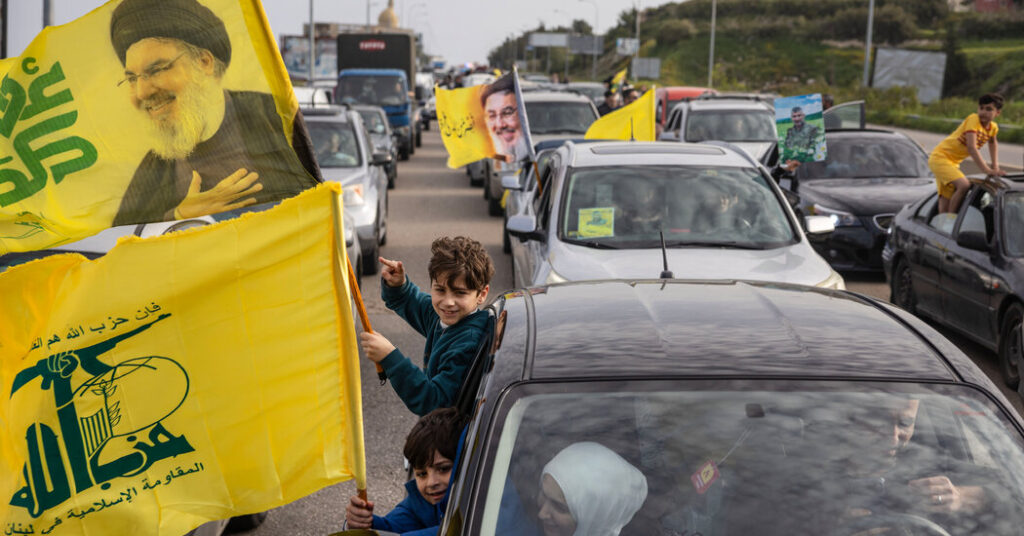
President Trump may be trumpeting the cease-fire between Israel and Lebanon, but Prime Minister Benjamin Netanyahu cannot.
Israeli voters did not want the fighting to end.
Overwhelmingly, polls showed, they wanted the military to keep up the pressure on Hezbollah, the militant group whose rockets and missiles have made life miserable and perilous for residents of northern Israel, until the group, which Iran backs, was destroyed or forced to disarm.
That, after all, is what Mr. Netanyahu and his military chiefs had promised to do.
But Mr. Netanyahu quickly, if grudgingly, fell in line on Thursday when Mr. Trump pressed for a cease-fire in Lebanon — just as the Israeli leader did with prior cease-fires the president had orchestrated.
Now, the prime minister’s critics, and even some of his allies on the right, have seized on what appears plain as day: his inability to resist Mr. Trump’s pressure, not just in pushing to bring the long-distance war with Iran to a close but even in demanding a truce with an enemy directly across Israel’s northern border.
“A cease-fire must come from a position of strength and be an Israeli decision, reflecting leverage that serves negotiations,” said Gadi Eisenkot, a former military chief of staff whose new centrist opposition party, Yashar, is gaining in the polls. “A pattern is emerging in which cease-fires are being imposed on us — in Gaza, in Iran, and now in Lebanon.”
It is a stark turnabout from Mr. Netanyahu’s role in personally persuading Mr. Trump to join Israel in attacking Iran in the first place — a hard-sell pitch, as The New York Times reported, that Iran was ripe for regime change, that a combined U.S.-Israeli operation could quickly topple the Islamic Republic, and that concerns about Iran’s responding by closing the Strait of Hormuz and attacking U.S. interests in the region were overblown. None of those assurances proved true.
A core element of Mr. Netanyahu’s appeal to voters — the argument that his close bond and strategic mind meld with Mr. Trump make him uniquely equipped to ensure Israel’s security — now appears far less convincing.
“Netanyahu influenced how the war started,” said Aaron David Miller, a former Middle East negotiator now at the Carnegie Endowment for International Peace. “He won’t influence how it ends.”
Mr. Netanyahu, who is up for re-election this year — and whose coalition is behind in the polls — took pains to reassure Israelis about the halt in fighting with Hezbollah, saying that soldiers would remain in a security buffer zone extending 10 kilometers into Lebanon. That would guard against incursions into Israel and against the use by Hezbollah of anti-tank rockets to terrorize border communities, he said in a televised address.
“Of course, there are still problems,” Mr. Netanyahu conceded. “They still have rockets left.”
But Mr. Netanyahu said that could be addressed in the context of talks over what he said could be a “historic peace agreement with Lebanon.”
David M. Halbfinger is The Times’s Jerusalem bureau chief, leading coverage of Israel, Gaza and the West Bank. He also held that post from 2017 to 2021. He was the politics editor from 2021 to 2025.
The post Lebanon Cease-Fire Leaves Netanyahu in an Uncomfortable Spot appeared first on New York Times.