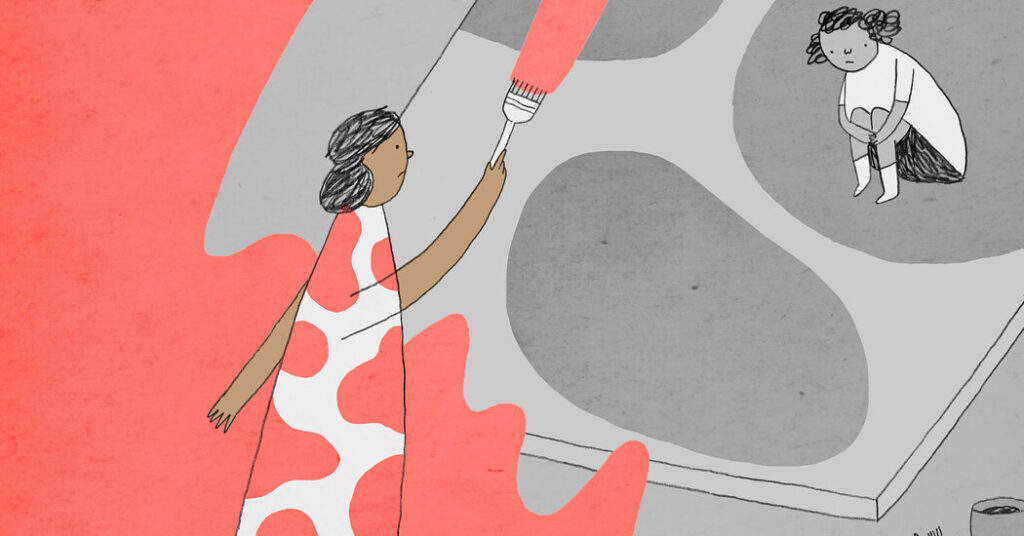
Two years ago, I packed up several of my father’s Abstract Expressionist paintings and dropped them off with a handful of visual artists to be painted over. This was my solution to a problem that had haunted me all my life.
I was born in Manhattan in 1976. Before I was 2, my mother left my father and me to be a road manager for a popular folk band, and she never returned as a full-time mother. In her absence, I was raised by my father, an artist with a Brooklyn accent as thick as his beard.
We lived in his painting studio in Carroll Gardens with a spirit of “anything goes.” We roller-skated over the uneven floorboards as a disco ball cast its magic over the loft walls. My half-siblings from my father’s first marriage sometimes crashed with us as they started their adult lives, but mostly it was just my father and me. The laughs and alcohol were abundant. But mixed with the music, frequent houseguests and as many Star Wars figures as I could ask for was the secret presence of my father’s hand between my legs.
Though he died in 2012 at the age of 76, it has taken me decades to come to terms with the less artful things that happened in that home. For most of my adult life, I had chosen to live as if, at night in his bed, he hadn’t treated me as he might treat a wife — long before I went through puberty or understood that any of it was wrong. As I began to admit the truth, I was struck by a revulsion so strong it threatened to bring down the walls of my carefully constructed fantasy life.
A few years ago, in my late 40s, I decided I could no longer live my life as if none of this had happened. When I researched the common symptoms of an incest survivor — chronic traumatic neurosis, interpersonal relationship imbalances and increased intergenerational risk of abuse — I realized why I didn’t want to accept that this was me.
Pretending the abuse didn’t happen was an easier route. Incest was too taboo, too stigmatizing. Even as a child, I was aware of this shame. My father referred to our bond as so precious and private that no one would ever understand.
When I spent time with my mother, she somehow ignored my obvious signs of distress: nightmares, anxiety, blood in my underwear. Everyone around me acted as if this wasn’t happening, so I did too, and I strove to live a normal life, graduating at the top of my class, earning my Master of Fine Arts in film and becoming an academic like my father before I was 25.
At the same time, I tried to build a family with someone whose background was the opposite of mine — a man from a large religious family in the suburbs. I hoped that he would show me the way to a healthy life. But even after having three children together, we remained distant and detached, and we divorced when our youngest child was 2. I had two significant relationships after, but neither stuck.
My constant struggles in love forced me to confront my loneliness and inability to feel close to a romantic partner. And I realized I had better try to heal from this trauma if I ever wanted to experience real love.
The first step: Live my life as if my memories were true. Stop promoting the myth of my happy childhood. Removing the constant reminder of my father in the form of his paintings was an obvious place to start, but it felt as harsh as ripping a favorite blankie away from a sleeping baby.
I had never known a time when my father’s art had not surrounded me with its uneven lines and overlapping geometric shapes. His style of abstraction, a holdover of the 1950s, had dissipated by the 1970s.
Even as I packed for college, I chose five of his paintings to hang in my dorm as proof of my creative, bohemian upbringing. When I met new people, I took a certain pride in my preferred childhood narrative: I had managed without a consistent, loving mother because I’d had my wacky, artistic father. My father loved to point out that he devoted his life to me and to his work, in that order, and I loved to repeat it.
Our life was full of other artists, some of whom became lifelong mentors. I believed in his talent with the blind faith of a child. When I became an experimental filmmaker, I hoped to be like him, surrounded by inspiring people, creating and teaching for a living.
This narrative calmed me. Once I admitted the abuse, however, the dozens of artworks that I had carried with me for years became something new — the glaring evidence of denial. I couldn’t stand to look at them any longer. But what should I do? Burn them? Paint them black?
The first painting I took down, a canvas the size of a window with mushy marks that blurred shades of pink, gray and green, had been in my bedroom. I didn’t love all my father’s artwork, but this was a favorite I had hung in a place of prominence wherever I lived. Its muted swirls loom in the background of countless photos from potlucks I hosted in my 20s. They even enliven the photo of my husband at the time holding our first child after we returned from the hospital.
I dropped it off with an artist friend and said “goodbye” when I handed it over. I asked her to return it to me as a new work of art. Her studio was lush and vibrant, the opposite of my father’s sparse loft, which felt right. She welcomed the assignment.
Not every artist was as enthusiastic. Interestingly, all who expressed discomfort were men who worried about how they would feel if someone painted over their art. I tried not to be bothered by their apparent empathy for my father; their art was everything to them, and it pained them to picture their babies being damaged.
To be clear, this was not like painting over a Rauschenberg. My father had been a working artist his whole life but not a successful one. His work was not widely shown or sold in galleries; his entire archive belonged to various members of my family.
Most of the resisters came around when I explained that I was the owner of these objects and free to do whatever I wanted with them. If I didn’t want them on my walls, was I required to pay for the storage of these canvases forever?
While the artists worked on the paintings, I worked on myself, beginning therapy with a trauma specialist, journaling, practicing somatic work and guided meditation. I tried every treatment and alternative therapy I could find for incest survivors. The effort felt harder and more exhausting than any of my three pregnancies. I felt nauseated, unable to eat, wracked by shame and fear that I had opened a terrible line of inquiry into the past that no one wanted to hear about.
Slowly, though, I began to regain my footing, in time to receive the art that has been returning to my home, often unrecognizable and always for the better. I was nervous with anticipation, afraid that I had set an impossible expectation. Picking up a canvas from my friend Chris Nau, I found that what was once a minimalist rectangle of black paint with one blue line had been transformed into an oval-shaped burst of color.
Chris hadn’t achieved this by painting over my father’s work; he had unearthed it by chipping away at the layers of paint, bending and crumpling the canvas to reveal bright oranges and yellows. He then put the canvas on a round stretcher, no edges, and titled it “Brave Child.” The process reminded me of the Japanese art of kintsugi, in which broken pottery is often repaired to highlight the damage.
Two years in, my walls and closets are overflowing with these new works of art. When I began this process, I worried that I was destroying what was, in my mind, my father’s only worthwhile legacy. Now, after repeating my story in dozens of artists’ studios, I can finally claim the truth about my past while living in the present, if uncomfortably most of the time.
I wanted to shatter the lies about my childhood and embrace a new story, one where two things could be true: My father may have helped make me into the artist I became, but I no longer need his art to remind me of that. I need new art, made with love, to show me what’s possible.
Sarah Hanssen is an artist and educator who lives in New York City and the Hudson Valley.
Modern Love can be reached at [email protected].
To find previous Modern Love essays, Tiny Love Stories and podcast episodes, visit our archive.
Want more Modern Love? Watch the TV series, sign up for the newsletter and listen to the podcast on iTunes or Spotify. We also have two books, “Modern Love: True Stories of Love, Loss, and Redemption” and “Tiny Love Stories: True Tales of Love in 100 Words or Less.”
The post Painting Over My Painful Past appeared first on New York Times.