As California experiences its second-worst snow drought in 50 years, new images show a stark comparison with last year’s snow levels.
This year, the Sierra snowpack peaked on Feb. 25. It was only 73% of average, then rapidly dwindled from there.
Then, summerlike heat in March broke monthly records in many areas of the Western United States. Daniel Swain, a climate scientist with UC Agriculture and Natural Resources, described it as one of the most “extreme heat events ever observed in the American Southwest.”
Though a spring storm dropped up to 3.5 feet of snow in California’s Sierra Nevada mountains last week, extending ski season, snow levels remain extremely low.
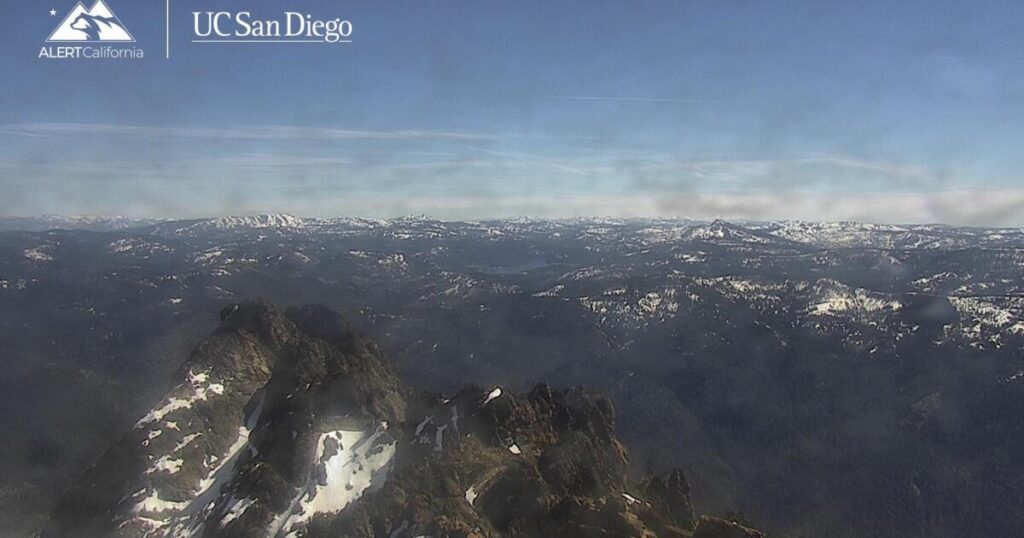
The images below show Grizzly Peak in Northern California’s Shasta-Trinity National Forest in March 2025 (left) and March 2026 (right).
A large mound of snow visible in the foreground in 2025 was gone in 2026. Mount Shasta, seen in the background, was also noticeably less snowy a year later.
The Northern Sierra has been hardest hit by this year’s snow drought. Snow levels were at just 10% of normal on April 16, compared to 27% in the Central and Southern Sierra.
On the same day last year, the Northern Sierra was at 102% of normal, the Central Sierra at 81% and the Southern Sierra at 68%.
Statewide, snow levels were 20% of normal. California’s smallest snowpack on record was in 2015, just 5% of average.
The images below show the Sierra Buttes in Tahoe National Forest on the same dates in March 2025 (left) and March 2026 (right).
The difference in snow levels is night and day, with last year’s white peaks replaced by browns and greens.
The Sierra Nevada snowpack provides around a third of the state’s water supply, its spring and summer runoff refilling reservoirs when the state needs the water most.
Nearly all of California’s reservoirs were at or above historical average levels after this year’s early runoff.
The warmth and premature melt mean the state’s forests will dry out a month earlier than usual, or even more, Peter Gleick, a leading water scientist and co-founder of the Pacific Institute, told The Times.
“It could be a very bad fire year,” he said.
Times staff writer Ian James contributed to this report.
The post Striking before-and-after images show extent of California’s snow drought appeared first on Los Angeles Times.