To some people, Anthony Griffin was the panhandler in a robe who rode the subway from Queens to the Bronx, weaving religious messages into freestyle rap that earned him the nickname “the Messiah.”
His route was more or less the same for at least the last two years. First, a short walk from his apartment in Long Island City, Queens, to the No. 7 train at Vernon Boulevard. Then, a transfer at Grand Central Station to the uptown No. 6 train. He would get off at Cypress Avenue in the South Bronx, around the corner from his childhood home. As he moved through the subway system, Mr. Griffin would rap and proselytize, often carrying a carved wooden staff.
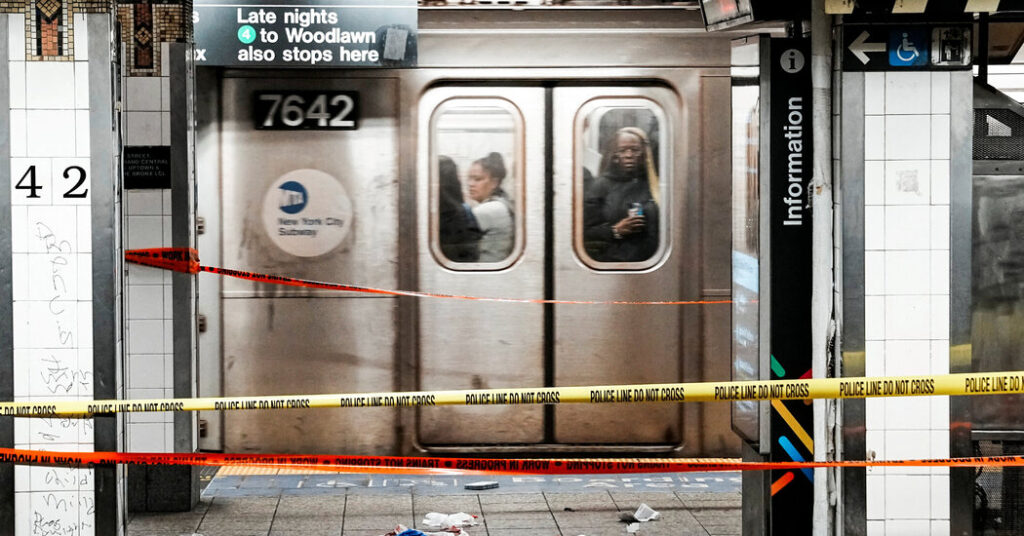
Mr. Griffin, 44, appeared to set out on the same journey on Saturday morning. But this time, when he arrived at Grand Central Station, the police said, he stepped off the No. 7 train and pulled out a machete. He swung the blade, slicing an 84-year-old man across the face, then walked up the stairs to the platform for the No. 6 train, where he slashed a 65-year-old man and a 70-year-old woman.
A commuter flagged down two detectives, who repeatedly told Mr. Griffin to drop the blade, the police said. He refused. He said he was Lucifer, the fallen angel.
Then he made a move toward them, the machete still in his hand, the police said. One of the officers shot Mr. Griffin twice, killing him.
The chaos sent tourists and weekend workers running through one of the city’s most crowded stations on a warm Saturday, one of the season’s first. Some saw the victims, who survived the attacks, as emergency workers treated them on the train platforms.
The account of the violence on Saturday, provided by police officials, and details about Mr. Griffin from interviews with neighbors, friends and family members, revealed a portrait of a man who was struggling to find his place in New York City, becoming more isolated and turning to religious rhetoric that confused others.
Mr. Griffin did not have a mental health history documented with the police, officials said. His family said that, to their knowledge, he had never been diagnosed with a mental illness. But in recent years, he had been seen by many on trains unspooling his religious messages, and last year, he posted a photograph on social media showing him holding a staff and what appeared to be a machete in a sheath, crossed in front of his chest.
While he had 13 arrests in New York City that spanned two decades, 10 of those are sealed, according to an internal police document. Of the three arrests that are public, the most serious was in 2019, when he was charged in the Bronx with assault with intent to cause physical injury with a weapon, according to the document, which did not provide further details about the case or its outcome.
Mayor Zohran Mamdani on Saturday applauded the swift police response to the attacks, and Jessica S. Tisch, the police commissioner, said the incident showed why the city needed to keep officers in the subway system. But the incident also put a spotlight on people who appear to be in the throes of a mental health crisis in the subways, and the challenge of identifying them before there are tragic consequences.
Mr. Griffin grew up in the 1980s on East 138th Street in the Mott Haven neighborhood of the Bronx. He lived with his mother and spent most weekends at their apartment watching episodes of “The Benny Hill Show” with his cousin Nate Baker. When they were 15, Mr. Baker said, Mr. Griffin was writing rap lyrics about religion and what it was like to grow up in a rough part of town. He would scribble rhymes throughout the day, the scraps of paper strewed around his room.
“He’d say, ‘Cuz, listen to this over here,’” Mr. Baker said. “‘You didn’t hear this one yet.’”
The allure of songwriting led him to pursue a career in battle rap, where artists would rib one another in front of spectators. Terrell Blair, 53, a music producer, said he first heard Mr. Griffin perform in the neighborhood around 1999, and introduced him to the wider battle rap scene. They traveled to Philadelphia, Newark, N.J., and across New York City, where fans — who knew Mr. Griffin by the moniker “Fox 5” — recorded videos of him free-styling in community centers and barbershops.
But Mr. Griffin, seen by some as a rising star in the battle-rap circuit, surprised his friends and family when in his mid-20s he fell out of the scene and began to lean heavily into the religious studies that had intrigued him as a child. He wore robes and shawls, and delved deeper into the Bible and the Quran. He continued to rap, but by 2010 he had assumed a new name: “Almighty Gawdflow.”
“As he got older, he got real preachy to the point where it kind of lost people,” Mr. Baker said.
Over the next decade, Mr. Griffin continued to drift. He was jobless, rapping in streets and on the train. He lived with his mother, though he spent brief stints in Compton, Calif., according to Mr. Baker and public records.
When his mother died of cancer in October 2021, family members said, it sent Mr. Griffin into a downward spiral from which they said he would never fully emerge.
Mr. Griffin’s name was not on the lease of his mother’s East 138th Street apartment, and he was forced to leave, Mr. Baker said. By May 2022, he had entered the city’s shelter system, according to a person who has seen some of his social service records but was not authorized to speak publicly about them. Even though the city has specialized shelters for people with mental illness, Mr. Griffin does not seem to have ever been placed at one, the person said.
He continued to rap on the subway. During one train ride in November 2022, Mr. Griffin free-styled for nearly three minutes, according to a video posted on his social media accounts.
“My lonely condition is the mission, survival. When the Bronx in the gutter, this my manger, straight danger. Who’s worried? My only mother,” he sang, pointing up to the sky.
“Ma, I’m in control,” he continued. “I’m God.”
Mr. Griffin appeared to catch a break the following year. He told Mr. Blair, the music producer, that he had won the housing lottery and had been offered an apartment in a high-rise on the waterfront in Long Island City. Mr. Blair gave him $20 to cover the cost of the background check before he moved in.
Residents soon became familiar with Mr. Griffin. Some described him as frenetic; others said he was cordial, even calm. He gravitated to dog owners like Kelly Still. Earlier this month, he told her that he was moving out of the building. “He hugged me and said: ‘I love you. I wish you all the best,’” Ms. Still recalled.
On a recent walk, Mr. Griffin stopped at a smoke shop just outside the Vernon Boulevard-Jackson Avenue Station, where he would catch the No. 7 train. He had become a regular over the last year, and often strode through the door with his wooden staff to buy a few bottles of beer.
“One day, he tell me: ‘I am a God!’” said the store clerk, Amit Patel, pantomiming Mr. Griffin driving an imaginary walking stick to the ground.
During his trips to the Bronx, Mr. Griffin would occasionally bump into Chase Milano, 44, a childhood friend who said he was a skilled basketball player with “a slick dribble.” Mr. Milano said he would see him in tattered robes panhandling near their elementary school, P.S. 65. The old neighborhood was a safe, familiar place where Mr. Griffin could count on others to give him food, booze and cash.
Last year, Mr. Baker drove from his home in Virginia to visit New York City, and his first stop was near where they grew up. Mr. Baker said he spent 45 minutes searching the area for his cousin. When he found him, he said Mr. Griffin seemed depressed, worn out from another sleepless night of drinking.
“‘You gotta rest, cuzzo,’” Mr. Baker recalled telling Mr. Griffin. “‘You gotta sleep.’”
On Saturday, after he heard about the attacks at Grand Central and Mr. Griffin’s death, Mr. Baker said he wondered why his cousin told the police he was Lucifer when “he had always considered himself God.”
“We were like brothers, same age, seven months apart,” Mr. Baker said. “This is probably the longest I’ve been without my cousin, these last few days. This feels so surreal.”
Andy Newman contributed reporting. Georgia Gee contributed research.
Chelsia Rose Marcius is a criminal justice reporter for The Times, covering the New York Police Department.
The post He Preached the Gospel on the Subway. Then He Pulled Out a Machete. appeared first on New York Times.