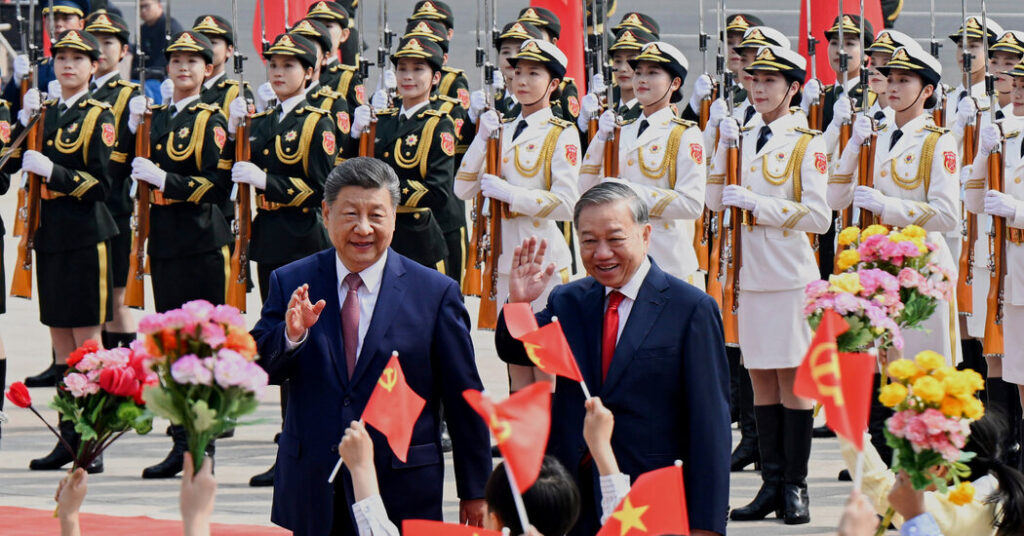
With the United States and China vying for influence in Asia, China’s leader, Xi Jinping, is keen to show that Vietnam is in his corner on trade, political ideology and, increasingly, security.
That was underscored this week when Mr. Xi met with Vietnam’s new leader, To Lam, in Beijing. Mr. Xi alluded to President Trump’s tariffs and the blockage of the Strait of Hormuz as reasons for China and Vietnam to ensure that trade flowed normally and their industrial supply chains were protected.
He also appealed to the two nations’ shared kinship as single-party, communist states.
“Defending the socialist system and the ruling position of the Communist Party is the greatest common strategic interest,” Mr. Xi told Mr. Lam on Wednesday.
While both sides agreed to strengthen ties in tourism, education and railway infrastructure, it was their pledges to work more closely on security that may provide China with the greatest advantage over the United States in the rivalry for deeper inroads with Vietnam.
As part of its diplomatic outreach, China has been pitching friendly countries its concept of global security, one that prioritizes regime protection above everything else. That has had purchase in Vietnam, which like China, has little tolerance for dissent and has remained repressive even as its economy has developed and opened up to the outside world.
Mr. Lam, a former security chief, recently secured Vietnam’s two most powerful posts, as Communist Party general secretary and the country’s president, an elevation that moves Vietnam closer to the strongman model of China, which Hanoi had long avoided. Even as Mr. Lam has pushed economic changes to unleash the private sector, he has given more power to the police, expanding their reach into business and surveillance.
A day before Mr. Xi and Mr. Lam met, the two countries held a meeting in Beijing of senior security officials that included Gen. Luong Tam Quang, the head of Vietnam’s public security ministry; Chen Wenqing, China’s top security official and a Politburo member; Wang Xiaohong, the head of China’s domestic security agency; and Chen Yixin, China’s spy chief.
Chinese and Vietnamese state media said the two sides agreed to boost cooperation in safeguarding “political security.” No details were provided, but in China, this term has become synonymous with a massive surveillance apparatus used to root out activists, rights lawyers and dissidents, while quashing online criticism and protests against the government.
The two countries also said they would work together more closely to combat transnational crime such as online gambling and online fraud.
Sheena Chestnut Greitens, a political scientist at the University of Texas at Austin who studies China’s global security initiatives, said China’s Ministry of Public Security has more cooperation agreements with Vietnam than with any other country. She said it was also especially rare for Chinese state media to acknowledge the spy chief’s participation in a security partnership with another country.
“The density and seniority of security interactions between China and Vietnam is really striking,” she said. “Nothing in U.S. efforts to build defense cooperation with Vietnam comes close to matching this combination of frequency and seniority.”
Mr. Lam’s visit was his first foreign trip since consolidating power. Vietnam has long followed a tradition in which its top leader chooses Beijing for his first foreign trip, a gesture meant to underscore political ties and a relationship both sides often describe as “both comrades and brothers” between countries under Communist Party rule.
Vietnamese officials said the visit was meant to open a new chapter in ties with China, deepening strategic coordination at a time of intensifying competition between Beijing and Washington.
For Hanoi, the relationship has long been defined by both necessity and unease. Vietnam’s economy is far more closely tied to China’s than the reverse, leaving Hanoi deeply exposed to its giant neighbor.
But the two sides have also been locked in disputes over the South China Sea. Last month, Vietnam’s Foreign Ministry criticized China’s resumption of island-building in reefs in the Paracels Islands off Vietnam’s coast.
Under Mr. Lam’s leadership, Vietnam is expected to continue its hedging strategy, seeking stable ties with China while balancing them with relations with other major powers, including the United States, another key economic and security partner.
Mr. Lam, in his meeting with Mr. Xi, proposed that both sides should “strengthen political trust and strategic coordination at a new level,” according to an official Vietnamese summary of the talks.
He also sought to signal a more self-assured Vietnamese posture toward Beijing, saying that in areas of disagreement, they should “genuinely respect each other’s legitimate rights and interests,” according to the summary.
Berry Wang contributed research.
David Pierson covers Chinese foreign policy and China’s economic and cultural engagement with the world. He has been a journalist for more than two decades.
The post Xi Courts Vietnam With His Authoritarian Vision of Security appeared first on New York Times.