Among the mysteries about William Shakespeare’s later life is why he plunged into London’s real estate market for the first time in 1613, three years before his death at the age of 52.
His family lived 100 miles away in Stratford-upon-Avon, and he had rented rooms in several parts of the capital city over the course of his career.
Now, by examining 17th-century property deeds, a scholar has confirmed for the first time the precise location and dimensions of the property he bought by the River Thames.
That has raised intriguing questions of whether the Bard was thinking of spending more time in London, perhaps to add a final act to his illustrious dramatic career, instead of planning retirement in Stratford-upon-Avon.
“This discovery throws into question the narrative that Shakespeare simply retired to Stratford,” said the author of the new research, Lucy Munro, professor of Shakespeare and early modern literature at King’s College London. “It makes us think again about his relationship with London: Why would he want to buy property in London in 1613?”
In or around the same year, Shakespeare coauthored one of his lesser known plays, “The Two Noble Kinsmen,” with John Fletcher, and Professor Munro believes it “not inconceivable” that some of it was written at this property.
“One of the reasons I wonder whether he has an eye to using it for himself — at least a bit — is because it’s in the Blackfriars,” she added, referring to a small district on the north of the Thames that included the Blackfriars theater. This was the space used by the King’s Men, the company of actors for whom Shakespeare wrote and performed.
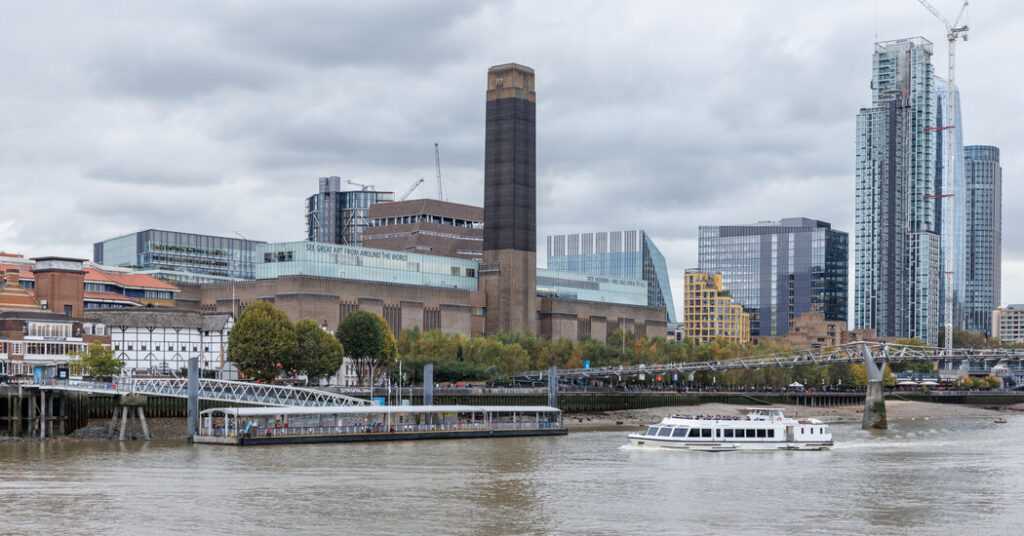
The property was also a short walk across the river from the Globe Theater, which staged his plays then and does so today, having been recreated and reopened in 1997.
The new research has been welcomed by other experts including René Weis, an emeritus professor at University College London and author of “Shakespeare Revealed: A Biography” who said he agreed that “after ‘retiring,’ Shakespeare would have remained actively involved in London life.”
He added: “These exciting documents may not in themselves make the case for Shakespeare-in-London after 1611, but they certainly firm up further what has long been suspected.”
That Shakespeare bought a London home was already well known, but the exact location was never confirmed. In the narrow streets around St Andrew’s Hill, a blue plaque on a white office building states that the playwright “purchased lodgings in the Blackfriars gatehouse located near this site.”
Professor Munro now says she has proved that this is the precise location of Shakespeare’s property rather than an approximate one. She made the discovery while researching the Blackfriars playhouse and working her way through a couple of boxes of property deeds in the London Archives, a free public record collection that is managed by the City of London. The property plan had been found before but had not been connected to Shakespeare, she said.
Toward the end of the 16th century, parish records suggest that Shakespeare rented accommodation in Bishopsgate, in east London, and later, in Southwark on the southern side of the Thames. In 1604 he lodged in Cripplegate just north of Blackfriars.
These were the years in which Shakespeare completed his most famous works.
The property that Shakespeare bought was destroyed half a century later, in the devastating great fire of London in 1666, which is partly why so little has been known about it.
Shakespeare’s granddaughter, Elizabeth Hall Nash Barnard, inherited the property but fortuitously sold it in 1665 — a year before the fire.
The plan that Professor Munro rediscovered was drawn up in 1688, during a sale of the plot, and it marks the boundaries that applied before the conflagration. By linking the names on that plan to the 1665 deeds, she pinpointed the site of Shakespeare’s property to the precise building where the plaque hangs. The plan also provides ground floor dimensions.
The structure was on the site of a converted priory and the adjacent building may have been a tavern. Records suggest one likely existed there at least by the 1630s.
The part of the property over the gateway does not appear on the post-fire plan because it had no foundation, but the rest of it measured 45 feet from east to west, 15 feet from north to south at the eastern end and 13 feet at the western end.
The property was substantial enough to be divided into two homes by 1645.
According to Professor Munro, there are conflicting indications as to whether anyone was living in the property when Shakespeare purchased it in 1613, although at the time of his death, a tenant, John Robinson, was recorded as living there.
“We don’t know quite what physical health Shakespeare is in by 1613 but he is obviously pretty active at that point: he’s buying property in London, he writes with John Fletcher.”
Chris Laoutaris, an associate professor at the University of Birmingham’s Shakespeare Institute, believes that the tenant, John Robinson, might have been a printer based on other information he has collected, and that Shakespeare might have been planning to compile his collected works.
“It’s fabulous that we’ve got more detail about the property,” said Dr. Laoutaris, referring to Professor Munro’s findings. He argues in a recent book about Shakespeare that Blackfriars at the time was a creative hub with a prominent library, and that Shakespeare’s texts might have been kept in the local theater.
“Lucy Munro’s findings are significant,” he said, “in that if that property is large and boasts more rooms than we would previously have thought, then there is much more opportunity for this to be both a business investment, to be leased out to a lodger, and also lodgings for himself or a base where he might have continued to work.”
Professor Munro believes that Shakespeare’s two final plays, “The Two Noble Kinsmen” and “Henry VIII” — both written with Fletcher — have not received the credit they deserve because of assumptions “that collaborative writing isn’t as good as solo writing and that late writing isn’t as good as midcareer writing.”
His investment in Blackfriars suggests Shakespeare might have had more such works in mind, she thinks. “We know in retrospect that those are the last two plays that he writes,” she said. “But I don’t know whether he necessarily knows.”
Stephen Castle is a London correspondent of The Times, writing widely about Britain, its politics and the country’s relationship with Europe.
The post Shakespeare Bought One Property in London. Now We Know Exactly Where. appeared first on New York Times.