President Trump offered a surprising justification last month for forging ahead with construction of his White House ballroom: Halting the $400 million project would pose a grave threat to national security.
“Everything is drone-proof and bulletproof,” Mr. Trump said, listing the security features of a bunker being built beneath the ballroom to protect the president in the event of an emergency.
It was hardly the first time the administration had invoked national security to justify a contentious decision. Over the past year, top officials have cited similar concerns when stripping union rights from thousands of federal workers, pausing the construction of wind farms off the East Coast, and exempting oil and gas drilling in the Gulf of Mexico from protections for endangered species of whales.
Critics see a troubling trend that is testing the limits of presidential power.
“When you look under the hood, they’re fake national security emergencies,” said Patrick Parenteau, an emeritus professor at the Vermont Law and Graduate School. “This is a power grab. This is his way of circumventing Congress.”
Federal judges, including those appointed by Mr. Trump, have often rebuked the Justice Department over its claims of potential national security risks, though an appeals court signaled last week that such assertions about White House construction might be valid.
“It’s hard not to be concerned about the credibility of the United States in court when making representations about national security matters,” said Andrew Mergen, a professor at Harvard Law School who spent more than three decades at the Justice Department.
Taylor Rogers, a White House spokeswoman, said the administration was right to prioritize national security considerations across the government.
“It is a top priority and critical responsibility of the commander in chief to ensure the United States is not jeopardized by any potential national security threat,” Ms. Rogers said in an email.
Ballrooms and Bunkers
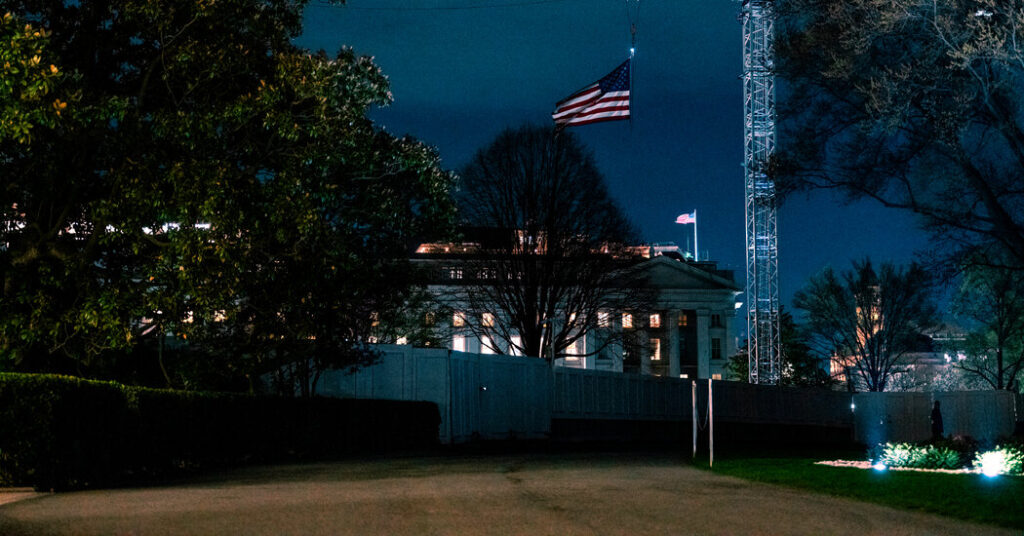
When Mr. Trump unveiled his plan in July to replace the East Wing of the White House with a ballroom, he shared his desire for a much larger space that could hold hundreds of attendees for state dinners, galas and other events. At 90,000 square feet, officials said, the new structure would cost about $200 million.
Since then, the price tag has more than doubled, and the stated purpose of the renovation has shifted significantly, focusing more on a bunker being built underground than the event space above.
After preservationists sued in December to try to stop the construction, the administration increasingly argued that the work must continue because of essential security facilities being built beneath the ballroom, including a giant bunker complex. (It is highly unusual to disclose details of such facilities.)
Last month, Judge Richard J. Leon of Federal District Court in Washington rejected those arguments and ordered construction stopped. In an opinion punctuated by 19 exclamation points, he wrote that Mr. Trump likely lacked the authority to replace entire sections of the White House without approval from Congress.
Judge Leon, an appointee of President George W. Bush, added that he took seriously the government’s concerns about safety on the White House grounds. But, he wrote, “the existence of a ‘large hole’ beside the White House is, of course, a problem of the president’s own making! Bald assertions of ‘national security’ cannot excuse the government’s failure to follow the law and then insulate those failures from judicial review.”
Over the weekend, however, a federal appeals court panel temporarily sided with the administration. By a 2-to-1 vote, the panel allowed the ballroom construction to continue until Friday and sent the case back to Judge Leon to take a closer look at the national security claims.
Trump Administration: Live Updates
Updated
- Trump threatens to fire Powell if he does not resign from the Fed.
- Vance says the pope should be more careful when talking about theology.
- The Pentagon says four people were killed in the latest boat strike in the Pacific.
In court filings this week, the administration continued to spar with the group suing over the project, the National Trust for Historic Preservation.
The project “includes national security and military installations that cannot serve their functions without an appropriate structure to shield and protect them,” Justice Department lawyers argued. They added that the court “is not positioned to second-guess these determinations about what is needed to ensure presidential security, let alone to superintend the construction process.”
The preservationists fired back. “No matter how much the defendants insist otherwise,” they wrote, “the lack of a massive ballroom on the White House grounds is not a national security emergency.”
Wind and Whales
The Trump administration has also pointed to national security risks when blocking offshore wind turbines, a source of clean energy that the president has disdained for decades.
Days before Christmas, the Interior Department abruptly ordered all work to halt on five wind farms in the Atlantic Ocean. To justify the sweeping move, officials said the Defense Department had produced a classified report that found that the projects threatened national security.
The developers of the wind farms and several states sued, and federal judges handed the administration a series of losses. Several judges said they were unpersuaded by the government’s national security claims after reviewing the classified report, which has not been made public.
The administration recently missed a deadline to appeal those losses. Interior Secretary Doug Burgum has continued to insist, however, that wind farms can interfere with military radar, making drone attacks more difficult to detect.
“They create tremendous radar interference that could represent a tremendous threat, particularly off our highly populated Northeast coast,” Mr. Burgum told Fox Business in early February.
Kirk Lippold, a military analyst who served as commander of the U.S.S. Cole when it was attacked by Qaeda suicide bombers in 2000, called these arguments “silly and specious.” He said the military had extensively studied the potential for wind farms to disrupt radar and found that the risk was real but can be offset with planning and technological upgrades.
“If we have a drone attack taking out our wind farms that close to the coast of the United States, we’ve had a major intelligence failure that goes way beyond 9/11,” Mr. Lippold said. “We’ve got bigger problems on our hands at that point.”
Ms. Rogers, the White House spokeswoman, defended the administration’s efforts to stifle the country’s nascent offshore wind industry.
“The Trump administration has paused the construction of all large-scale offshore wind projects because our No. 1 priority is to put America first and protect the national security of the American people,” she said.
At times, Mr. Trump has argued that the noise and vibrations from offshore wind turbines can disturb and even kill whales, though marine biologists have said there is no evidence to support such claims.
“The windmills are driving the whales crazy,” the president declared in January 2025, weeks before pausing federal approvals for new wind farms.
Yet the administration has also invoked national security concerns to remove legal protections for whales.
Last month, a panel of Trump administration officials voted unanimously to exempt oil and gas drilling in the Gulf of Mexico from measures to protect endangered whales and other imperiled species. The panel, which is often called the God Squad because it essentially holds the power to decide whether a species lives or dies, adopted the move during a brief, closed-door meeting.
Defense Secretary Pete Hegseth said at the meeting that waiving the restrictions would bolster national security by increasing domestic oil production. “To be as secure as a nation, we need a steady, affordable supply of our own energy,” he said.
Conservation groups have sued to try to overturn the move. Seth M. Barsky, a partner at the law firm Bracewell, said it was difficult to predict the outcome of the litigation because no previous administration had ever invoked national security to override a landmark environmental law, the Endangered Species Act.
“We’re in uncharted territory,” he said.
Maxine Joselow covers climate change and the environment for The Times from Washington.
The post Trump’s Go-To Justification for Contentious Decisions: National Security appeared first on New York Times.